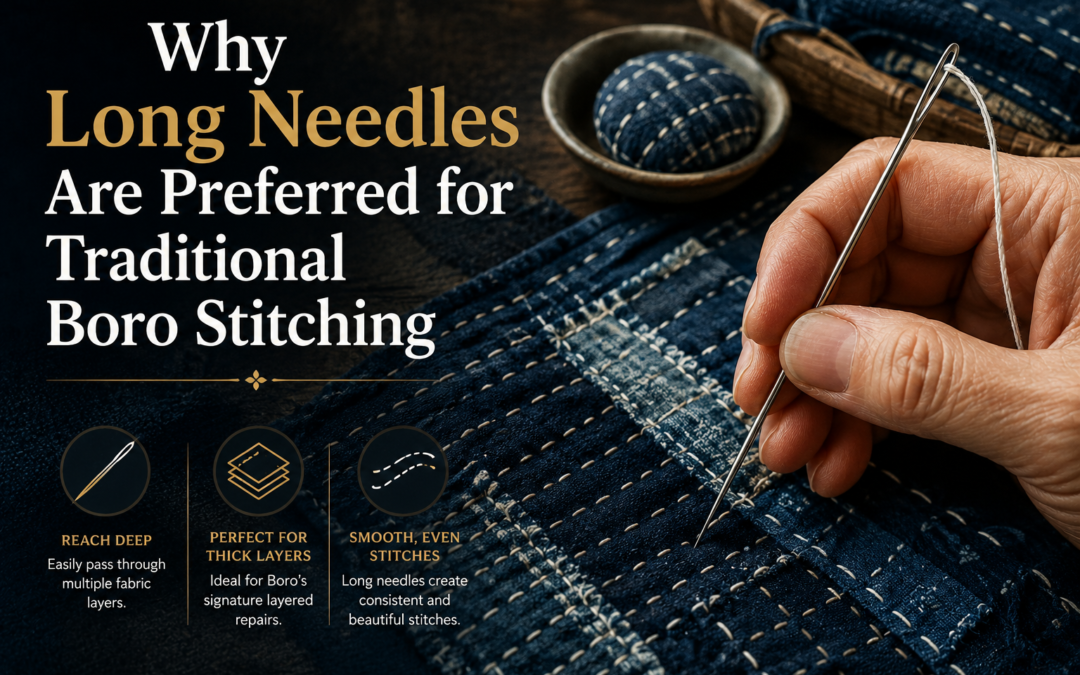
Traditional Boro stitching uses long needles because they improve running stitch rhythm, fabric control, layered repair efficiency, and hand comfort during repetitive sewing. Long sashiko needles allow artisans to load multiple stitches at once, maintain even spacing, reduce hand fatigue, and repair thick indigo textiles more efficiently than short sewing needles. These practical advantages made long needles an essential part of historical Japanese textile repair traditions.
Why Are Long Needles Used in Traditional Boro Stitching?
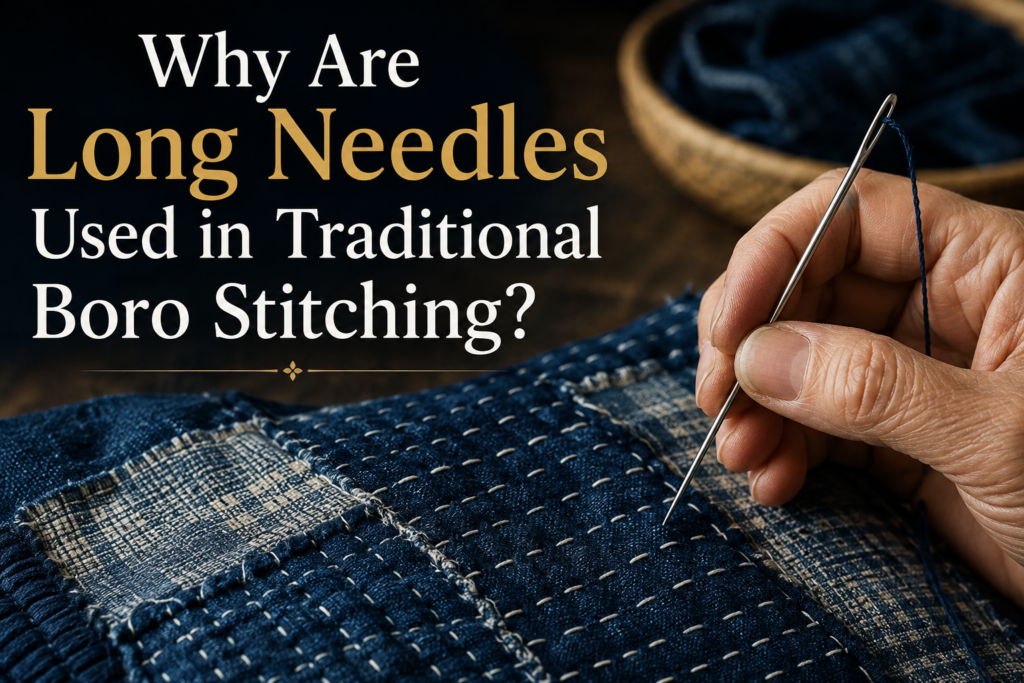
Long needles became an important part of traditional Boro stitching because they improved the speed, consistency, and efficiency of repetitive repair work. Boro was originally developed in rural Japan as a practical way to extend the life of clothing through repeated patching and reinforcement. Traditional Japanese repair culture developed during periods when fabric was expensive, difficult to produce, and rarely wasted. Rural families often repaired the same garments repeatedly over many years, especially during cold northern winters where layered indigo clothing provided important insulation for agricultural workers. Some garments were even passed between generations after undergoing continuous reinforcement and patching.
Because repairs were constant household tasks rather than occasional creative projects, stitching efficiency became extremely important. Long sashiko needles helped speed up repetitive repair work while reducing physical strain during long sewing sessions. The goal was not decorative perfection but durable reinforcement that allowed garments to survive heavy labor, weather exposure, and daily use. Over time, the long running-stitch needle became directly associated with practical textile preservation in Japanese working-class communities.
Historical factors influencing long needle use:
- Limited textile availability
- Expensive handmade fabric
- Multi-generational garment repair
- Agricultural workwear damage
- Cold-weather layering needs
- Continuous utility stitching
Farmers, laborers, and working families repaired garments constantly, especially thick indigo cotton jackets, aprons, and workwear that experienced heavy daily use. Because repairs were done frequently, the sewing tools had to support smooth repetitive stitching instead of delicate decorative embroidery techniques.
Traditional sashiko needles are longer than standard sewing needles because they are designed specifically for running stitches. The extra length allows the sewer to load several stitches onto the needle before pulling the thread through the fabric. This creates a flowing stitching rhythm that reduces interruptions and improves efficiency. Instead of making one stitch at a time, the sewer can move continuously across the fabric surface with a rocking hand motion.
Long needles also work better on layered fabrics commonly found in Boro repair. Thick overlapping patches create resistance that short needles struggle to handle comfortably. The additional length improves leverage and helps the needle glide through dense textile layers with less strain on the hand and wrist.
Important reasons long needles are preferred include:
- Faster running stitch movement
- Better control on layered fabric
- Improved stitch consistency
- Reduced repetitive hand motion
- More efficient visible mending
- Easier stitching through thick indigo cotton
These advantages explain why long needles remained closely connected to traditional Japanese textile repair practices for generations.
How Do Long Needles Improve Running Stitch Rhythm?
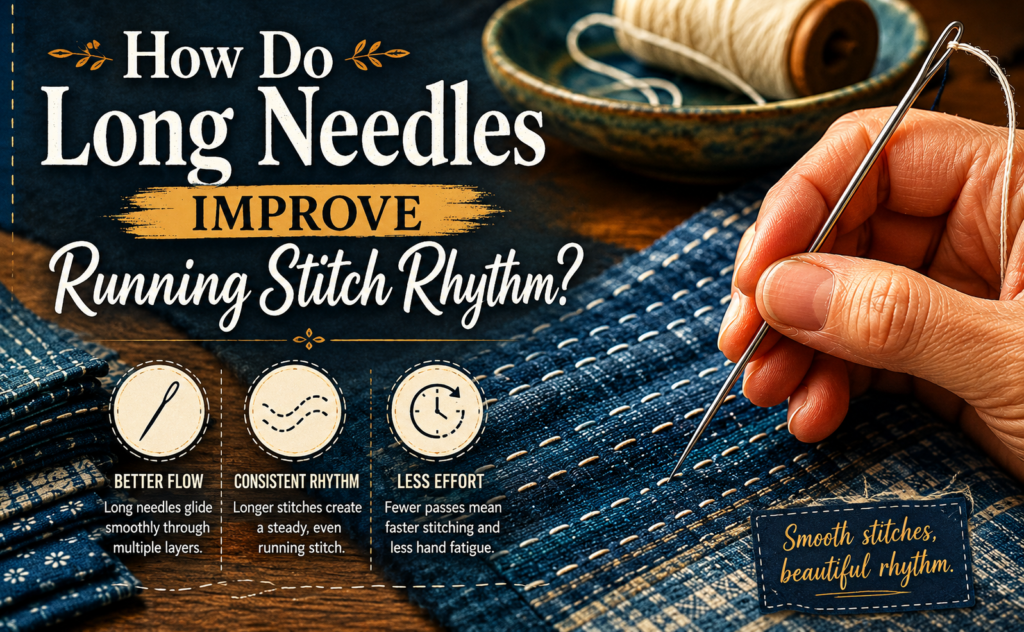
Running stitch rhythm is one of the most recognizable parts of traditional Boro and sashiko stitching. Long needles improve this rhythm because they allow multiple stitches to be gathered onto the needle before the thread is pulled through the fabric. This creates a smoother sewing flow that helps artisans maintain speed, spacing, and consistent tension across repaired areas.
Traditional Boro stitching depends heavily on repetitive hand movement. When using a short needle, the sewer must stop constantly to reposition their fingers and pull the thread through after nearly every stitch. These interruptions break the stitching rhythm and make the process slower and more tiring. Long needles solve this problem by supporting continuous motion across the fabric surface.
The sewing technique itself becomes more fluid with a long needle. Experienced Boro artisans often rely more on wrist-guided movement than finger pressure during running stitch work. Instead of gripping the needle tightly and forcing each stitch individually, the hand moves in a smooth rocking rhythm that allows the needle to glide naturally through the fabric. This technique reduces strain while helping the sewer maintain balanced stitch spacing across large repair areas.
The long needle supports this movement because it extends the range of motion available during stitch loading. Small wrist adjustments create multiple evenly spaced stitches without excessive hand repositioning. Over time, experienced stitchers develop strong muscle memory that allows them to maintain consistent tension almost automatically. This relaxed movement pattern is one reason traditional sashiko stitching often appears visually balanced even when created quickly during practical repair work.
Benefits of wrist-guided stitching:
- Reduced finger strain
- Smoother stitch rhythm
- Better spacing consistency
- Faster running stitches
- Improved hand comfort
- More controlled tension balance
Many artisans use a gentle rocking motion that allows the needle to move in and out of the fabric several times before the thread is pulled tight. This motion creates evenly spaced running stitches that are both functional and visually balanced. The rhythm eventually becomes muscle memory, allowing experienced stitchers to work quickly without measuring every stitch individually.
Consistent stitch rhythm also improves the final appearance of visible mending repairs. Balanced stitch spacing distributes fabric tension more evenly across layered patches, reducing distortion and helping the repair remain flexible over time.
Benefits of improved running stitch rhythm include:
- Faster repair speed
- Cleaner stitch alignment
- More balanced fabric tension
- Reduced wrist fatigue
- Smoother sewing motion
- Better long-term repair durability
Traditional Japanese stitching techniques evolved around efficiency and practicality, and long needles became one of the most effective tools for maintaining continuous running stitch flow.
Why Do Long Needles Work Better on Layered Boro Fabric?
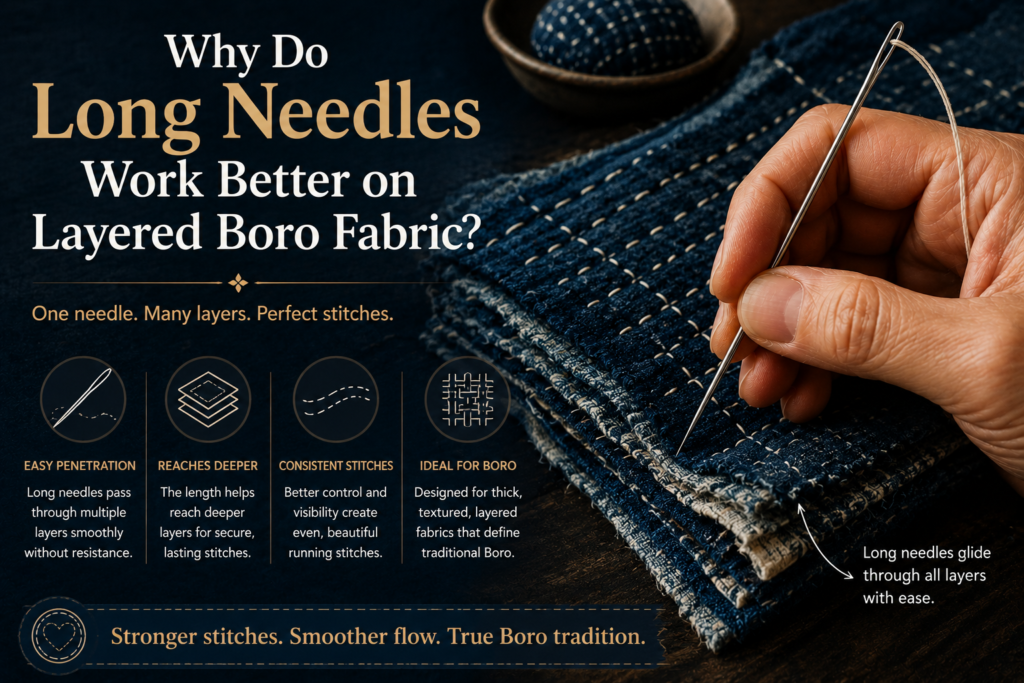
Traditional Boro garments often contain multiple layers of patched fabric because clothing was repaired repeatedly over many years. These stacked layers create dense areas that are difficult to sew with short needles. Long needles work better on layered Boro fabric because they improve penetration, leverage, and stitching control while reducing strain on the hands.
Old indigo cotton textiles become thick when several reinforcement patches are stitched together. Some heavily repaired garments contain overlapping layers around knees, elbows, cuffs, collars, and pocket edges where friction and wear occur most often. Short needles struggle in these dense areas because the sewer must repeatedly force the needle through resistant fabric while constantly adjusting hand position.
Long sashiko needles provide better leverage during this process. Dense indigo cotton creates more resistance than lightweight modern fabric because traditional Japanese textiles were tightly woven for durability and insulation. When several repair patches overlap in one area, friction increases significantly as the needle moves through multiple layers of cotton fibers. Short needles concentrate this resistance into smaller repetitive hand movements, which increases wrist strain and slows stitching speed.
Long sashiko needles distribute force more evenly across the hand and forearm. Instead of relying entirely on finger pressure, the sewer can guide the needle through thick fabric using smoother wrist-assisted motion. This reduces resistance buildup during repetitive stitching and helps maintain more consistent running stitch rhythm across dense repaired sections. The difference becomes especially noticeable when repairing old workwear, patched denim, or thick cotton jackets containing years of layered reinforcement stitching.
Fabric conditions that increase stitching resistance:
- Multiple overlapping patches
- Thick indigo cotton
- Dense denim weave
- Reinforced elbow sections
- Heavy winter workwear
- Repeated historical repairs
Their extra length allows smoother hand movement and more stable control when sewing through thick material. Instead of using tight repetitive finger motions, the sewer can guide the needle through the fabric using a broader and more natural movement pattern.
Long needles also reduce fabric distortion. When sewing layered fabric with short needles, uneven pulling can create puckering or tension imbalance around the repair area. Longer needles help distribute tension more smoothly because the stitches can be loaded and pulled through more evenly.
Reasons long needles perform better on layered fabric include:
- Improved leverage on thick material
- Easier penetration through multiple layers
- Reduced fabric bunching
- Better tension control
- Smoother patch alignment
- More flexible finished repairs
Traditional Boro repair focused heavily on durability because garments needed to survive years of physical labor. Long needles helped artisans create stronger reinforcement stitching while maintaining flexibility and comfort in repaired clothing.
Can Long Needles Reduce Hand Fatigue During Boro Stitching?
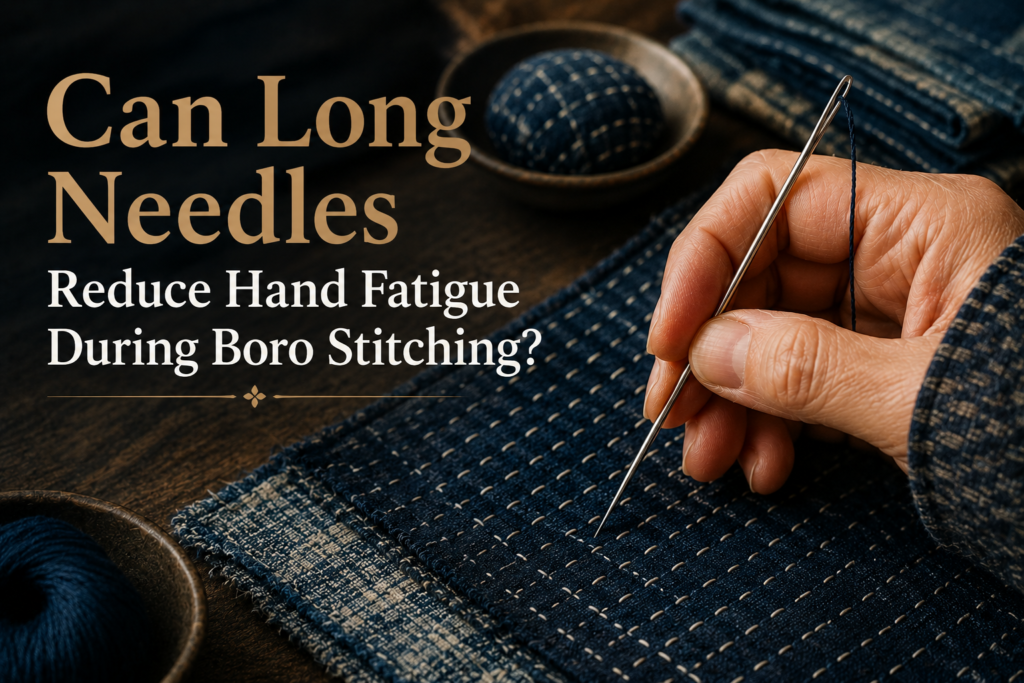
Long stitching sessions can create significant strain on the fingers, palm, and wrist, especially when repairing thick layered textiles. Long needles reduce hand fatigue because they allow smoother movement, fewer repetitive grip adjustments, and more efficient stitch loading during continuous sewing sessions.
Traditional Boro repair was not casual hobby sewing. Textile repairs were necessary household tasks performed repeatedly throughout the year. Clothing needed constant reinforcement because garments were valuable and difficult to replace. As a result, Japanese sewing tools evolved around long-term comfort and efficiency.
Short needles force the hand into repetitive pinching movements. Every stitch requires repositioning the fingers, pushing the needle through the fabric, and pulling the thread tight. Over time, these repeated motions increase strain on the wrist and fingertips. Thick indigo cotton makes the problem even worse because dense fabric requires more pressure to penetrate.
Long needles reduce these issues by allowing multiple stitches to be loaded onto the needle before pulling the thread through. This decreases the number of repetitive sewing motions required to complete a repair. The hand can also move more naturally because the stitching motion involves the wrist and forearm instead of relying entirely on finger pressure.
Reduced hand fatigue becomes especially noticeable during:
- Large patch repairs
- Repetitive sashiko patterns
- Heavy denim reinforcement
- Multi-layer stitching
- Long visible mending sessions
Benefits of reduced fatigue include:
- Longer comfortable sewing sessions
- More consistent stitch quality
- Better hand control
- Reduced wrist stress
- Improved sewing efficiency
- Smoother stitch rhythm
Many modern visible mending artists notice a major difference after switching from standard sewing needles to traditional sashiko needles designed specifically for running stitch techniques.
How Does Stitch Loading Improve Traditional Sewing Efficiency?
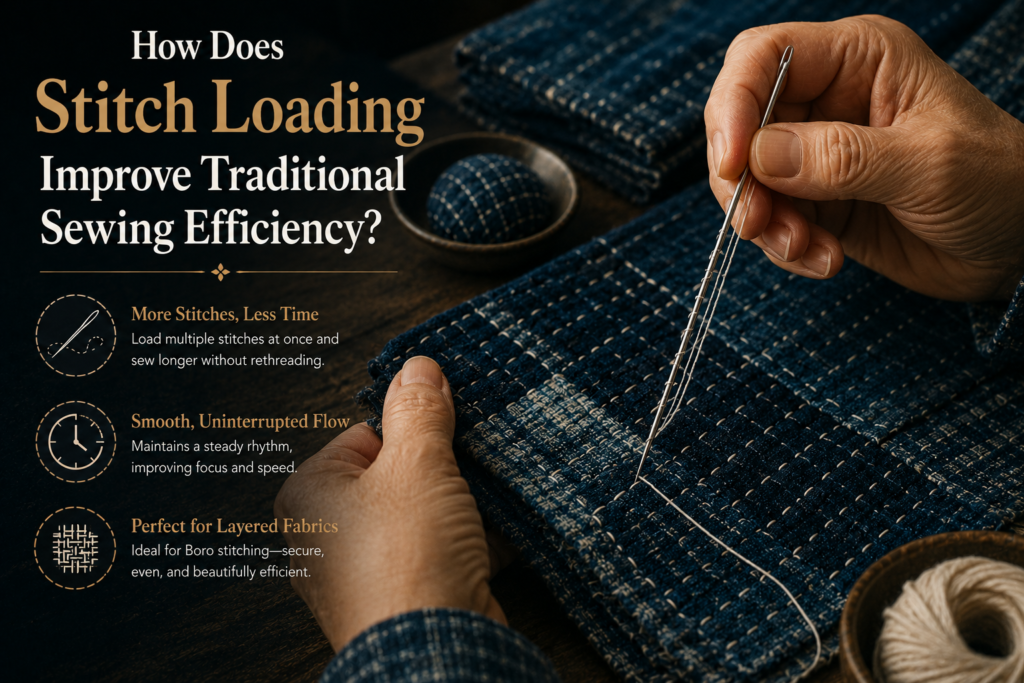
Stitch loading is one of the most important techniques in traditional Japanese Boro stitching. This method involves placing several running stitches onto the needle before pulling the thread through the fabric. Long needles are essential for this process because their length provides enough space to hold multiple stitches at once.
Traditional Boro repair depended heavily on efficiency because garments required frequent maintenance. Rural Japanese families repaired work clothing continuously, especially during agricultural seasons when fabric experienced heavy wear. Faster stitching techniques allowed damaged clothing to be reinforced quickly without sacrificing durability.
With stitch loading, the sewer can move across the fabric in a smooth continuous motion instead of stopping after every stitch. This creates faster sewing speed and more balanced stitch spacing. The process also reduces unnecessary hand movement, making long repair sessions less tiring.
Long needles support stitch loading by allowing:
- More stitches per motion
- Better spacing consistency
- Faster sewing rhythm
- Reduced interruptions
- Smoother tension control
The technique also improves the visual appearance of sashiko stitching. Repetitive running stitches become more evenly aligned when they are created through continuous motion rather than isolated individual stitches.
Traditional artisans often developed highly refined hand rhythms that allowed them to sew quickly while maintaining balanced geometric stitch patterns. The long needle became part of the sewing rhythm itself, functioning almost like an extension of the hand.
Important advantages of stitch loading include:
- Improved sewing efficiency
- Faster repair completion
- Reduced repetitive motion
- More balanced running stitches
- Better fabric control
- Cleaner visible mending appearance
This combination of practicality and rhythm explains why long sashiko needles remained central to traditional Japanese textile repair methods for generations.
Are Long Sashiko Needles Different From Regular Sewing Needles?
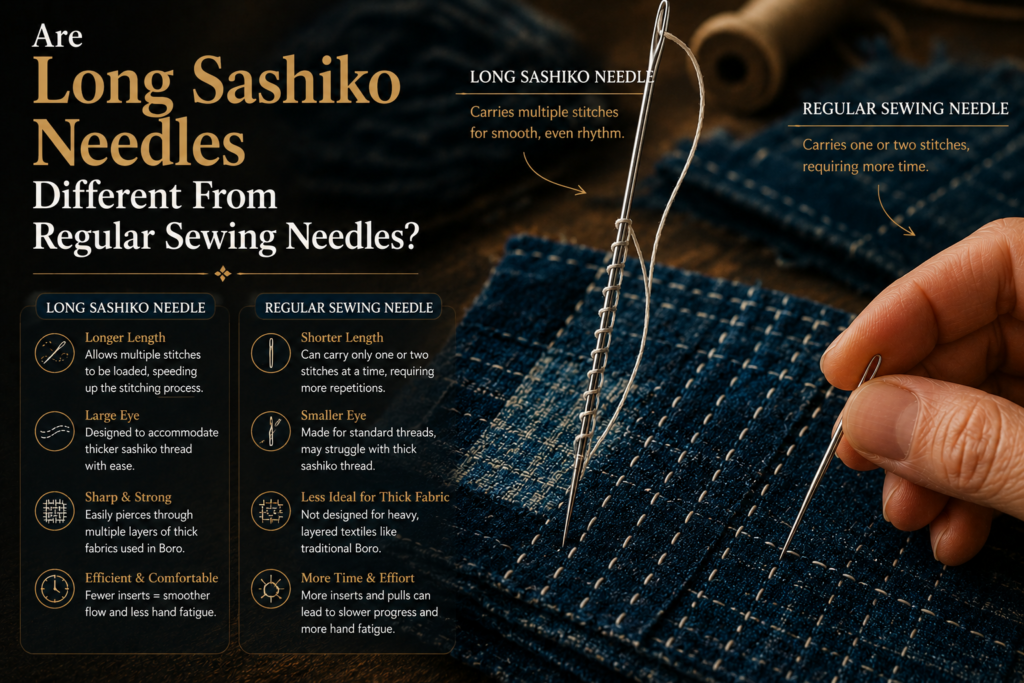
Long sashiko needles differ from regular sewing needles in both structure and purpose. Traditional sashiko needles are specifically designed for repetitive running stitches across layered fabric, while regular sewing needles are optimized for smaller precision sewing tasks and general garment construction.
The most obvious difference is length. Sashiko needles are much longer because they support stitch loading and continuous sewing motion. Regular sewing needles are shorter because they are intended for individual stitch placement rather than flowing running stitch techniques.
Traditional sashiko needles are also slightly flexible. Traditional sashiko needles also have structural differences that improve performance during repetitive running stitches. Many traditional needles feature a narrow shaft, elongated eye, smooth steel finish, and slight flexibility that helps reduce friction while moving through layered indigo fabric. The elongated eye is especially important because thick sashiko thread creates more drag than standard sewing thread. Traditional sashiko thread is usually thicker and less tightly twisted than standard sewing thread, which changes how the thread moves through fabric during repetitive stitching. Long sashiko needles are designed to accommodate this heavier thread without creating excessive abrasion or tension buildup. A larger needle eye allows thick cotton thread to glide more smoothly through layered fabric while reducing fraying during long repair sessions.
This relationship between needle size and thread thickness becomes especially important in visible mending because heavy thread creates stronger visual texture and reinforcement across repaired patches. If the needle eye is too small, the thread may snag repeatedly or wear down faster from friction inside the eye opening. Traditional Japanese sewing tools evolved together as a connected system where needle length, eye shape, and thread thickness all supported efficient running stitch techniques.
Benefits of proper thread and needle pairing:
- Smoother thread glide
- Less thread abrasion
- Better tension balance
- Cleaner running stitches
- Improved repair durability
- Reduced friction during stitching
A larger eye opening allows the thread to glide more smoothly without excessive abrasion during long stitching sessions.
The needle shaft itself is usually thinner relative to its length, which helps the needle pass through dense cotton layers with less resistance. Some experienced Boro stitchers specifically prefer slightly flexible needles because they absorb small pressure changes during continuous stitching motion. This flexibility improves fabric glide control and reduces the harsh resistance often felt when using rigid short sewing needles on heavily patched textiles.
Key physical features of traditional sashiko needles:
- Long narrow shaft
- Slight flexibility
- Smooth polished steel surface
- Elongated thread eye
- Reduced fabric drag
- Better thick-thread compatibility
This flexibility helps them move more smoothly through layered fabric while maintaining better tension control. Standard sewing needles are usually more rigid because they are designed for controlled precision stitching rather than repetitive rhythmic movement.
Another major difference is the sewing style each needle supports. Sashiko stitching focuses on straight repetitive running stitches that reinforce fabric while creating visible geometric patterns. Standard sewing techniques often involve smaller directional stitches, curved seams, and detailed garment shaping.
Key differences between sashiko and regular sewing needles include:
| Feature | Sashiko Needle | Regular Sewing Needle |
| Length | Long | Short |
| Stitch Style | Running stitch | Precision sewing |
| Fabric Type | Layered heavy fabric | General fabric |
| Motion Style | Continuous rhythm | Individual stitches |
| Flexibility | Slightly flexible | More rigid |
Many beginners initially try Boro stitching with embroidery needles or household sewing needles. While this works for small repairs, the stitching process becomes noticeably smoother and more efficient once a proper long sashiko needle is used.
The needle design itself reflects the practical history of Japanese textile repair traditions.
What Needle Length Works Best for Traditional Boro Stitching?
| Needle Type | Best Use | Main Weakness |
| Long sashiko needle | Running stitches and layered Boro repair | Takes practice for beginners |
| Embroidery needle | Decorative threadwork | Poor stitch loading ability |
| Sharps needle | Precision garment sewing | Slow for repetitive running stitches |
| Quilting needle | Thin layered quilting fabric | Limited leverage on dense denim |
| Curved repair needle | Tight repair areas | Less effective for straight sashiko lines |
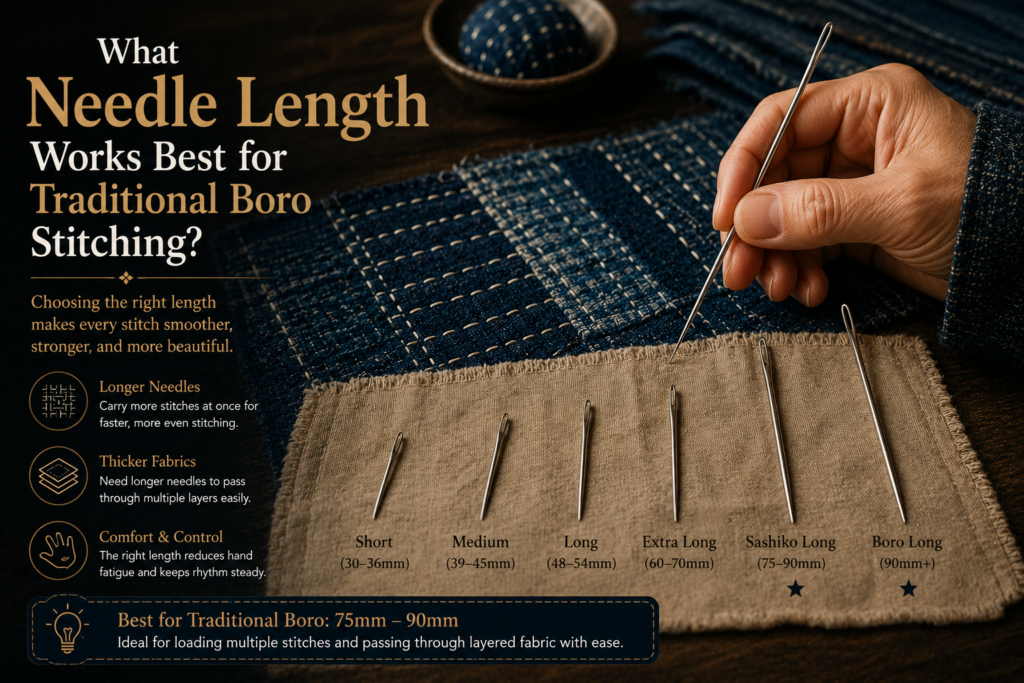
The ideal needle length for traditional Boro stitching depends on fabric thickness, stitching style, and personal comfort. Most traditional sashiko needles range between 48 mm and 65 mm Different sashiko needle lengths create noticeably different stitching experiences depending on skill level and repair style. Medium-length needles around 48 mm usually provide the best control for beginners because they feel more stable while still supporting basic stitch loading techniques. Needles between 54 mm and 57 mm are commonly preferred for balanced traditional Boro stitching because they combine comfortable control with efficient running stitch rhythm.
Longer needles above 65 mm are often favored by experienced stitchers working on large visible mending projects or heavily layered repairs. These needles allow more stitches to be loaded at once, increasing sewing speed and reducing interruptions during repetitive stitching sessions. However, they may initially feel difficult for beginners who are not yet comfortable with relaxed wrist-guided movement.
Common sashiko needle length ranges:
- 48 mm → beginner-friendly control
- 54–57 mm → balanced traditional use
- 65 mm+ → advanced stitch loading
- Extra-long needles → large repair efficiency
because this size supports efficient stitch loading while remaining comfortable to control during long sewing sessions.
Beginners often feel more comfortable with medium-length needles because extremely long needles can initially feel unfamiliar. However, many experienced Boro artisans gradually prefer longer needles once they become accustomed to the flowing running stitch motion.
Longer needles improve sewing efficiency because they hold more stitches during stitch loading. This allows smoother movement across the fabric surface and reduces interruptions caused by frequent thread pulling. Medium-long needles also improve leverage when stitching through layered denim or thick cotton patchwork.
The best needle length often depends on:
- Fabric thickness
- Number of patch layers
- Hand size
- Stitch spacing preference
- Repair size
- Sewing experience
Good traditional Boro needles should also include:
- Smooth surface finish
- Durable steel construction
- Sharp but stable tip
- Slight flexibility
- Large enough eye for sashiko thread
Short needles may feel easier for beginners at first, but they usually limit running stitch rhythm and reduce sewing efficiency on larger repairs.
Benefits of medium-long sashiko needles include:
- Better stitch flow
- More comfortable hand movement
- Improveda fabric penetration
- Easier tension balance
- Faster visible mending
- More traditional stitching rhythm
Choosing the correct needle length helps both beginners and experienced stitchers create.
Common Beginner Mistakes When Using Long Sashiko Needles
Many beginners struggle with long sashiko needles at first because the stitching motion feels different from standard sewing techniques. One of the most common mistakes is gripping the needle too tightly. Excess pressure restricts the smooth rocking motion needed for efficient running stitches and quickly increases hand fatigue during longer sewing sessions.
Another common problem is loading too many stitches onto the needle at once. While long needles are designed for stitch loading, beginners often overload the needle before learning proper tension control. This can distort the fabric or create uneven stitch spacing. Incorrect stitching angles also create problems because pushing the needle too vertically through layered fabric increases resistance and makes the sewing motion less fluid.
Experienced Boro stitchers typically use relaxed wrist-guided movement instead of aggressive finger pressure. Developing this rhythm takes time, especially when working on thick indigo textiles or layered repairs.
Common beginner mistakes include:
- Holding the needle too tightly
- Loading excessive stitches
- Pulling thread too forcefully
- Using incorrect stitching angles
- Forcing thick fabric layers
- Creating uneven tension
stronger, cleaner, and more consistent Boro repairs.
What Problems Can Short Needles Cause During Boro Repair?
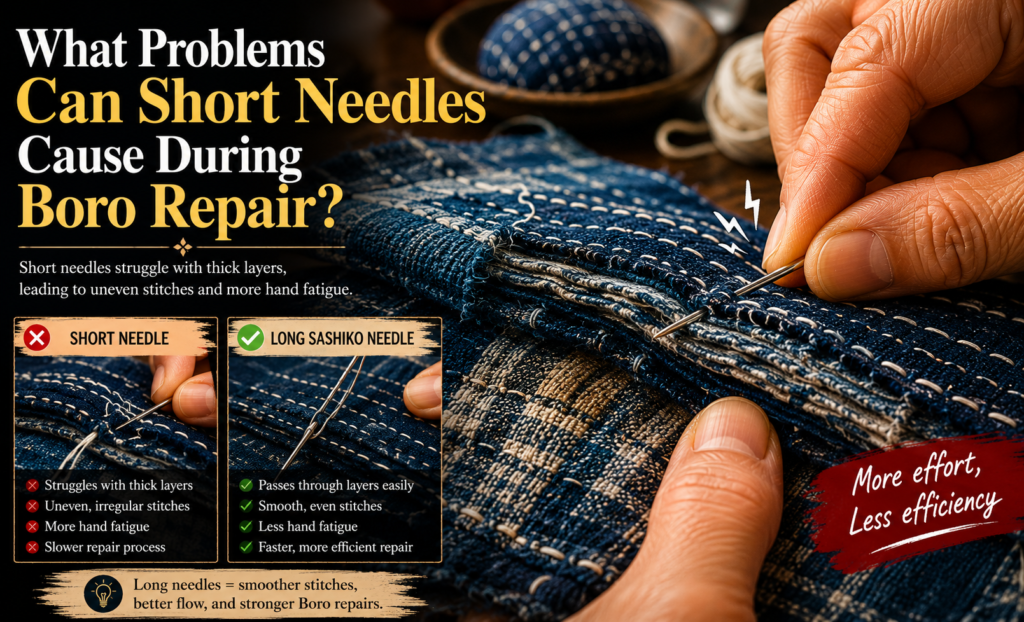
Using short needles for large Boro repairs often creates several stitching problems that reduce efficiency, comfort, and stitch consistency. Short needles interrupt the natural running stitch rhythm because they hold fewer stitches during stitch loading. This forces the sewer to stop more frequently, reposition the hand repeatedly, and pull the thread through the fabric after almost every stitch.
These repeated interruptions increase hand fatigue and make stitch spacing less consistent across larger repair areas. Uneven tension can also develop because short repetitive movements create harsher pulling angles around layered patches. In dense indigo cotton or heavily repaired garments, short needles may feel difficult to control because the sewer must apply more finger pressure to penetrate resistant fabric layers.
Over time, these small inefficiencies become more noticeable during long visible mending sessions. Many beginners initially assume stitch inconsistency comes from lack of skill, when the real problem is often the needle itself.
Common problems caused by short needles:
- Uneven running stitches
- Slower sewing rhythm
- Increased wrist strain
- Poor stitch loading ability
- Fabric puckering
- More interrupted hand movement
- Reduced efficiency on layered fabric
Can Short Needles Still Be Used for Boro Stitching?
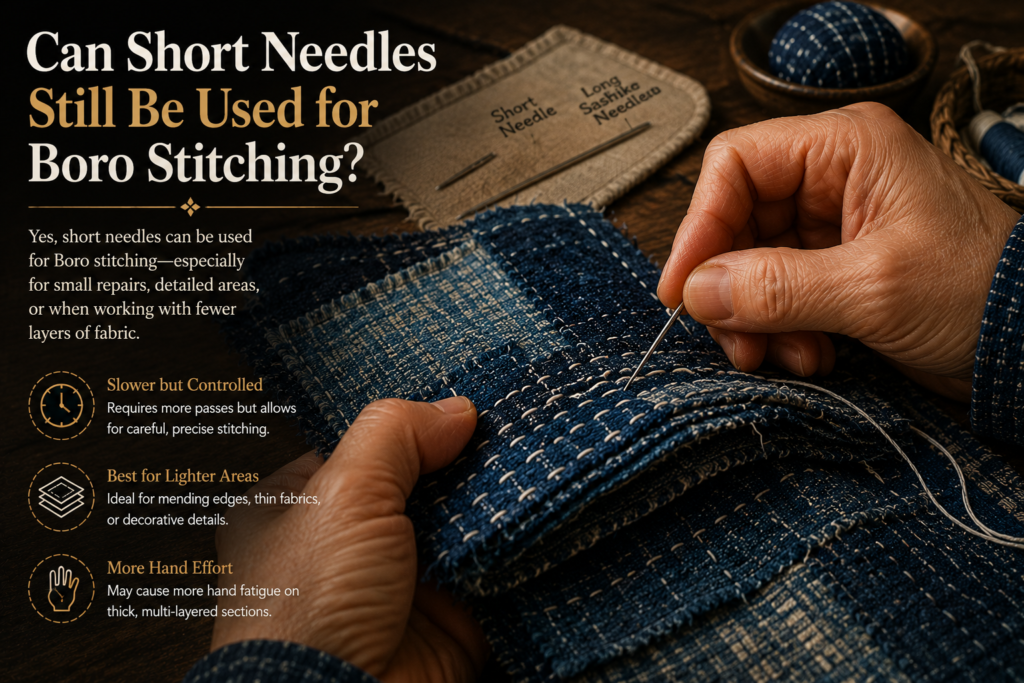
Short needles can still be used for Boro stitching, especially for beginners or detailed repair work, but they usually reduce efficiency and interrupt the traditional running stitch rhythm associated with sashiko techniques. Many people begin visible mending with standard sewing needles before transitioning to longer sashiko needles later.
Short needles perform reasonably well for:
- Small fabric tears
- Tight corners
- Curved patch edges
- Decorative details
- Fine reinforcement stitching
However, larger repairs become more difficult with short needles because the sewer cannot load many stitches at once. This creates more interruptions during stitching and increases repetitive hand movement. Over time, the sewing process becomes slower and more tiring compared to using a proper long sashiko needle.
Short needles also reduce the smooth rocking motion commonly used in traditional Boro stitching. Because fewer stitches fit onto the needle, the sewer must stop more frequently to pull the thread through the fabric. This interrupts stitch rhythm and can create uneven spacing.
Common limitations of short needles include:
- Reduced stitch loading ability
- Slower repair speed
- More hand fatigue
- Less consistent running stitches
- Poor efficiency on layered fabric
- Increased wrist strain
Despite these limitations, short needles still have practical uses for precision repair areas where large needles feel difficult to control.
Traditional Japanese Boro techniques evolved around long repetitive running stitches across large reinforcement patches. Long needles simply support this sewing style more naturally. Many modern visible mending artists eventually switch to sashiko needles after experiencing how much smoother and more efficient the stitching process becomes.
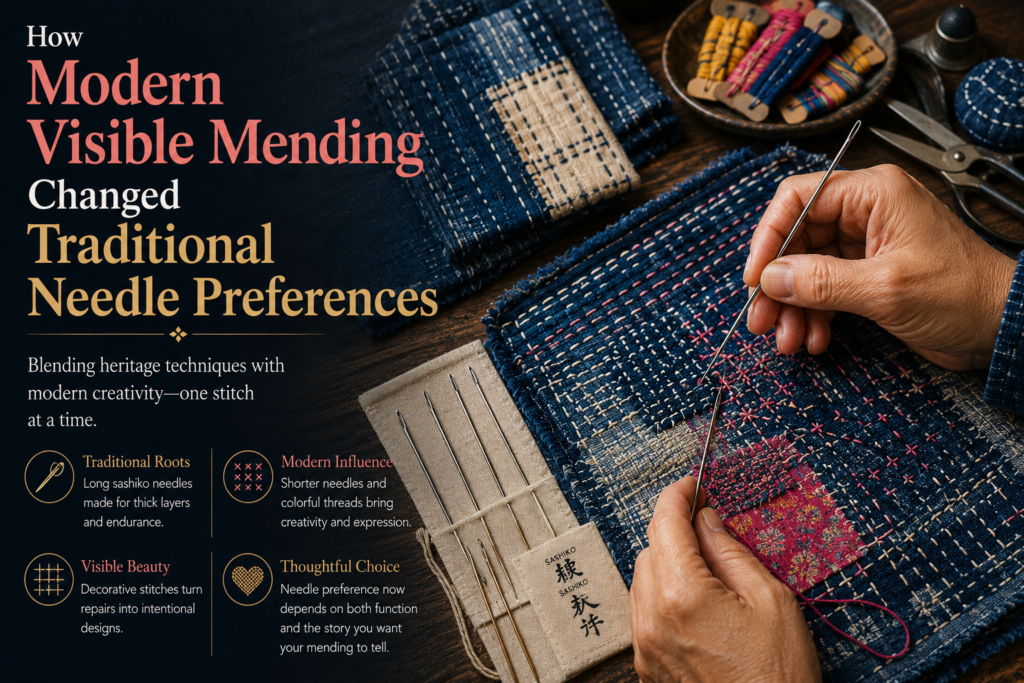
How Modern Visible Mending Changed Traditional Needle Preferences
Modern visible mending has slightly changed how some people use traditional sashiko needles. Historical Boro repair focused primarily on durability and garment preservation, while modern visible mending often combines repair with decorative textile art. Because of this shift, some contemporary stitchers prefer shorter or more specialized needles for detailed patterns, curved stitching, or experimental fabric work.
However, long sashiko needles still remain the preferred choice for traditional running stitch techniques and large reinforcement repairs. Their efficiency, smooth stitch rhythm, and layered fabric control continue to make them highly effective for practical visible mending. Many modern artisans combine traditional Japanese sewing tools with newer textile styles while still preserving the core principles of running stitch movement and repetitive repair rhythm.
Machine-made modern sashiko needles also differ slightly from older handcrafted versions. Contemporary needles are often more uniform in size and finish, while traditional handmade needles sometimes varied slightly in flexibility and surface texture depending on regional production methods.
Modern visible mending changes include:
- More decorative stitch experimentation
- Increased use of mixed fabrics
- Smaller artistic repair details
- Western embroidery influence
- Modern machine-made needle production
- Expanded creative stitching styles
FAQ Section
Why are sashiko needles so long?
Sashiko needles are long because they allow multiple running stitches to be loaded onto the needle at once, improving stitch rhythm, speed, and fabric control during traditional Boro repair.
Are long needles necessary for Boro stitching?
They are not mandatory, but long needles make traditional running stitch techniques much easier and more efficient, especially on layered fabric.
What is the best needle length for Boro stitching?
Most Boro stitchers prefer needles between 48–65 mm because they balance stitch loading, comfort, and control.
Can beginners use long sashiko needles?
Yes. Medium-long sashiko needles are often easier for beginners because they improve stitch rhythm and reduce repetitive hand motion.
Do long needles reduce hand fatigue?
Yes. Long needles allow smoother hand movement and fewer repetitive grip adjustments during long stitching sessions.
Are sashiko needles different from embroidery needles?
Yes. Sashiko needles are longer and designed specifically for repetitive running stitches through layered fabric.
Can short needles damage stitch consistency?
Short needles do not damage fabric directly, but they often interrupt stitch rhythm and create less consistent spacing.
Why do traditional Boro repairs use running stitches?
Running stitches provide flexible reinforcement, distribute tension evenly, and work efficiently across layered patched fabric.