The best sashiko stitches for boro repair include running stitch, hitomezashi, asanoha, kikko, seigaiha, and moyozashi patterns because they combine structural reinforcement with visible handmade beauty. Some stitches focus on flexibility for wearable garments, while others create dense reinforcement for damaged denim and heavily worn fabric. The ideal stitch depends on fabric thickness, repair location, durability needs, and the visual style you want from the finished boro piece.
What Are Sashiko Stitches in Boro Repair?
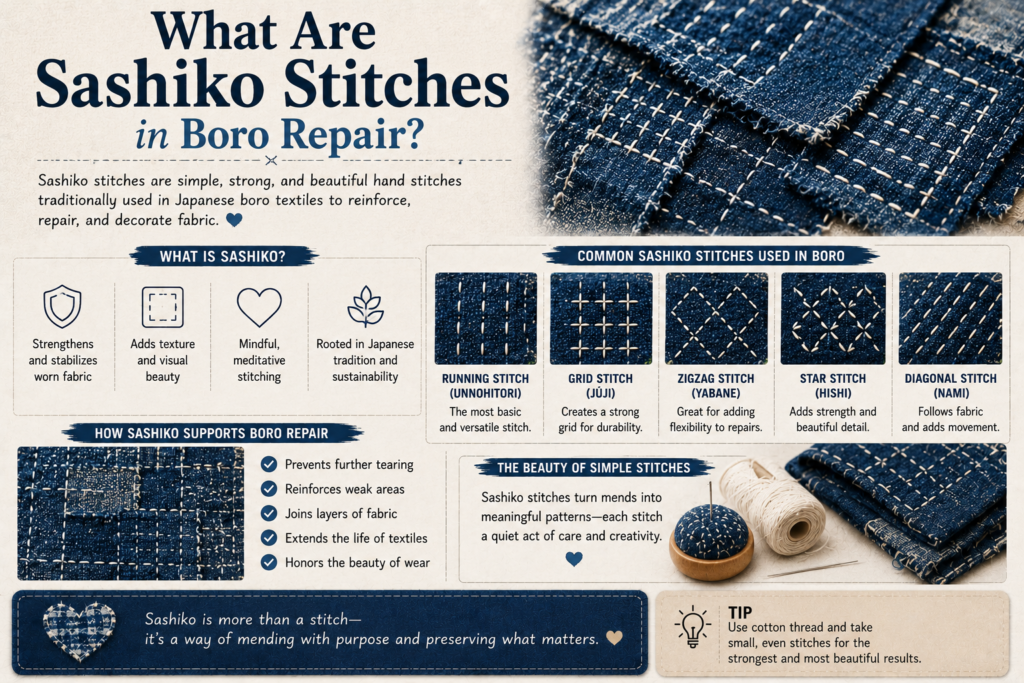
Sashiko stitches are traditional Japanese hand-sewing techniques used to reinforce worn or damaged fabric through repeated visible stitching. In boro repair, these stitches secure patches, strengthen fragile cloth, and extend garment life while creating decorative texture across the fabric surface. Historically, sashiko developed in rural Japan where fabric was extremely valuable, and families repaired clothing repeatedly instead of replacing it. Over time, practical reinforcement evolved into beautiful geometric stitch patterns that became part of Japanese textile culture.
Unlike modern invisible mending, sashiko embraces visible repair. The stitching intentionally becomes part of the garment’s identity instead of hiding damage. This philosophy is central to authentic boro aesthetics because repaired fabric tells a story of use, preservation, and craftsmanship. Even simple stitches can dramatically improve fabric durability when applied correctly across weakened areas.
Many modern makers use sashiko purely for decoration, but traditional boro stitching always had a functional purpose first. Stitch patterns helped distribute stress, reduce tearing, and stabilize layered patches on garments exposed to years of physical labor and repeated washing.
Why Sashiko Stitches Matter in Boro Repair
- strengthen weak fabric areas
- secure layered patches
- reduce future tearing
- improve garment lifespan
- add decorative texture
- preserve traditional craftsmanship
- create visible mending aesthetics
- stabilize fragile textiles
Real-World Insight
Authentic vintage boro garments often contain thousands of stitches layered over decades of repairs. The beauty comes not from perfection, but from visible evidence of repeated care and practical craftsmanship.
How Stitch Density Affects Flexibility and Durability
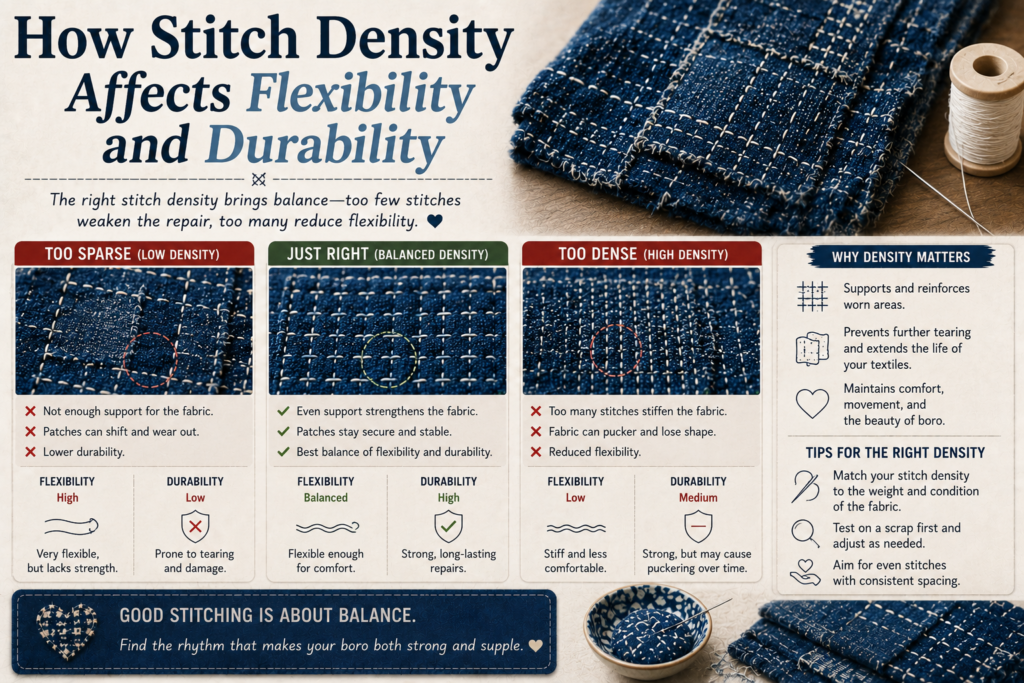
Sashiko stitch density dramatically changes how repaired fabric behaves during daily wear. Dense stitching creates stronger reinforcement because more thread distributes stress across a larger surface area, but excessive density can also make garments stiff and uncomfortable. Looser stitching preserves flexibility and natural drape, which is important for lightweight shirts, soft cotton garments, and flowing wearable repairs. Traditional boro repairs often balanced density carefully depending on where the garment experienced friction and movement.
High-friction areas like knees, elbows, pockets, and cuffs usually benefit from tighter stitch spacing because these zones absorb repeated stress during movement. Softer areas of clothing often require wider spacing to avoid restricting flexibility. This balance between durability and comfort is one of the most important concepts in successful boro repair because overstitching can create new tension points around the repaired area.
How Stitch Density Changes Fabric Behavior
- dense stitching increases durability
- loose stitching improves flexibility
- heavy density reduces fabric drape
- wider spacing creates softer movement
- tight spacing works better on denim
- lightweight fabrics need softer reinforcement
- balanced tension prevents puckering
- stitch density affects long-term comfort
Real-World Insight
Many beginners mistakenly believe more stitching always creates stronger repairs. In reality, excessive density can sometimes weaken surrounding fabric by creating rigid stress zones during movement.
How Thread Thickness Changes the Repair
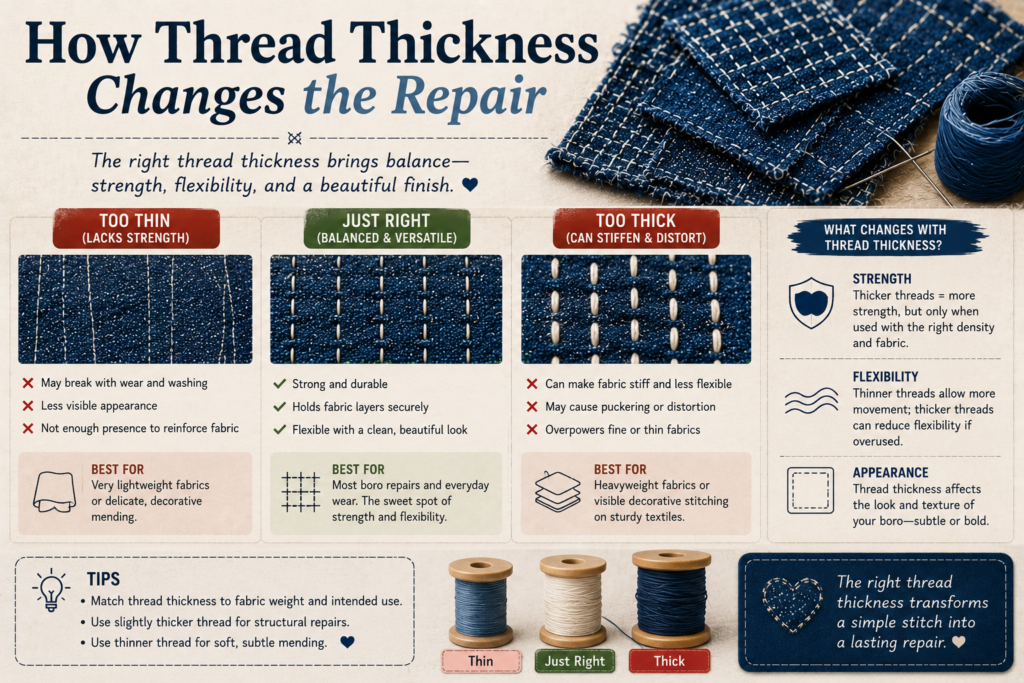
Thread thickness affects both the appearance and structural behavior of sashiko repairs. Thick sashiko thread creates stronger visual contrast and more textured reinforcement, while thinner thread produces softer stitching that blends more naturally into lightweight fabrics. Traditional sashiko thread is usually less twisted than standard sewing thread, allowing it to sit visibly on the fabric surface without cutting deeply into the textile.
Heavy thread works especially well on denim, layered indigo patchwork, and heavily worn workwear because it improves visibility and reinforcement strength simultaneously. Thinner thread may feel more comfortable on lightweight shirts or delicate cotton fabric where flexibility matters more than aggressive reinforcement. The relationship between thread thickness and stitch spacing also changes how repairs age over time as fabric softens and fades.
How Thread Thickness Affects Repairs
- thick thread creates bold texture
- thin thread preserves soft drape
- heavy thread improves visibility
- lightweight thread reduces stiffness
- thicker thread suits denim better
- thin thread works for softer fabrics
- thread texture changes aging appearance
- cotton thread develops softer wear patterns
Decision Clarity
The best thread choice depends on balancing durability, visibility, comfort, and how much texture you want the repair to develop over time.
Running Stitch: The Most Important Sashiko Stitch for Boro Repair
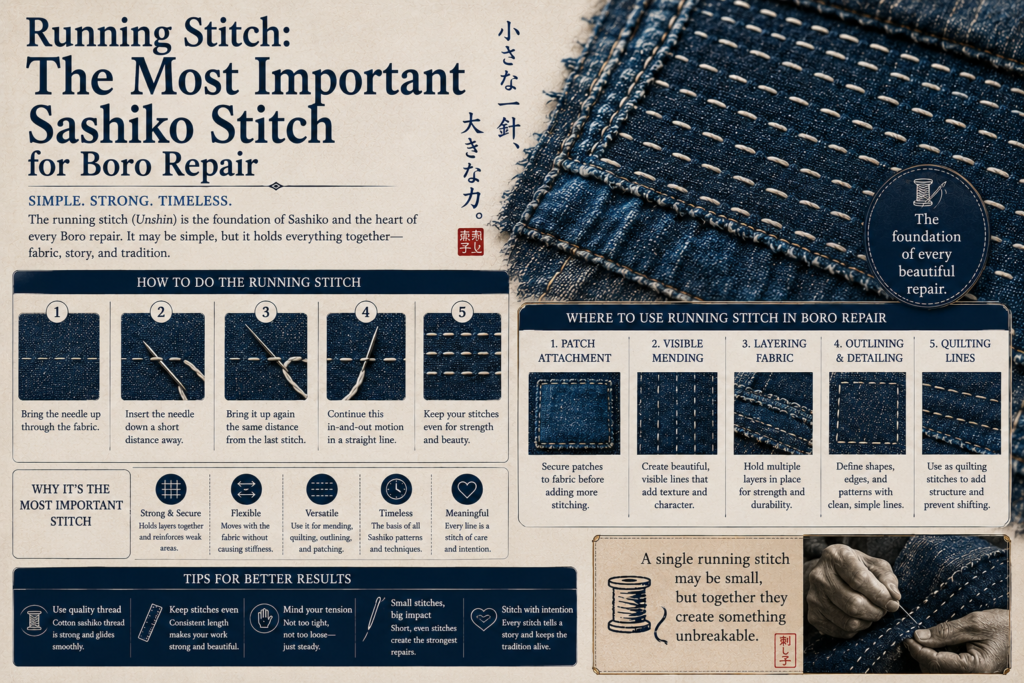
The running stitch is the foundation of nearly all sashiko and boro repair techniques. Although simple, it remains one of the most effective reinforcement methods because it balances flexibility, durability, and ease of stitching. Traditional boro garments relied heavily on repeated rows of running stitches to hold patches securely while allowing clothing to move naturally during wear.
This stitch works by passing the needle in and out of the fabric at regular intervals, creating evenly spaced dashed lines across the textile surface. Running stitches can be sewn horizontally, vertically, diagonally, or in grid formations depending on the repair requirements. Because the stitch is simple and adaptable, it works on almost every fabric type used in boro repair, including denim, cotton, hemp, and indigo-dyed textiles.
For beginners, mastering running stitch tension is more important than learning complicated decorative patterns. Uneven tension can distort fabric, create puckering, or weaken repair stability. Consistent spacing allows tension to distribute evenly across damaged areas, helping repairs survive repeated movement and washing.
Running stitch is also ideal because it preserves flexibility. Dense geometric patterns can sometimes stiffen garments excessively, while basic running stitches maintain comfort and natural drape.
Why Running Stitch Works So Well
- beginner friendly
- highly versatile
- flexible for clothing movement
- effective for patch attachment
- suitable for all fabric weights
- fast to sew
- visually clean and traditional
- excellent for visible mending
Real-World Example
Many historical Japanese work jackets survived decades because simple running stitches spread stress across broad areas rather than concentrating tension in one repair point.
Best Sashiko Stitches for Different Repair Areas
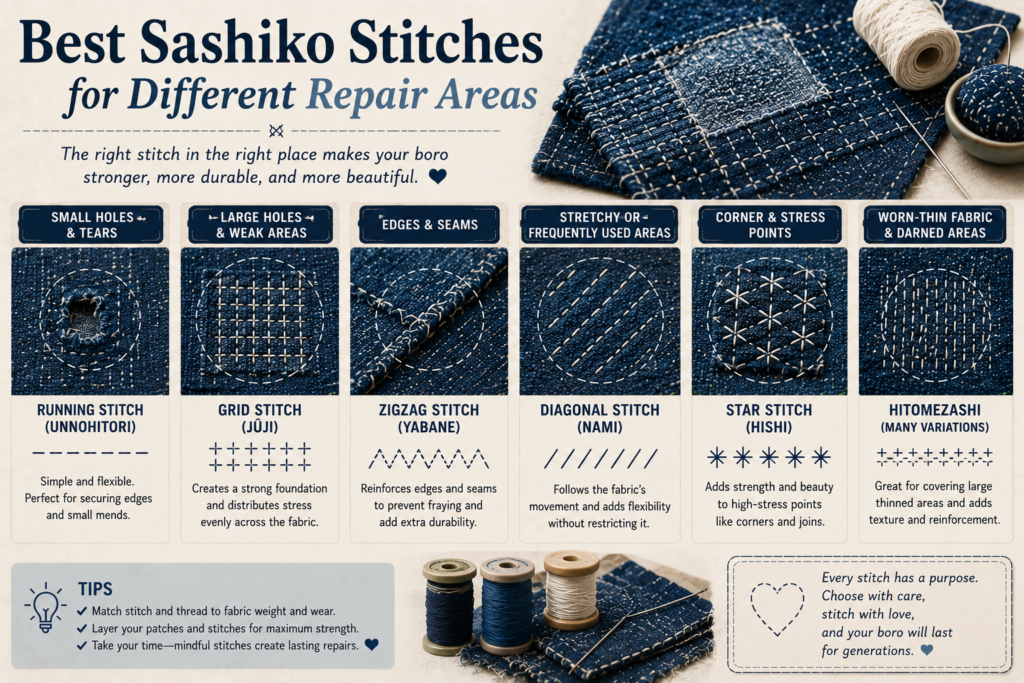
Different garment areas experience different types of stress, which means stitch selection should change depending on the repair location. A knee repair absorbs bending pressure and friction, while a shirt shoulder experiences lighter movement and stretching. Traditional boro repairs naturally adapted stitch density and pattern choice according to how each garment section wore down over time.
Dense reinforcement patterns like hitomezashi and kikko work especially well for knees, cuffs, and workwear because these areas need strong structural support. Softer running stitches and wider spacing work better for lightweight fabric sections that require flexibility. Matching the stitch pattern to the repair location creates repairs that feel more comfortable while lasting significantly longer.
Best Stitch Choices by Repair Area
- knees: hitomezashi or dense running stitch
- elbows: diagonal reinforcement rows
- jacket cuffs: cross-grid reinforcement
- shirt fabric: lighter running stitch
- pocket corners: dense anchor stitching
- denim thighs: layered running stitch grids
- bag bottoms: kikko reinforcement
- decorative repairs: asanoha or seigaiha
Decision Clarity
The best repairs prioritize how the garment moves during real wear instead of choosing stitch patterns based only on visual appearance.
..
Hitomezashi Stitch for Heavy Reinforcement
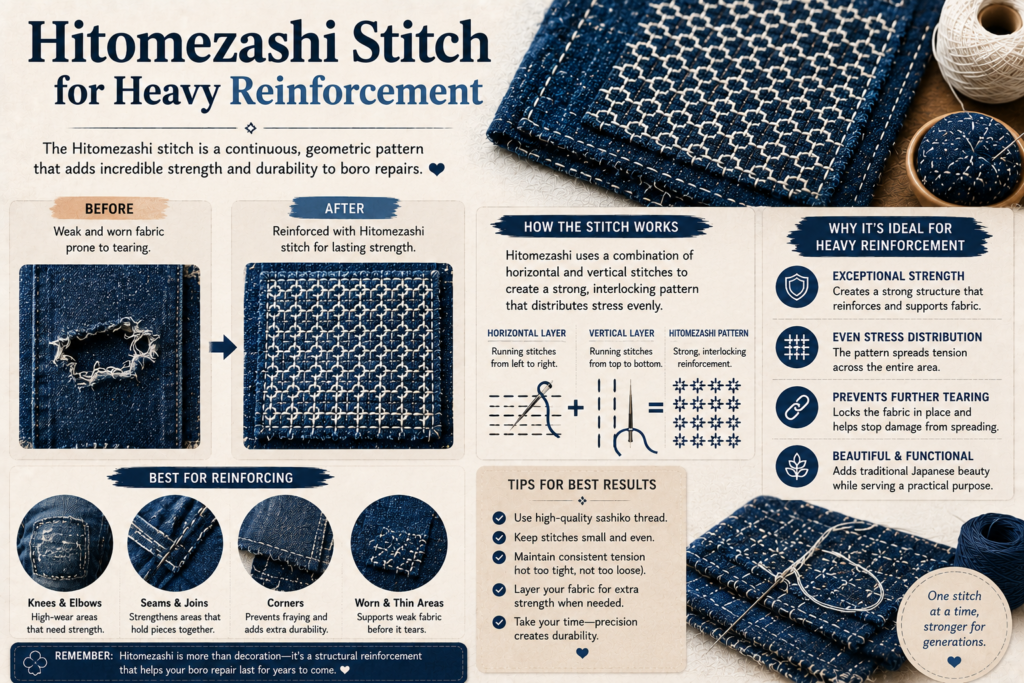
Hitomezashi is one of the strongest sashiko stitching styles used in boro repair because it creates dense geometric reinforcement across damaged fabric. Unlike simple running stitch rows, hitomezashi builds structured repeating patterns that stabilize weak textiles aggressively. This makes it especially useful for heavily worn areas like knees, elbows, cuffs, and distressed denim.
The stitch pattern forms through repeated intersecting lines that create small geometric shapes across the surface. The resulting texture becomes visually rich while dramatically improving fabric strength. Because of its density, hitomezashi prevents patches from shifting and distributes stress across multiple stitch directions simultaneously.
This stitch is commonly used when garments require long-term durability rather than lightweight flexibility. Thick cotton fabrics and denim respond particularly well to hitomezashi because they can support the heavier thread density without becoming excessively rigid. However, lightweight garments may lose too much softness if stitched too densely.
Hitomezashi also creates striking visual contrast when white sashiko thread is sewn over dark indigo fabric. The repetitive geometry becomes more visible over time as washing softens the fabric and reveals subtle texture changes around the stitches.
Benefits of Hitomezashi Stitching
- extremely durable reinforcement
- excellent for denim repairs
- stabilizes large damaged areas
- reduces patch shifting
- creates rich geometric texture
- distributes tension evenly
- ideal for workwear repairs
- long-lasting structural support
Decision Clarity
Use hitomezashi for high-friction areas that experience repeated movement and stress. It works best when durability matters more than soft fabric drape
Asanoha Stitch for Decorative Boro Repairs
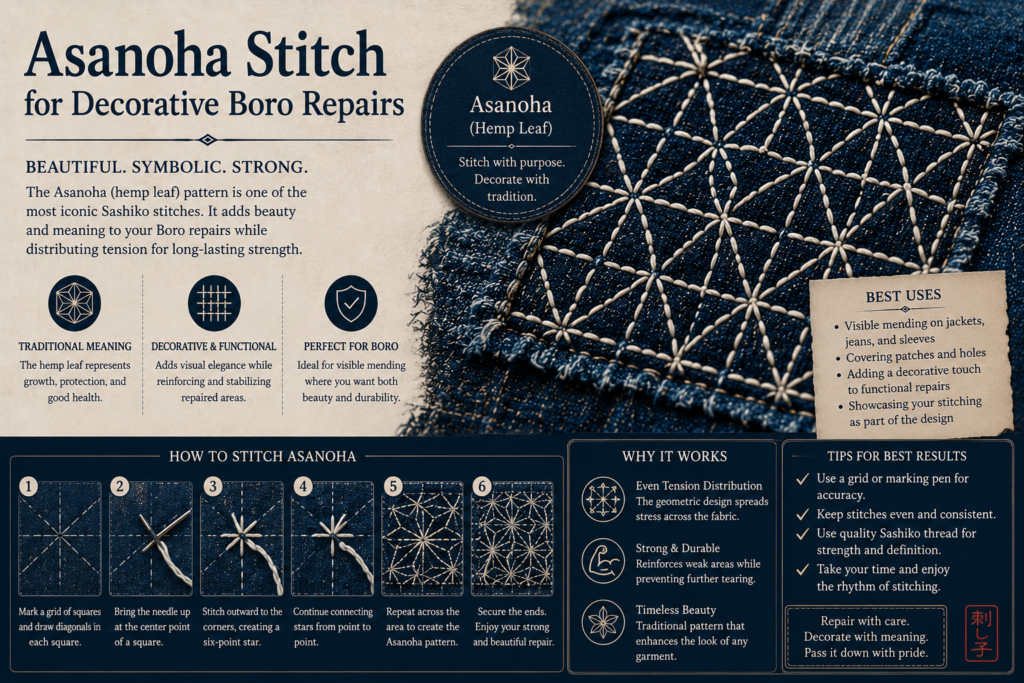
The asanoha pattern is one of the most recognizable sashiko motifs used in decorative boro repair. Inspired by hemp leaf geometry, this stitch creates repeating star-like structures that combine visual elegance with practical reinforcement. The angular pattern spreads tension outward in multiple directions, helping stabilize damaged fabric while adding sophisticated texture to the repair.
Historically, hemp symbolized strength and healthy growth in Japanese culture, which is why asanoha became associated with durability and resilience. In modern boro repair, the pattern is commonly used on visible repair areas where both aesthetics and reinforcement matter equally.
Asanoha stitching works especially well for medium-to-large patches because the repeating geometry helps organize broad repair surfaces visually. The stitch creates strong multidirectional support while still allowing moderate fabric flexibility. Many textile artists use asanoha on jackets, bags, decorative panels, and statement denim repairs because the pattern instantly communicates traditional Japanese craftsmanship.
Although visually impressive, asanoha requires careful spacing and consistent angles. Beginners sometimes struggle maintaining symmetry across uneven repair surfaces. However, once mastered, the pattern becomes one of the most rewarding sashiko designs for visible mending projects.
Why Asanoha Is Popular
- elegant traditional appearance
- balanced reinforcement strength
- strong multidirectional support
- highly decorative texture
- excellent for visible mending
- ideal for indigo fabric
- culturally iconic sashiko pattern
- suitable for artistic repairs
Real-World Insight
Asanoha patterns become especially beautiful after repeated washing because softened indigo fabric increases contrast between thread lines and aged textile texture.
Authentic Boro vs Decorative Fashion Boro
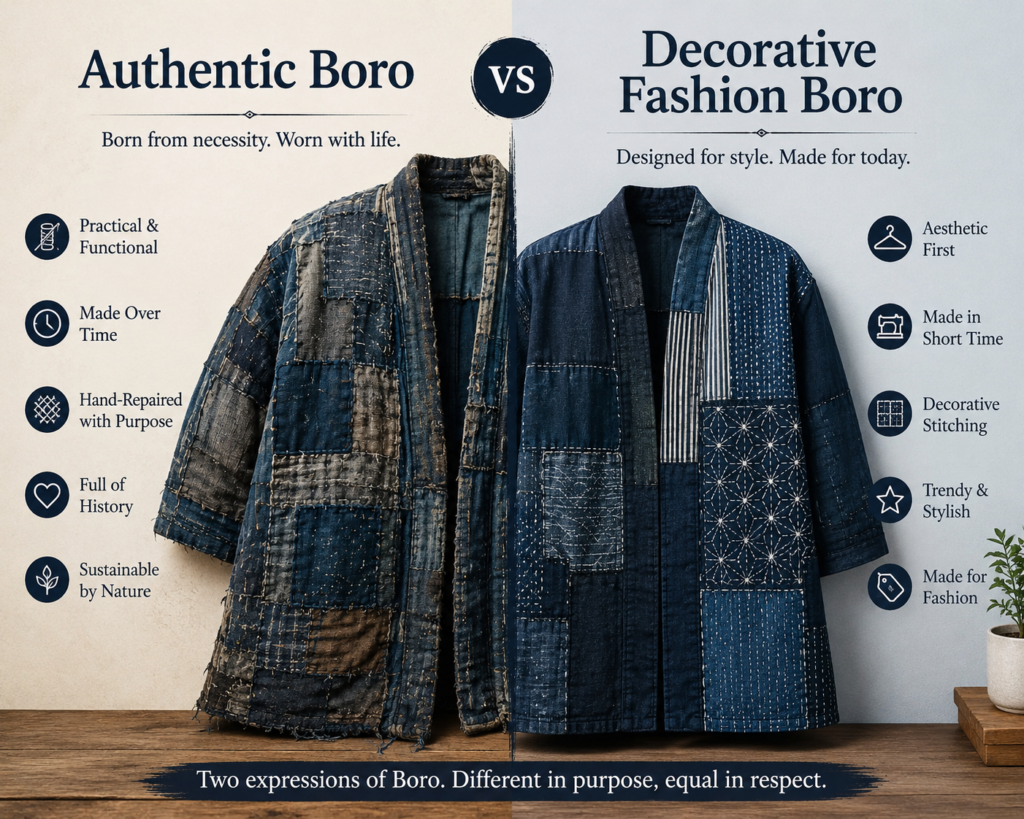
Authentic historical japanese boro stitching developed from necessity rather than decoration. Rural Japanese families repeatedly repaired garments because fabric was valuable and replacement clothing was difficult to obtain. Over generations, layers of patches, sashiko stitches, fading indigo dye, and visible wear gradually created the textured appearance now associated with traditional boro textiles. These garments reflected survival, labor, and long-term preservation rather than intentional fashion design.
Modern decorative boro often focuses more heavily on aesthetics. Contemporary fashion brands and textile artists sometimes recreate visible patchwork and sashiko stitching for artistic expression rather than practical reinforcement. While both approaches can be beautiful, authentic boro usually contains irregular stitching, uneven fading, overlapping repairs, and practical reinforcement choices shaped by real wear conditions.
Key Differences Between Traditional and Modern Boro
- authentic boro prioritized survival
- fashion boro emphasizes aesthetics
- traditional repairs evolved over decades
- modern pieces may be intentionally designed
- irregular stitching is historically authentic
- layered wear tells a repair story
- practical reinforcement shaped old repairs
- visible imperfection became part of the beauty
Real-World Insight
Many collectors value historical boro textiles because every repair layer reflects years of real use, maintenance, and handmade preservation.
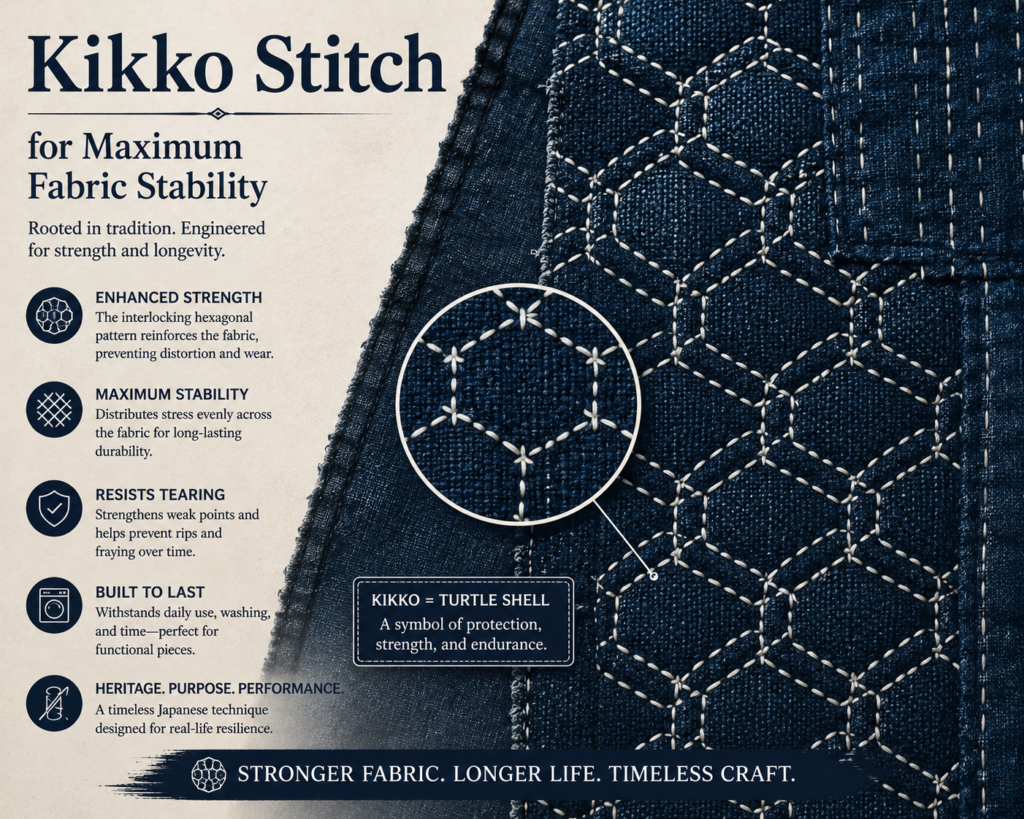
Kikko Stitch for Maximum Fabric Stability
Kikko stitch patterns use repeating hexagonal structures inspired by turtle shells. In sashiko and boro repair, these interconnected hexagons create highly stable reinforcement zones capable of handling years of wear and friction. The structure distributes stress efficiently across fabric surfaces, making kikko especially effective for workwear, utility garments, and thick cotton textiles.
Hexagonal geometry naturally balances pressure distribution, which is why similar structures appear throughout nature and traditional engineering. In textile repair, this means tension spreads evenly instead of concentrating around a single weak point. As a result, kikko stitching can dramatically extend the lifespan of heavily damaged garments.
Kikko patterns work particularly well on denim, aprons, jackets, tote bags, and layered patchwork repairs. Because the stitch density is relatively high, the fabric becomes stronger but slightly stiffer. For this reason, kikko is often used in high-stress areas rather than lightweight flowing garments.
The pattern also creates bold visual rhythm across repaired surfaces. Combined with indigo fabric and contrasting white thread, kikko stitching produces a classic Japanese repair aesthetic strongly associated with traditional sashiko craftsmanship.
Advantages of Kikko Stitching
- exceptional structural support
- ideal for thick fabric
- strong geometric reinforcement
- distributes pressure evenly
- long-lasting durability
- visually striking texture
- excellent for workwear
- stabilizes layered patchwork
Decision Clarity
Kikko is best for repairs that prioritize strength and longevity over soft drape or lightweight flexibility.
How Layered Boro Repairs Become Stronger Over Time
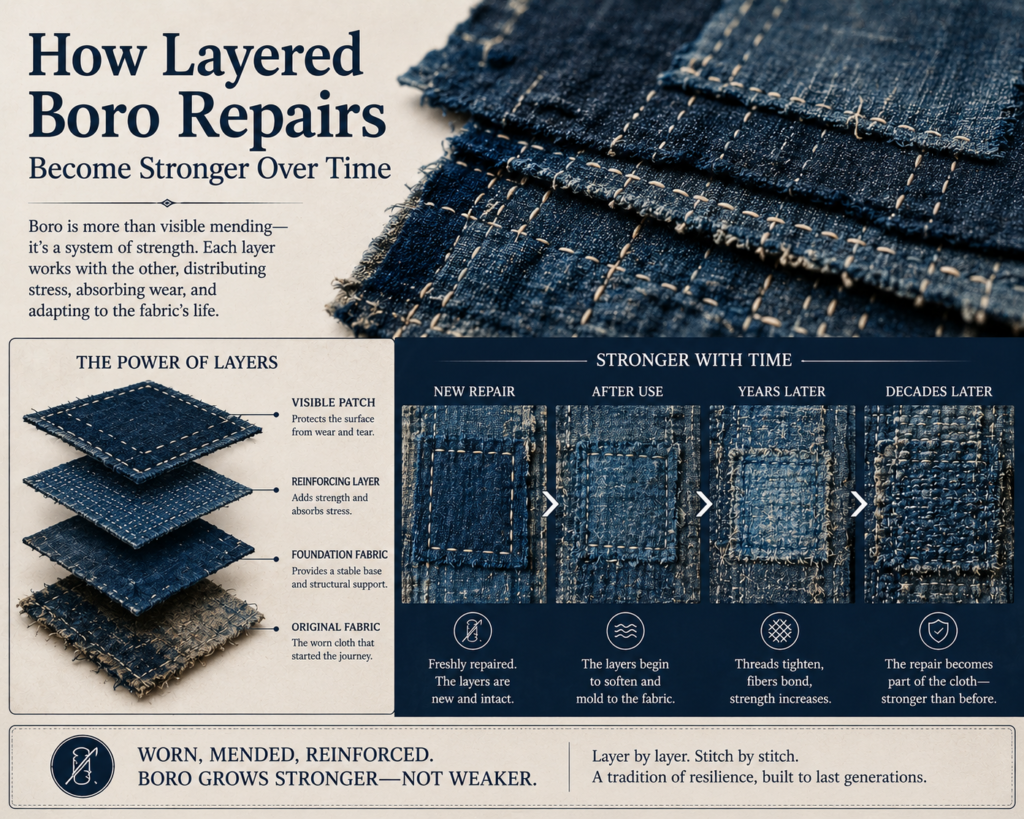
Layered patchwork is one of the most important structural principles in traditional boro repair. Instead of replacing damaged fabric entirely, old garments were reinforced gradually through overlapping textile layers secured with repeated sashiko stitching. Each additional patch distributed stress across a larger area, reducing pressure on weakened fabric and extending garment life significantly.
Over time, these layered repairs often became stronger than the surrounding original fabric. Internal patches stabilized thin cloth from beneath, while outer patches protected high-friction areas from additional wear. Repeated stitching also helped lock layers together so movement stress spread across multiple textile surfaces rather than concentrating around a single tear.
Why Layered Repairs Work So Well
- overlapping patches spread tension
- multiple layers reduce tearing
- internal patches improve stability
- outer patches absorb friction
- repeated stitching strengthens structure
- layered fabric creates durability
- edge reinforcement prevents fraying
- patch stacking extends garment lifespan
Real-World Insight
Many historical boro garments survived for decades because repairs evolved gradually instead of relying on a single replacement patch.
Seigaiha Stitch for Flexible Wearable Repairs
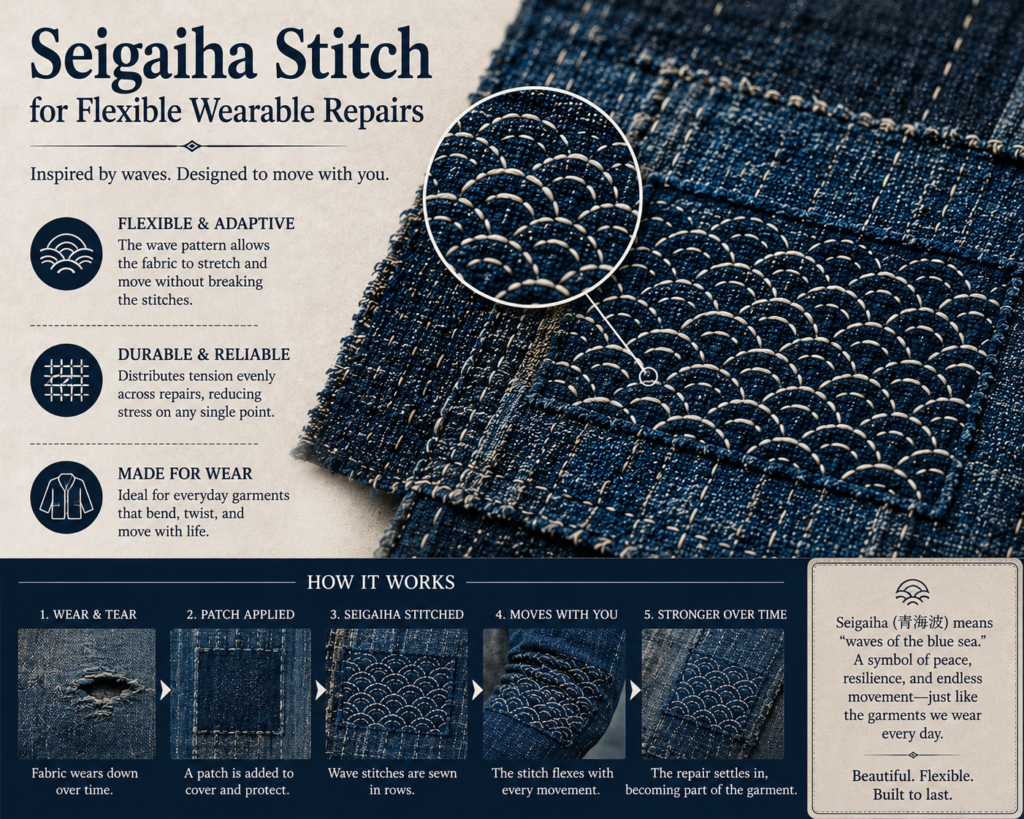
Seigaiha, often called the wave pattern, is a flowing sashiko stitch design used in boro repair to create softer and more flexible reinforcement. Unlike rigid geometric grids, the curved wave structure allows garments to move naturally while still strengthening fragile fabric areas. This makes seigaiha ideal for wearable repairs where comfort and drape matter.
The pattern consists of repeating arcs layered in rows that resemble ocean waves. In Japanese culture, seigaiha symbolizes peace, resilience, and continuity. The flowing visual rhythm also complements faded indigo textiles beautifully, which is why many modern boro artists favor this design for decorative repairs.
Seigaiha works especially well on shirts, lightweight jackets, scarves, and soft cotton fabrics that require movement flexibility. While it may not reinforce fabric as aggressively as hitomezashi or kikko, it provides balanced support without making garments feel rigid or heavy.
This pattern is also visually calming compared to sharper angular sashiko motifs. The smooth curved lines soften the appearance of layered patchwork and create elegant transitions between repaired sections.
Why Seigaiha Works for Wearable Repairs
- preserves fabric flexibility
- softer visual appearance
- elegant flowing texture
- comfortable for garments
- suitable for lightweight fabrics
- traditional symbolic design
- ideal for artistic boro
- visually balanced reinforcement
Real-World Example
Many contemporary slow-fashion designers use seigaiha stitching on naturally faded indigo garments because the flowing pattern enhances the soft aged appearance of the fabric.
Why Indigo Fabric Became Central to Boro and Sashiko
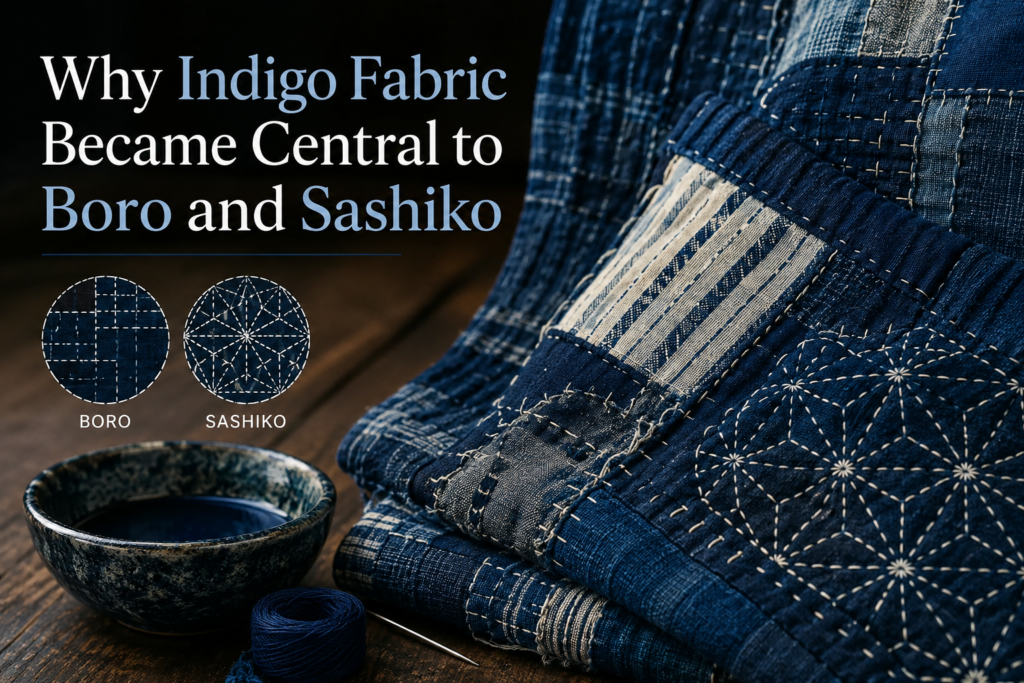
Indigo fabric became deeply connected to boro and sashiko because of its durability, availability, and unique aging behavior. Traditional Japanese workwear commonly used indigo-dyed cotton because the dye helped hide dirt while also resisting wear more effectively than many lighter fabrics. Over years of washing and repair, indigo textiles developed layered fading patterns that enhanced the visibility of sashiko stitching and patchwork textures.
White sashiko thread contrasts strongly against dark indigo cloth, which is one reason visible stitching became such a recognizable part of traditional Japanese textile aesthetics. As garments aged, repeated repairs created complex surfaces where faded blue
Real-World Insight
Vintage indigo boro textiles often become more visually complex over time because fading reveals subtle differences between original fabric and repaired sections.
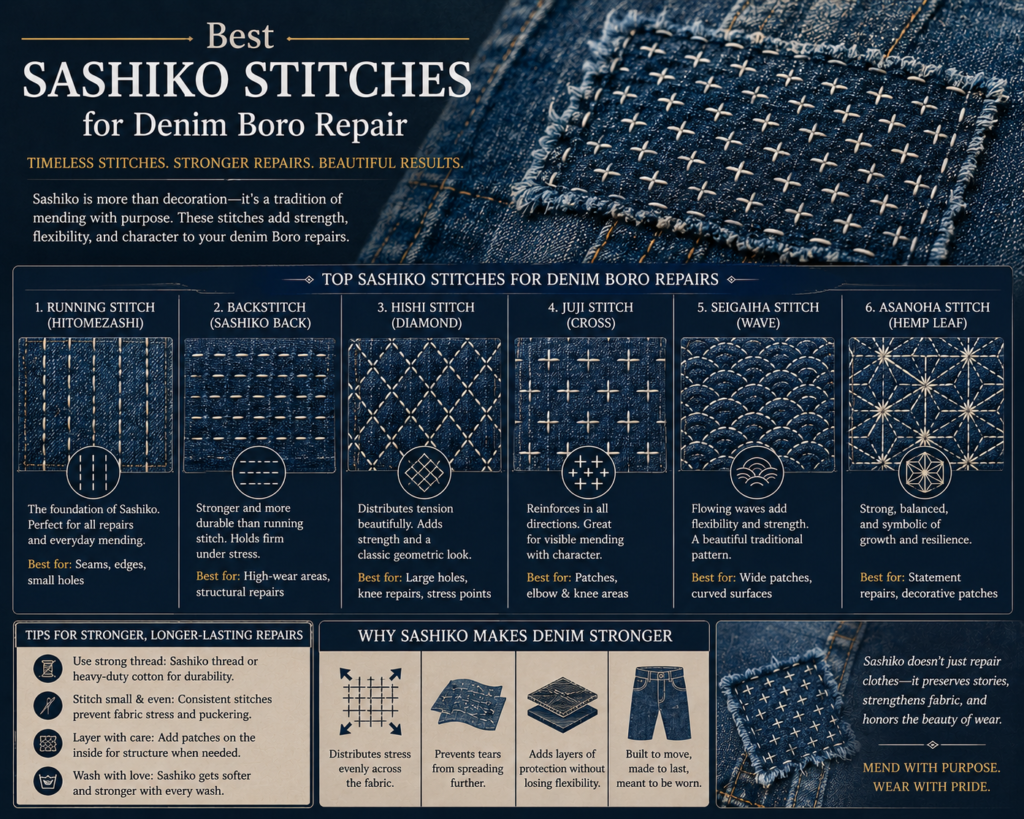
Best Sashiko Stitches for Denim Boro Repair
Denim is one of the most popular fabrics for modern boro repair because its texture, durability, and fading characteristics work extremely well with visible stitching. However, denim also experiences heavy stress, especially around knees, pockets, thighs, and cuffs. This means stitch selection becomes critical for long-term repair success.
The best sashiko stitches for denim combine strong reinforcement with moderate flexibility. Running stitch remains the most versatile option, while denser patterns like hitomezashi and kikko provide extra durability for high-friction areas. Cross-grid stitching and layered reinforcement rows are also commonly used because they stabilize thinning denim effectively.
One reason sashiko works so well on denim is the strong contrast between thread and fabric. White cotton thread over dark indigo creates bold texture that becomes even more beautiful as the denim fades naturally over time. Repeated washing softens both the fabric and stitching, giving repaired garments a highly textured handcrafted appearance.
Denim repairs also benefit from layered patchwork. Instead of replacing damaged sections entirely, boro repair reinforces weak zones gradually through overlapping patches secured with visible stitching. This creates stronger fabric while preserving the garment’s history and aging characteristics.
Best Denim Repair Stitches
- running stitch
- hitomezashi
- kikko
- cross-grid sashiko
- layered reinforcement rows
- diagonal running stitches
- patch anchoring stitches
- dense parallel stitch lines
Decision Clarity
For heavily damaged denim, combine simple running stitches with one denser geometric reinforcement area for the best balance of durability and comfort.
Sashiko Stitch Comparison Table for Boro Repair
Different sashiko stitches behave differently depending on durability needs, fabric flexibility, repair size, and visual style. Understanding these differences helps beginners choose patterns more confidently while improving long-term repair performance.
| Stitch Pattern | Durability | Flexibility | Difficulty | Best Use |
| Running Stitch | Medium | High | Easy | General repairs |
| Hitomezashi | Very High | Medium | Medium | Denim and knees |
| Kikko | High | Medium-Low | Advanced | Heavy reinforcement |
| Seigaiha | Medium | High | Medium | Wearable garments |
| Asanoha | High | Medium | Advanced | Decorative repairs |
Why Comparison Matters
- helps beginners choose correctly
- improves repair planning
- balances comfort and durability
- simplifies stitch selection
- clarifies reinforcement strength
- improves visible mending results
- reduces overstitching mistakes
- supports fabric-specific decisions
Decision Clarity
There is no single “best” sashiko stitch for every repair. The strongest results come from matching stitch behavior to the garment’s movement, stress level, and fabric weight.
Common Mistakes Beginners Make With Sashiko Stitches
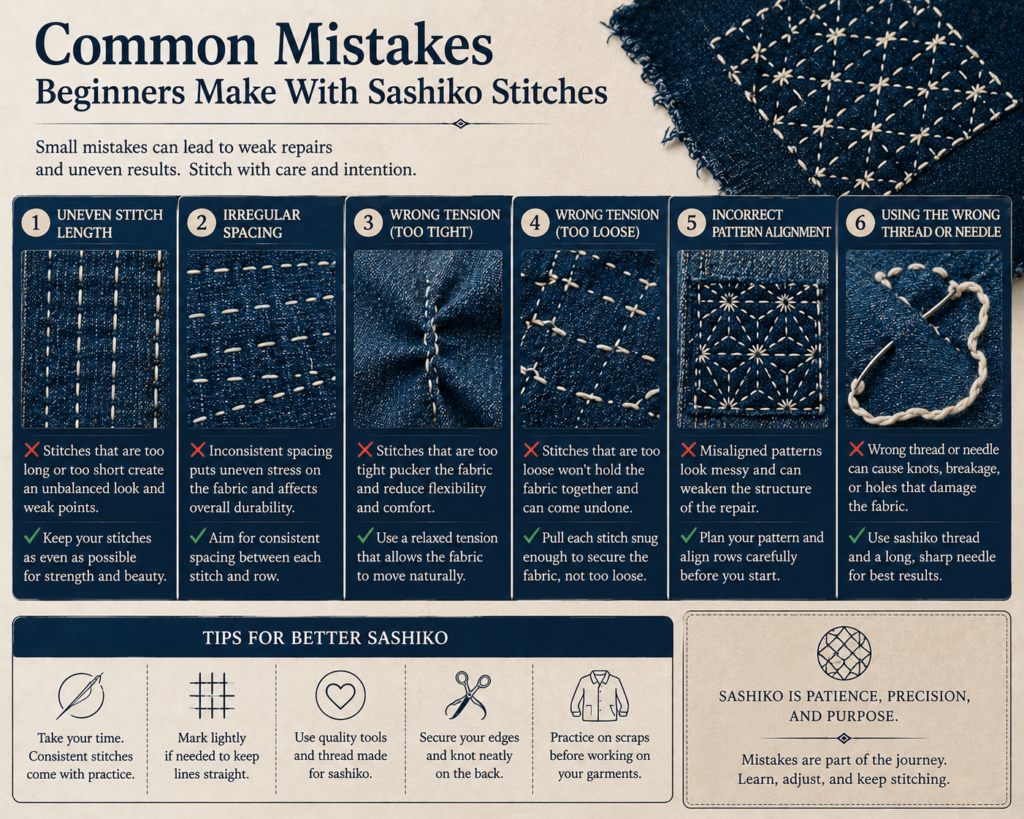
Many beginners focus heavily on decorative appearance while ignoring structural repair principles. As a result, repairs may look attractive initially but fail quickly during wear. Understanding common mistakes helps create stronger, more authentic boro repairs that age beautifully over time.
One of the biggest problems is stitching too tightly. Excessive tension causes puckering and restricts natural fabric movement, which can create new stress points around the repair. Another common mistake is choosing dense geometric patterns before mastering basic running stitch consistency. Uneven spacing and poor tension control become much more obvious in advanced designs.
Beginners also frequently use thread that is too thin or weak for reinforcement purposes. Traditional sashiko thread is thicker and more durable than standard sewing thread because it must withstand repeated friction and washing. Poor thread selection can reduce both visual impact and repair longevity.
Another issue is over-reinforcing lightweight fabrics. Dense stitching may strengthen the repaired section while making surrounding fabric disproportionately fragile. Balanced reinforcement matters more than maximum stitch density.
Common Beginner Errors
- pulling stitches too tight
- uneven stitch spacing
- choosing overly complex patterns early
- using weak sewing thread
- ignoring fabric flexibility
- overstitching lightweight fabric
- poorly secured patch edges
- inconsistent stitch direction
Real-World Insight
Traditional boro garments often contain imperfect stitching because functionality mattered more than visual perfection. Slight irregularities can actually enhance the handmade authenticity of the repair.
How Sashiko Repairs Age Over Time
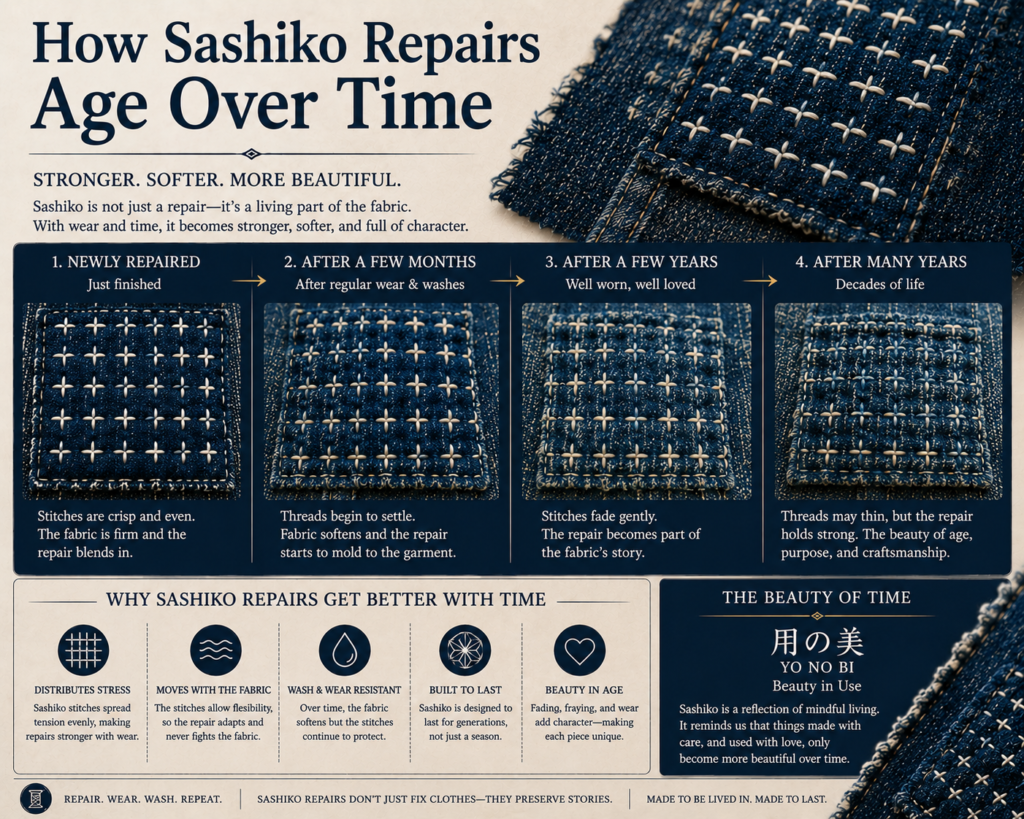
One of the most unique aspects of sashiko and boro repair is how the repairs continue evolving as garments age. Unlike machine repairs designed to disappear, visible sashiko stitching becomes more integrated into the fabric through repeated wear, washing, fading, and softening. Over time, thread texture relaxes, indigo fabric fades unevenly, and repaired sections develop richer surface character.
This aging process is one reason authentic boro garments are so admired today. The repairs become part of the garment’s visual history rather than temporary fixes. Slight puckering, softened thread, faded patch edges, and layered textile texture all contribute to the evolving appearance of handmade repairs. Many people intentionally continue wearing repaired garments for years because aging improves the depth and individuality of the textile surface.
How Repairs Change Over Time
- indigo fades around stitches
- thread softens with wear
- patch edges blend naturally
- texture becomes more complex
- repairs gain visual depth
- puckering creates handmade character
- layered fading increases contrast
- garments develop unique patina
Real-World Insight
The best boro repairs rarely look perfect immediately after stitching. Much of their beauty develops gradually through natural aging and repeated use.
Final Thoughts on the Best Sashiko Stitches for Boro Repair
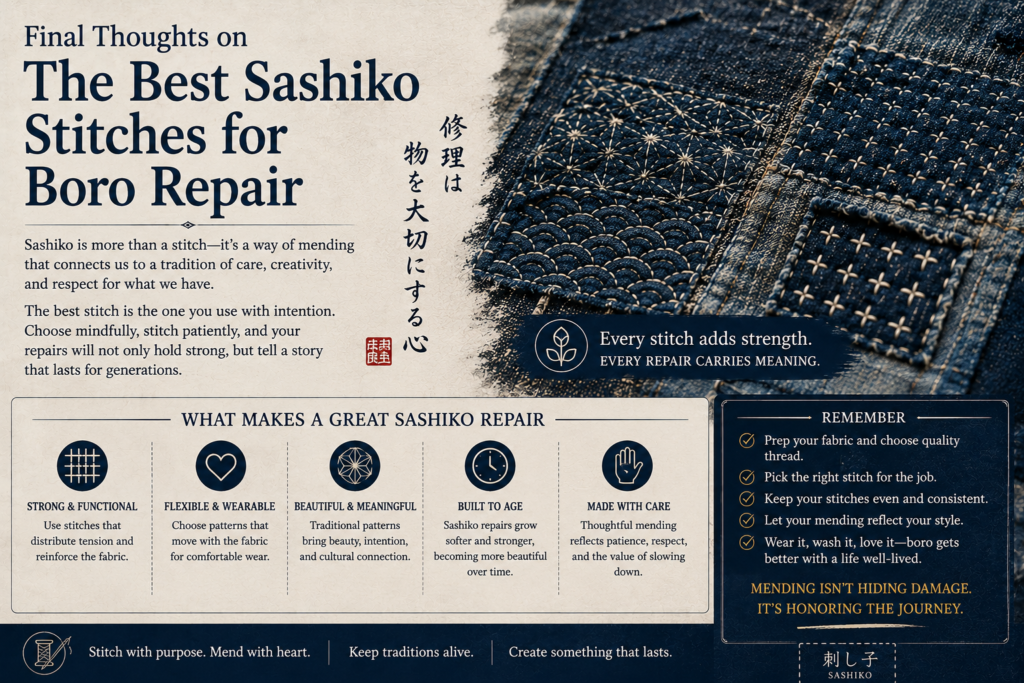
The best sashiko stitches for boro repair depend on the balance between durability, flexibility, and visual style. Running stitch remains the foundation of nearly all successful repairs because it adapts easily to different fabrics and repair situations. More advanced patterns like hitomezashi, asanoha, kikko, and seigaiha each provide unique structural and aesthetic benefits depending on the garment’s needs.
Authentic boro repair is not about hiding damage or making fabric appear brand new. Instead, it celebrates preservation, craftsmanship, and visible textile history. Every stitch becomes part of the garment’s evolving character. This philosophy explains why traditional boro garments remain so admired today despite their rough imperfections and repeated repairs.
Modern visible mending continues to grow because people increasingly value sustainability, slow fashion, and handmade craftsmanship. Sashiko stitching offers a practical and artistic way to extend garment life while creating deeply personal textile surfaces that cannot be replicated by machines.
For beginners, learning consistent running stitches and balanced tension matters far more than creating perfectly symmetrical decorative patterns. Once those fundamentals become comfortable, advanced sashiko motifs become easier to execute and much more structurally effective.
Key Takeaways
- running stitch is the most versatile option
- hitomezashi provides heavy reinforcement
- asanoha combines beauty with structure
- kikko excels in durability
- seigaiha preserves flexibility
- denim responds extremely well to sashiko
- thread choice affects durability
- visible imperfections enhance authenticity
Decision Clarity
The strongest boro repairs combine practical reinforcement logic with visual harmony instead of treating sashiko purely as decoration.
FAQs
What is the easiest sashiko stitch for beginners?
The running stitch is the easiest and most important sashiko stitch for beginners because it teaches spacing, tension control, and patch reinforcement fundamentals.
Which sashiko stitch is strongest for boro repair?
Hitomezashi and kikko patterns are among the strongest sashiko stitches because their dense geometric structures distribute stress very effectively.
Can sashiko stitching repair denim?
Yes, sashiko stitching works extremely well for denim repair because it reinforces worn areas while adding decorative texture and long-term durability.
What thread is best for sashiko stitching?
Traditional sashiko thread or thick cotton thread works best because it is durable, visible, and strong enough for repeated wear and washing.
Is sashiko only decorative?
No. Sashiko originally developed as a practical reinforcement technique used to strengthen and extend the life of worn clothing.
Do boro repairs need perfect stitching?
No. Traditional boro repairs often contain irregular stitches because functionality mattered more than visual perfection.
Which sashiko pattern works best for large repairs?
Moyozashi and structured geometric patterns work best for large repairs because they stabilize broad fabric areas evenly.
What fabric works best for sashiko boro repair?
Natural fabrics like cotton, linen, hemp, and denim work best because they handle repeated stitching and layering effectively.