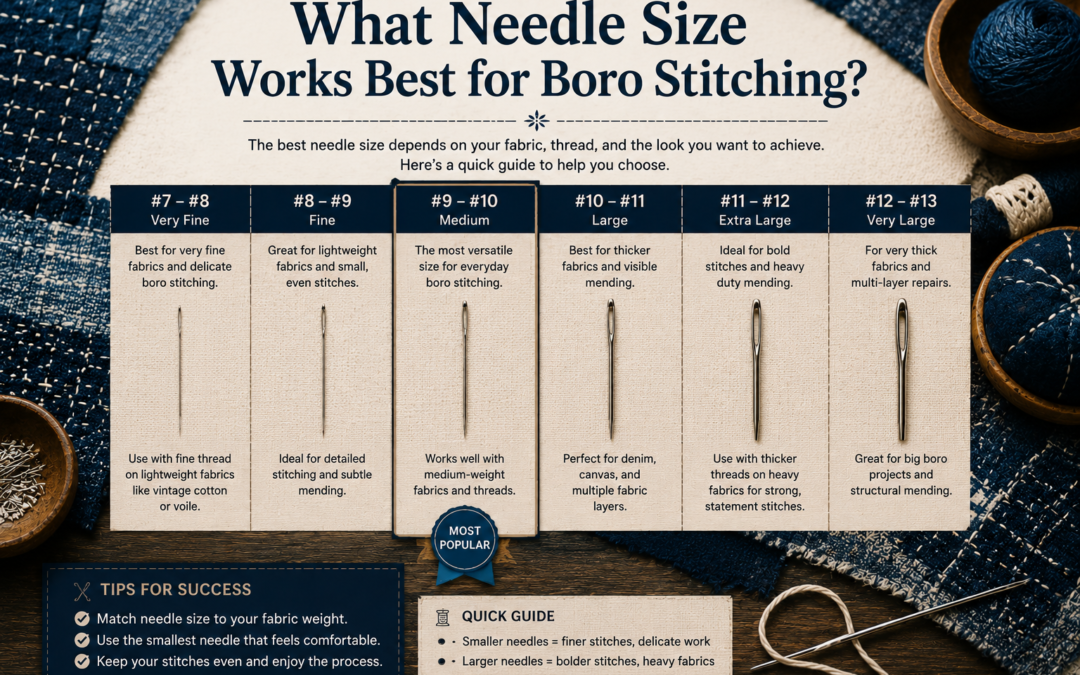
Traditional boro stitching works best with long sashiko-style needles that can pass through multiple fabric layers smoothly while maintaining even running stitches. Most experienced boro artists prefer needles between 48 mm and 65 mm because longer needles improve stitching rhythm, reduce interruptions, and help maintain balanced stitch spacing across repaired fabric. The correct needle size also depends on fabric thickness, thread type, repair density, and whether the stitching focuses on authentic utility repairs or modern decorative visible mending. Read this guide on “What Needle Size Works Best for Boro Stitching?” from start to end to have an experts level knowledge of the know-how of needles in Boro Stitching.
Boro Stitching developed historically as a practical Japanese repair method used to extend the lifespan of workwear, bedding, and indigo-dyed textiles. Because these garments were repaired repeatedly over time, stitch efficiency became extremely important. Long needles allowed workers to gather several running stitches at once before pulling thread through the fabric. This reduced hand fatigue while increasing repair speed across large textile surfaces.
Many beginners mistakenly assume that any sewing needle works equally well for boro stitching. In reality, needle length, thickness, eye size, and flexibility directly affect stitch consistency, thread friction, and overall repair durability. Choosing the wrong needle often causes uneven stitches, thread fraying, bent needles, or puckered fabric layers.
Key Factors That Affect Needle Selection
- Fabric thickness
- Number of fabric layers
- Thread weight
- Stitch spacing
- Decorative vs utility stitching
- Hand comfort during long sessions
Why Long Needles Are Preferred for Traditional Boro Stitching
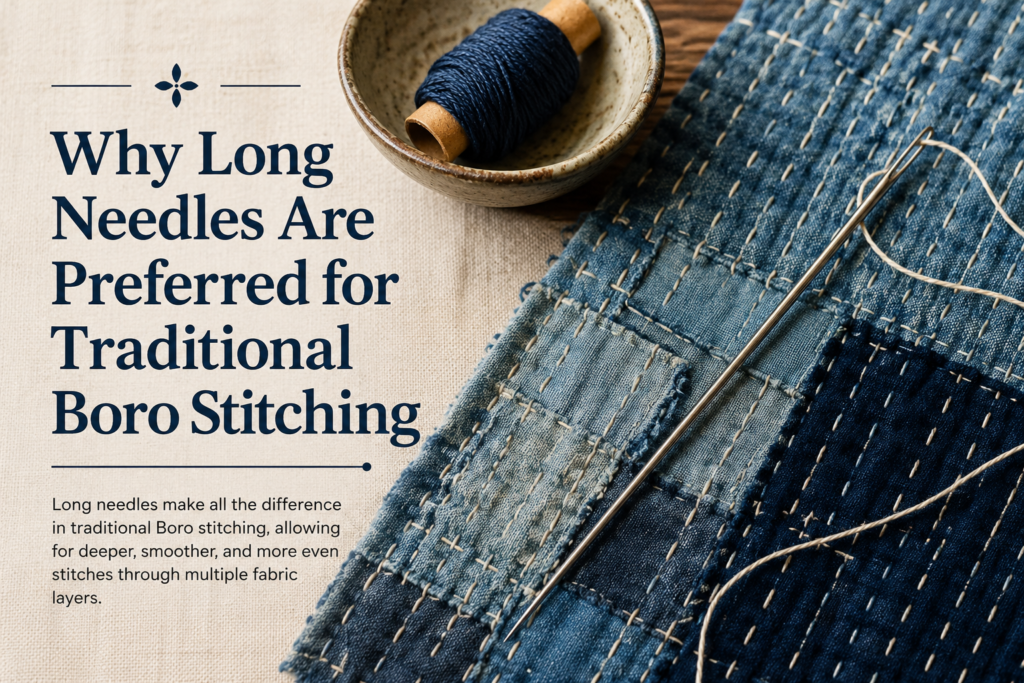
Long needles are preferred for traditional japanese boro stitching because they support continuous running-stitch motion across layered fabric repairs. Unlike standard sewing methods that use short individual stitches, boro stitching depends heavily on rhythmic stitch loading, where multiple stitches are placed onto the needle before the thread is pulled through the fabric. This traditional movement improves stitching efficiency and creates more consistent repair lines.
Most traditional sashiko and boro needles range from 48 mm to 65 mm. These longer needles allow the hand to maintain a smoother sewing rhythm without constantly repositioning the needle after every stitch. This becomes especially important when repairing old denim jackets, layered cotton garments, or heavily worn utility textiles.
Long needles also improve control across uneven surfaces created by stacked repair patches. Since boro repairs often involve several overlapping layers, shorter needles may struggle to penetrate the material evenly. Long sashiko needles distribute force more naturally across the hand, reducing wrist strain during large repair projects.
Traditional Japanese textile repair techniques evolved around practicality rather than decoration. Workers needed tools that allowed efficient repair of large garments under repetitive use conditions. Long needles became standard because they supported durability-focused stitching with less physical effort. Traditional Japanese workers developed long-needle stitching methods because garments needed constant repair over many years of physical labor. Rural families repeatedly patched indigo-dyed workwear, bedding, and fishing garments using practical running-stitch techniques designed for speed and durability rather than decorative perfection. Long sashiko needles allowed workers to repair larger textile areas efficiently while minimizing hand fatigue during repetitive stitching sessions.
This historical relationship between labor-intensive repair culture and tool efficiency explains why authentic boro stitching still favors longer needles today. The needle evolved around the practical needs of textile preservation rather than ornamental embroidery aesthetics.
Benefits of Long Needles
- Load multiple stitches simultaneously
- Improve stitch rhythm
- Reduce repetitive hand motion
- Handle layered fabric more efficiently
- Create straighter running stitches
- Improve repair speed on large garments
Modern visible mending artists still prefer long needles because they preserve the authentic appearance associated with historical boro textiles.
What Needle Length Works Best for Beginners?
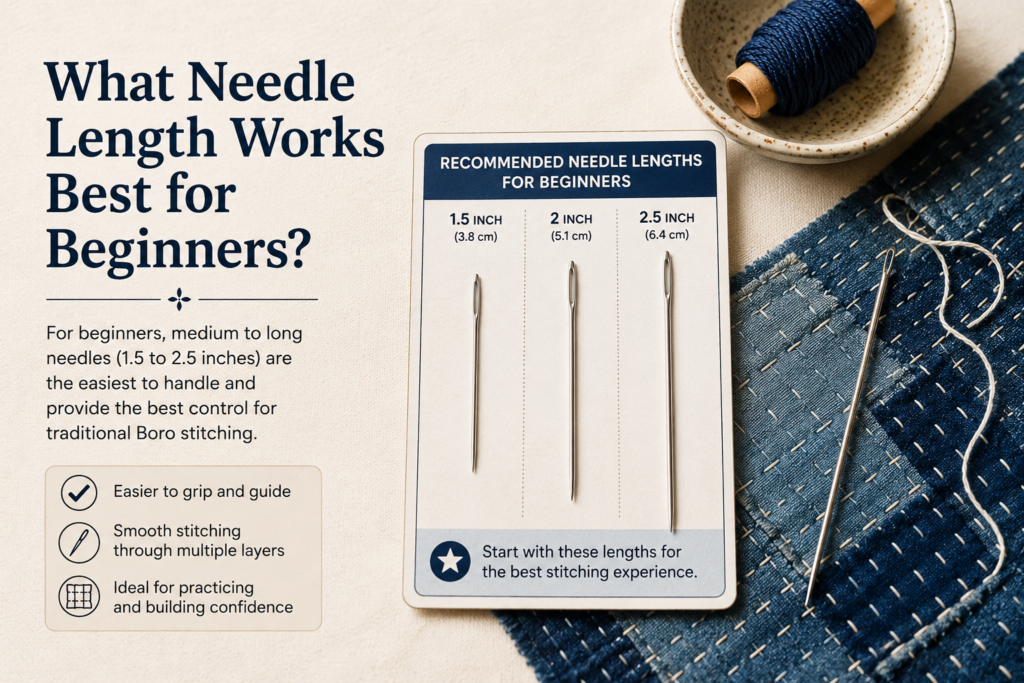
Beginners usually achieve the best balance with medium-length needles around 48 mm to 51 mm because they offer traditional sashiko functionality without feeling overly difficult to control. Extremely long needles can initially feel uncomfortable for people who learned sewing using standard embroidery or household sewing needles.
Medium-length needles allow beginners to practice traditional running-stitch movement while still maintaining reasonable hand control. They also help new stitchers understand how stitch rhythm affects spacing consistency across layered fabric repairs.
One common beginner mistake is starting directly on thick denim or heavily layered repairs using very long needles. This combination often creates frustration because beginners must simultaneously manage fabric resistance, stitch spacing, thread tension, and needle positioning. Starting with medium-weight cotton fabric and a moderate needle length creates a much smoother learning curve.
Needle flexibility also matters for beginners. Needles that are too thin may bend during stitching, while excessively thick needles may feel stiff and difficult to maneuver. A medium-thickness sashiko needle usually provides the best combination of durability and comfort.
Many beginners improve faster when they focus first on developing smooth hand movement rather than decorative precision. Even stitch rhythm becomes more important than perfectly equal stitch spacing during the early stages of learning.
Beginner-Friendly Needle Features
- Medium length
- Moderate flexibility
- Large thread eye
- Smooth steel finish
- Comfortable grip balance
- Compatible with sashiko thread
Learning on properly sized needles helps beginners develop the traditional sewing rhythm that defines authentic boro stitching aesthetics.
How Needle Size Numbering Systems Work
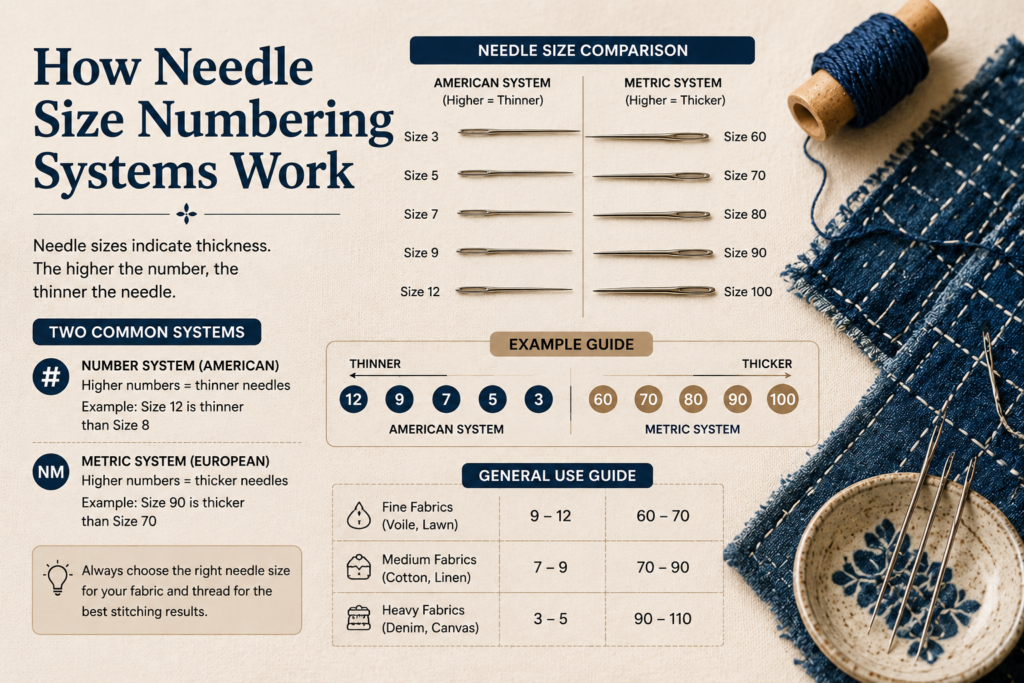
Many beginners become confused because sashiko needles are often measured differently from standard embroidery or household sewing needles. Traditional Japanese sashiko needles are usually categorized by physical length and thickness rather than the small-number sizing systems commonly used for embroidery needles. This creates confusion when stitchers compare international sewing tools online.
Milliners needles, embroidery needles, and sashiko needles may all use different numbering conventions even when the physical dimensions are similar. In many sewing systems, larger needle numbers actually represent thinner needles, which feels counterintuitive for beginners selecting tools for layered repairs.
Japanese sashiko needle packaging usually focuses on:
- needle length in millimeters
- steel thickness
- intended fabric density
- sashiko thread compatibility
Long sashiko needles between 48 mm and 65 mm remain the most common range used for traditional boro repairs because these lengths support efficient running-stitch movement across layered fabric.
Common Needle Measurement Systems
- Millimeters (Japanese sashiko sizing)
- Embroidery numbering systems
- Milliners needle sizes
- Crewel needle systems
- Thickness-based sizing categories
Understanding these systems helps stitchers avoid accidentally purchasing short embroidery needles that cannot support traditional boro stitching rhythm effectively.
How Needle Thickness Affects Layered Fabric Repairs
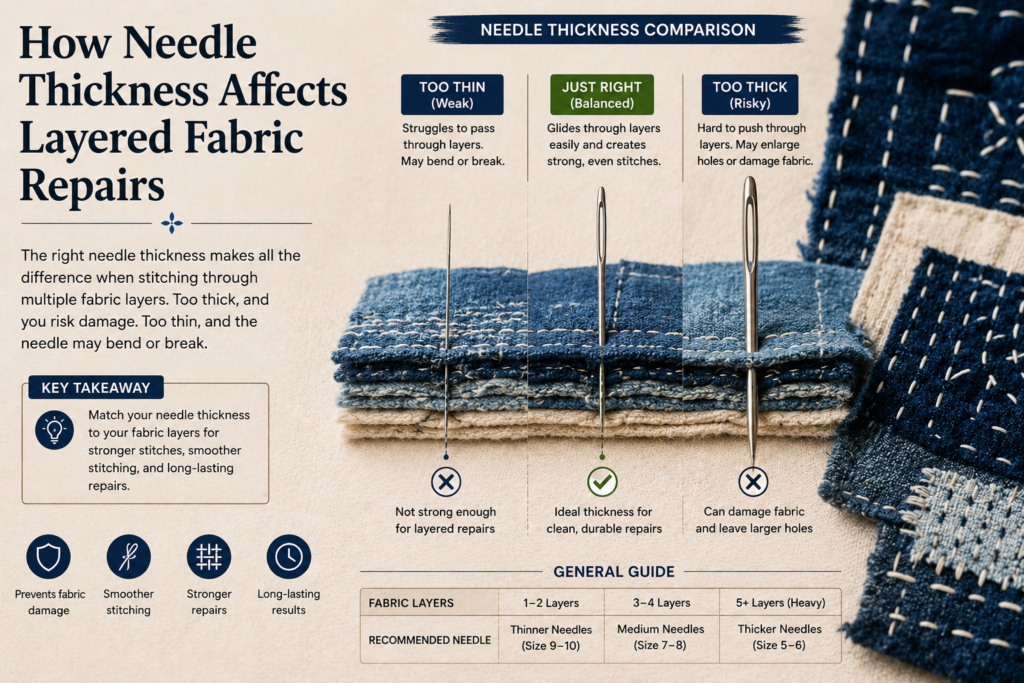
Needle thickness significantly affects how smoothly the needle penetrates layered fabric and how much stress is placed on the textile fibers during stitching. In boro stitching, the ideal needle thickness balances penetration strength with fabric preservation. Needles that are too thin often bend under pressure, while overly thick needles can enlarge stitch holes and weaken delicate vintage fabric.
Traditional boro repairs frequently involve multiple overlapping layers of indigo cotton, patched denim, or worn workwear textiles. These layers create resistance that requires stronger needles than standard embroidery projects. Medium-thickness sashiko needles are usually preferred because they can pass through dense fabric without excessive flexing.
Fabric condition also influences needle selection. Older vintage textiles may become fragile after years of wear and repeated washing. Extremely sharp or thick needles may damage weakened fibers by forcing large holes through the fabric. In these situations, smoother medium-gauge needles create more stable repairs with less structural damage.
Thread weight must also match needle thickness. Thick sashiko thread requires a larger eye opening to reduce friction during stitching. Small needle eyes may fray heavy thread over time, especially across rough layered surfaces.
The relationship between fabric density and needle thickness directly affects repair durability. Correct needle sizing creates balanced tension that allows the fabric layers to move naturally without excessive puckering.
Needle Thickness by Fabric Type
- Lightweight cotton → fine sashiko needle
- Medium indigo fabric → medium sashiko needle
- Thick denim → reinforced medium-thick needle
- Multi-layer repairs → durable long sashiko needle
Selecting the correct thickness improves both repair appearance and long-term fabric durability.
| Fabric Type | Recommended Needle Length | Needle Thickness | Best Thread Type |
| Lightweight cotton | 48–51 mm | Fine-medium | Fine sashiko thread |
| Vintage indigo fabric | 51–57 mm | Medium | Standard sashiko thread |
| Heavy denim | 57–65 mm | Medium-thick | Thick cotton sashiko thread |
| Canvas workwear | 57–65 mm | Reinforced medium-thick | Durable repair thread |
| Decorative visible mending | 48–51 mm | Fine | Pearl cotton or embroidery floss |
Different fabrics create different levels of resistance during stitching. Lightweight cotton allows smoother needle movement with finer tools, while raw denim and canvas generate significantly more friction during pull-through. Matching needle thickness and length to the fabric type improves stitch consistency while reducing fabric stress and hand fatigue.
Vintage indigo textiles often become softer after decades of wear, meaning excessively thick needles can enlarge stitch holes unnecessarily. Dense untreated denim, however, usually requires stronger medium-thickness sashiko needles capable of penetrating multiple repair layers without bending.
Why Boro Needles Bend During Layered Repairs
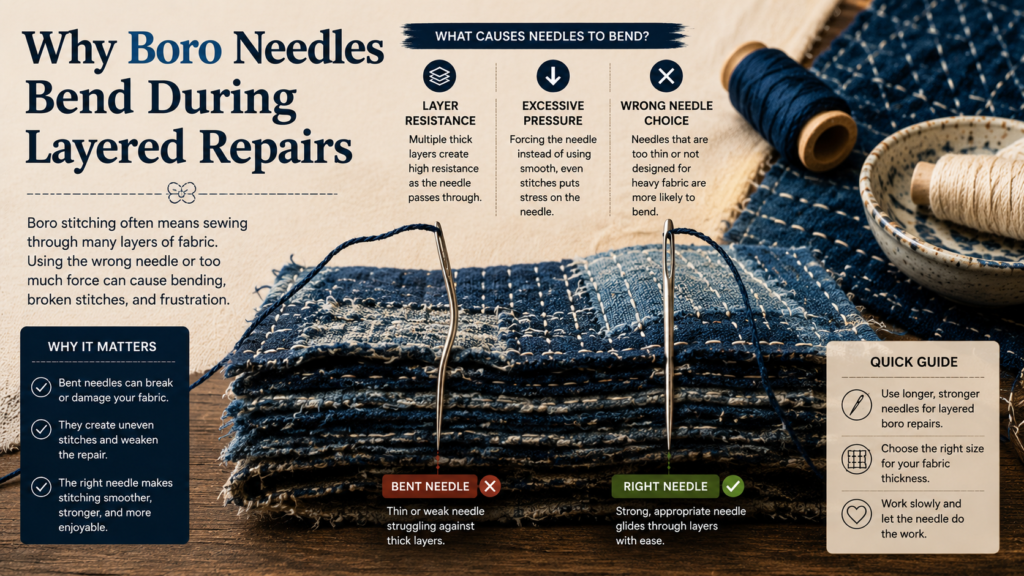
Boro needles usually bend because of uneven side pressure created while forcing the needle through dense layered fabric at an unstable angle. Thin needles become especially vulnerable during repairs involving raw denim, canvas, or stacked patchwork where fabric resistance increases significantly.
Traditional sashiko stitching works best when the needle moves smoothly in a straight running motion. Problems often begin when stitchers twist the needle sideways during pull-through or overload too many stitches onto the needle at once. This creates lateral torque that gradually weakens the steel structure.
Cheap low-quality needles bend faster because softer steel cannot maintain rigidity under repetitive pressure. Extremely thin needles may also flex excessively during large repair projects involving heavy fabric.
Common Causes of Needle Bending
- Forcing needles through dense dry denim
- Using overly thin needles
- Twisting the needle sideways
- Loading too many stitches at once
- Poor-quality soft steel construction
- Stitching at unstable angles
Experienced stitchers reduce bending by maintaining smooth forward motion rather than aggressive pulling. Strong medium-thickness sashiko needles usually perform best for large layered repairs because they balance penetration strength with flexibility.
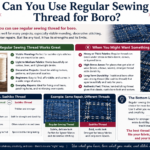
Can Regular Sewing Needles Work for Boro Stitching?
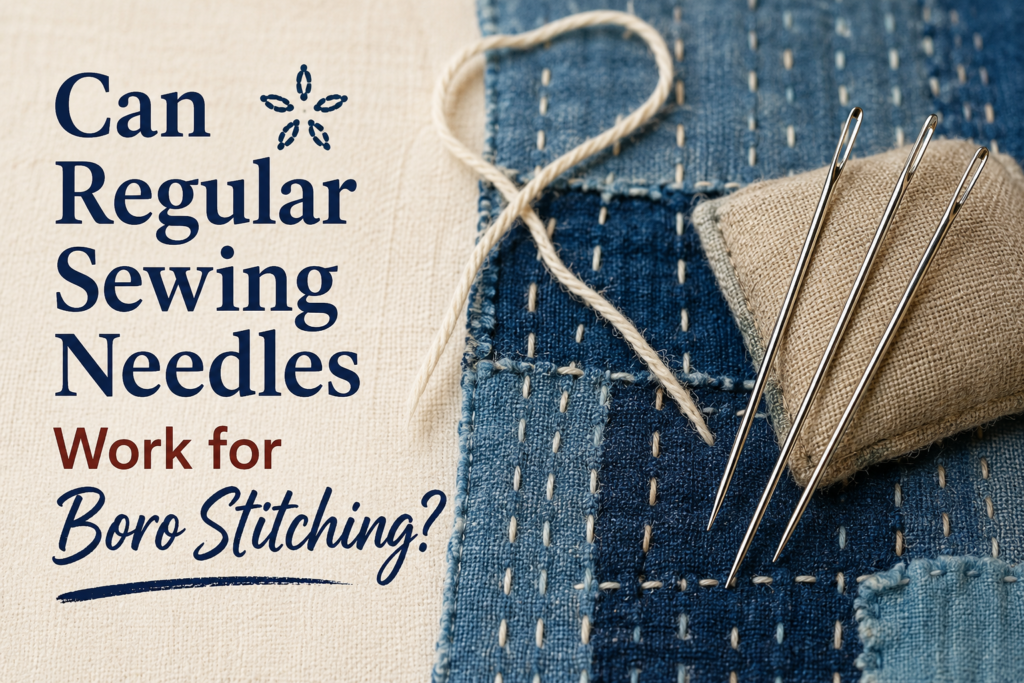
Regular sewing needles can work for boro stitching, but they are usually less efficient than traditional sashiko needles because they are designed for different stitching techniques. Standard sewing needles are typically shorter and optimized for individual stitch movement rather than continuous running-stitch loading.
Boro stitching depends heavily on rhythmic hand motion where several stitches are gathered onto the needle before pulling the thread through the fabric. Short sewing needles interrupt this process because they cannot hold enough fabric during each movement. This creates slower stitching speed and less consistent stitch spacing.
Regular sewing needles also tend to have smaller eyes designed for thinner thread. Thick sashiko thread may create friction inside narrow needle eyes, causing thread fraying Needle eye size directly affects thread friction during boro stitching. Thick cotton sashiko thread passing repeatedly through a small needle eye creates abrasion that gradually weakens the fibers. This becomes more noticeable during large repair projects involving rough layered denim or canvas.
Thread friction increases further when cotton thread absorbs humidity or expands slightly during long stitching sessions. Small needle eyes may also twist thread unnaturally during pull-through, leading to fraying and inconsistent tension.
during long repair sessions. This becomes more noticeable on layered denim repairs where thread resistance increases.
Despite these limitations, many beginners still start with embroidery or household sewing needles before investing in dedicated sashiko tools. This approach works reasonably well for learning basic stitch movement on lightweight fabric projects. Decorative visible mending also places fewer technical demands on the needle compared to authentic utility-style boro repairs.
However, stitch consistency usually improves noticeably after switching to proper sashiko needles. Longer needles reduce repetitive hand motion while improving the traditional visual rhythm associated with Japanese repair textiles.
Problems With Standard Sewing Needles
- Limited stitch-loading capacity
- Smaller thread eye
- Increased hand fatigue
- Slower repair speed
- Reduced stitch consistency
- Poor performance on layered fabric
Dedicated sashiko needles generally provide smoother stitching and better long-term comfort for large repair projects.
Refer to our comprehensive overview on if and why do you need special needles for boro stitching for a much better outllook and guidance.
Which Needle Brands Are Commonly Used for Boro Stitching?
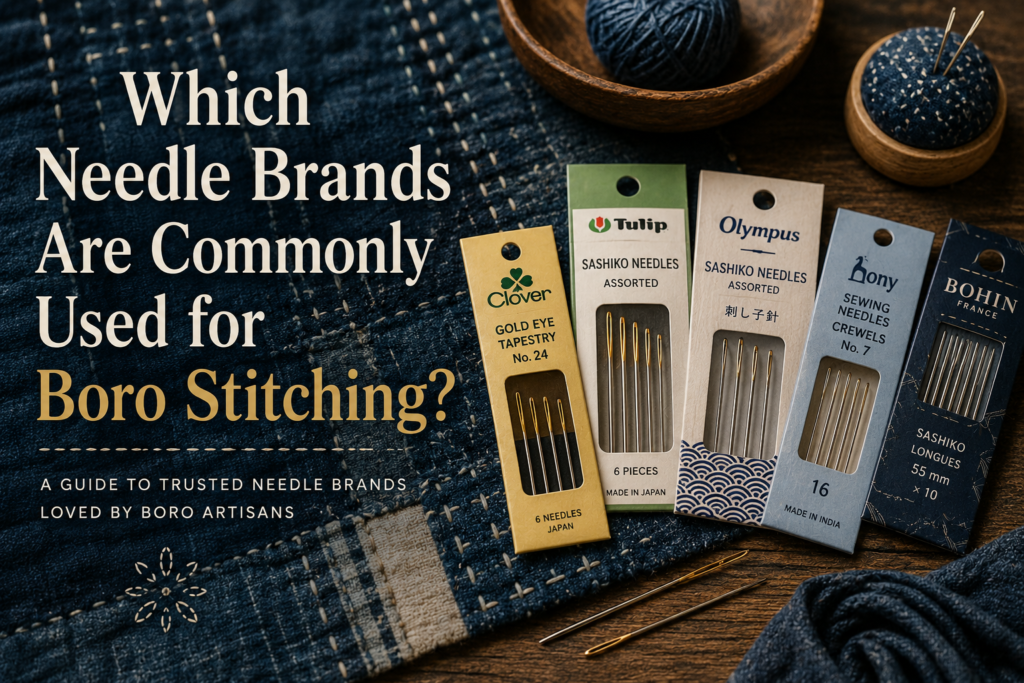
Several Japanese needle manufacturers are widely respected within the sashiko and boro community because their needles maintain smooth penetration, durable steel construction, and consistent sizing suitable for thick sashiko thread. High-quality needles often improve stitching comfort, reduce thread fraying, and prevent bending during layered fabric repairs.
Many experienced stitchers prefer Japanese-made sashiko needles because they are specifically engineered for long running-stitch movement rather than standard embroidery techniques. These needles usually feature polished surfaces that glide through dense fabric more smoothly while maintaining structural strength during repeated use.
Popular brands include Tulip, Olympus, and Clover. These companies produce needles in multiple lengths and thicknesses designed for different fabric densities and stitching styles.
Premium needles often feel noticeably smoother during long stitching sessions because the steel surface creates less friction against layered textiles. This becomes especially important when repairing old denim, work jackets, or heavily layered visible mending projects.
While inexpensive generic needles may still function adequately for casual decorative stitching, they often bend more easily or develop rough surfaces that fray thread over time. Long-term durability becomes important for people working on large traditional repair projects.
Features Found in High-Quality Sashiko Needles
- Polished steel surface
- Large thread eye
- Balanced flexibility
- Smooth penetration
- Strong resistance to bending
- Consistent manufacturing quality
Higher-quality tools generally create a more comfortable stitching experience while improving repair precision across dense layered fabrics.
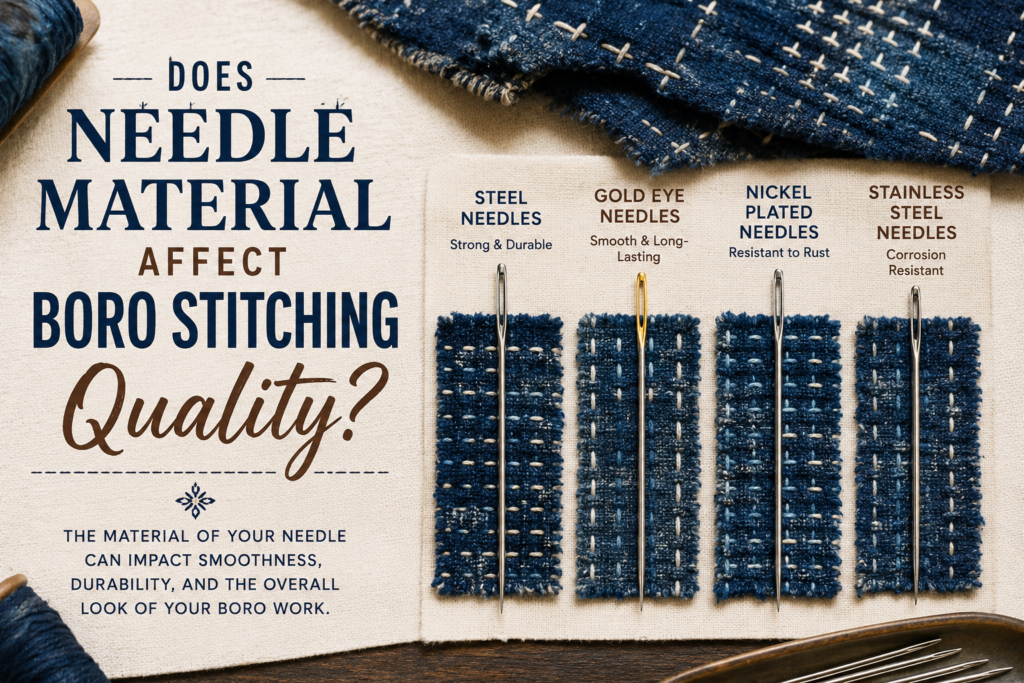
Does Needle Material Affect Boro Stitching Quality?
Needle material significantly affects how smoothly the needle moves through layered fabric and how long the tool maintains consistent performance during repetitive stitching. High-quality sashiko needles are usually made from polished steel that reduces friction while resisting bending during dense repairs.
Cheaper needles often develop rough microscopic surfaces that snag thread or create resistance during pull-through. This becomes especially noticeable on layered denim and heavily patched boro garments where fabric friction naturally increases.
Some premium needles use nickel-plated or specially polished steel surfaces designed to glide through fabric more efficiently. Reduced surface friction improves stitching rhythm while lowering thread abrasion during large projects.
Benefits of High-Quality Needle Materials
- Smoother fabric penetration
- Reduced thread fraying
- Better rust resistance
- Less surface drag
- Improved long-term durability
- Lower risk of fabric snagging
Humid environments may also affect needle longevity because untreated steel can develop oxidation over time. Proper storage helps preserve smooth stitching performance.
Best Needle and Thread Pairings for Boro Stitching
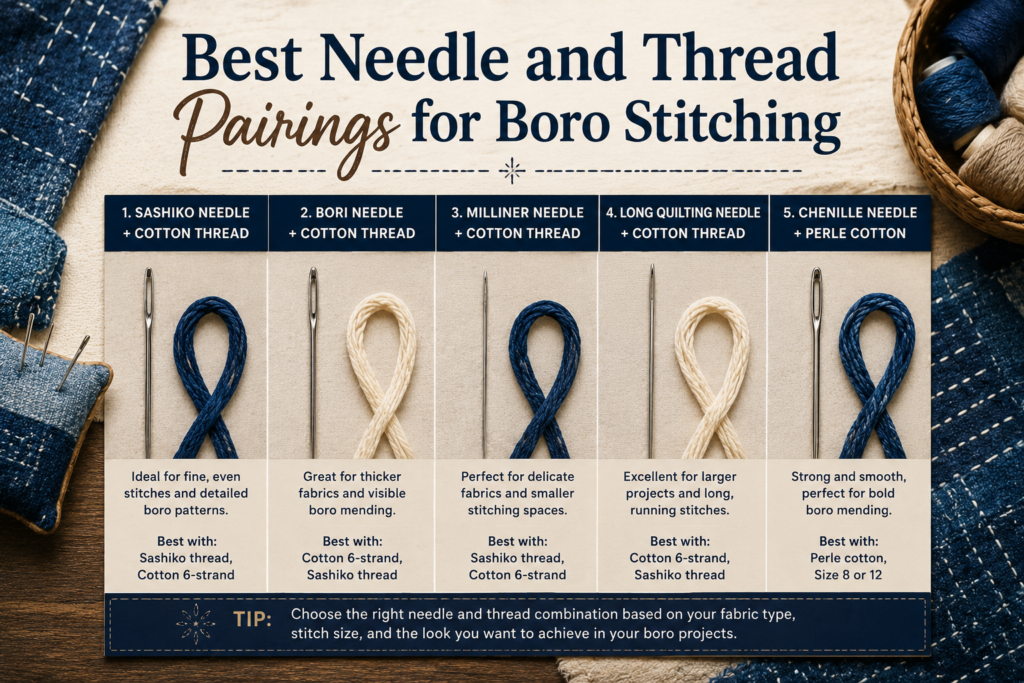
Different thread types perform better with specific needle sizes depending on fabric density and stitching style. Thick sashiko thread usually requires larger needle eyes and medium-thickness shafts to reduce friction during repetitive running stitches.
Decorative visible mending sometimes uses softer embroidery floss or pearl cotton that works comfortably with finer needles and tighter stitch spacing. Traditional utility boro repairs, however, generally favor stronger cotton sashiko thread paired with long medium-thickness needles.
| Thread Type | Recommended Needle |
| Fine sashiko thread | Fine-medium 48–51 mm needle |
| Standard sashiko thread | Medium 51–57 mm needle |
| Thick cotton repair thread | Medium-thick 57–65 mm needle |
| Pearl cotton | Fine decorative needle |
| Embroidery floss | Medium embroidery-compatible needle |
Balanced thread and needle combinations improve stitch consistency while reducing thread wear during large repair projects
Common Needle Mistakes That Affect Boro Stitching Quality
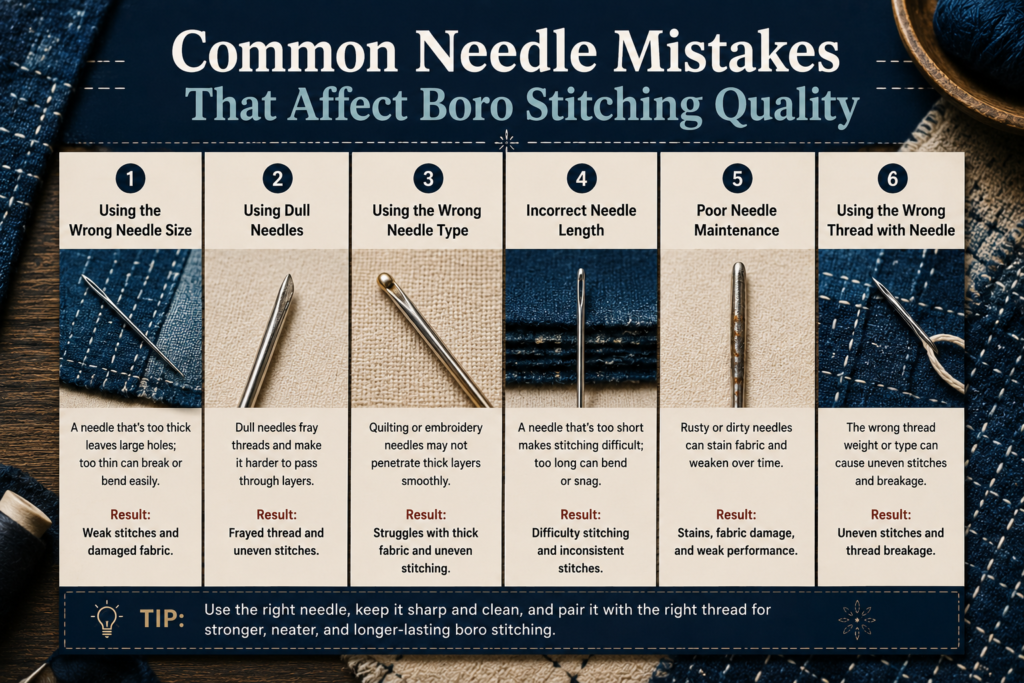
Many stitching problems in boro repair work are caused by improper needle selection rather than poor sewing skill. Using the wrong needle size can create uneven stitch spacing, fabric puckering, thread fraying, or excessive hand fatigue during long stitching sessions.
One of the most common mistakes is choosing needles that are too short for traditional running-stitch movement. Short needles force constant repositioning and interrupt stitching rhythm, making it difficult to maintain balanced stitch spacing across layered repairs. Another frequent problem involves using needles that are too thin for thick denim or multiple patch layers. Thin needles often bend under pressure, reducing stitching accuracy and increasing frustration.
Excessively thick needles can also create problems by enlarging stitch holes and weakening fragile vintage fabric. Older boro textiles frequently contain worn fibers that become vulnerable after years of use and washing. Oversized needles may damage these weakened fibers during repair work.
Needle eye size is another overlooked factor. Thick sashiko thread passing through small needle eyes creates friction that eventually frays the thread. This becomes particularly noticeable during large repair projects involving repeated stitching across rough fabric layers.
Many beginners also purchase extremely long needles before learning proper hand rhythm. Although traditional long needles improve efficiency, they require controlled movement that takes time to develop.
Common Needle Selection Mistakes
- Using short embroidery needles
- Choosing overly thin needles
- Using thick needles on fragile fabric
- Ignoring thread-eye compatibility
- Starting with extra-long needles too early
- Using rough low-quality steel needles
Correct needle selection improves both repair durability and the authentic visual texture associated with traditional Japanese boro stitching.
How Needle Length Affects Hand Fatigue
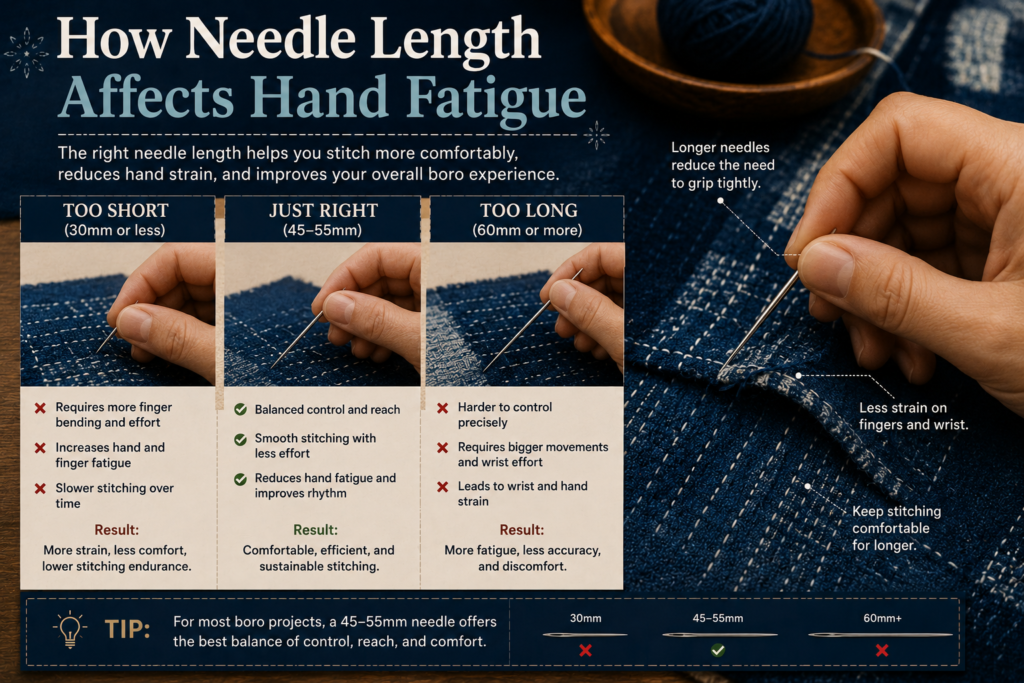
Needle length directly affects wrist movement, grip stability, and overall hand fatigue during long stitching sessions. Traditional long sashiko needles reduce repetitive hand motion because they allow multiple stitches to be gathered before pulling the thread through the fabric.
Short needles require constant repositioning after nearly every stitch, increasing finger strain during large repairs. This becomes especially noticeable on oversized denim jackets, blankets, or heavily layered boro projects that require several hours of stitching.
Many experienced stitchers notice smoother stitching rhythm and reduced wrist tension after transitioning from standard embroidery needles to longer sashiko needles. Proper rhythm allows the hand to move more naturally across the fabric instead of relying on repetitive stop-and-start motion.
Signs of Poor Ergonomic Needle Choice
- Wrist soreness
- Finger pressure discomfort
- Hand cramping
- Uneven stitch rhythm
- Faster fatigue during long sessions
Balanced needle sizing improves both stitching comfort and repair consistency over time.
How to Maintain Boro Stitching Needles
Proper needle maintenance helps preserve smooth stitching performance and prevents thread snagging during large repair projects. Over time, needles may develop microscopic roughness, oxidation, or slight bending that affects stitch consistency across layered fabric.
Many experienced stitchers store sashiko needles in dry fabric needle books or protective tubes to reduce humidity exposure. Polished steel needles generally remain smoother longer when cleaned occasionally after extended use on dense denim or dusty vintage textiles.
Basic Needle Maintenance Tips
- Store needles in dry containers
- Replace visibly bent needles
- Avoid excessive moisture exposure
- Clean lint buildup regularly
- Separate fine and heavy-duty needles
- Inspect rough needle eyes periodically
Well-maintained needles glide through fabric more consistently while reducing unnecessary thread abrasion during traditional boro stitching.
Decorative Visible Mending vs Traditional Utility Boro Needles
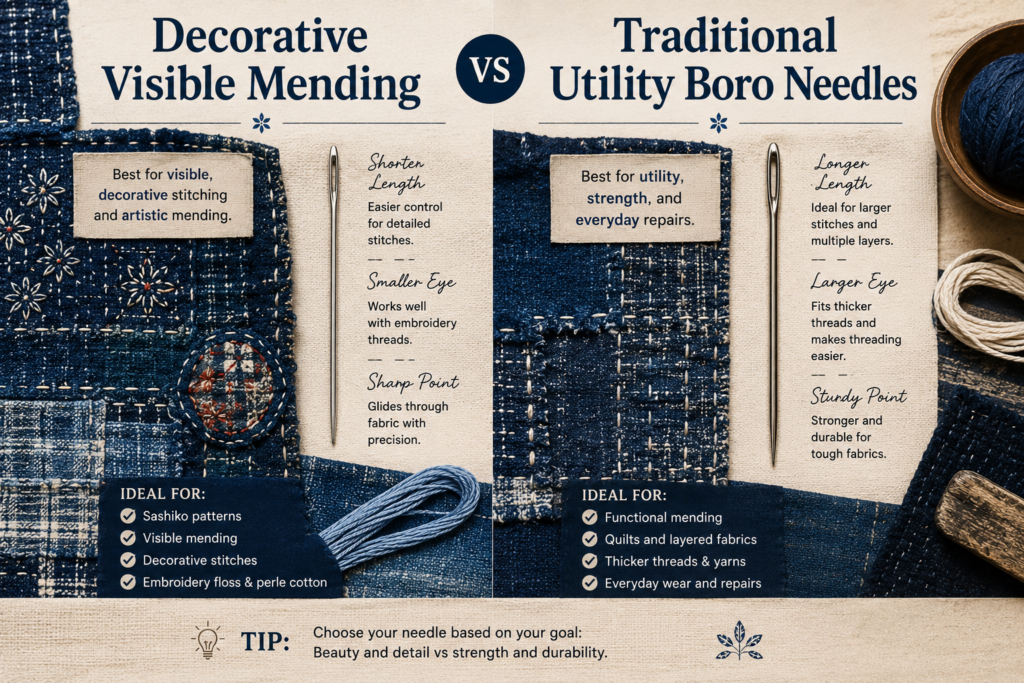
Modern visible mending and traditional utility boro often use different needle preferences because their goals differ significantly. Traditional boro developed primarily for garment preservation and durability, while decorative visible mending frequently prioritizes artistic texture and visual contrast.
Traditional utility repairs usually favor:
- long needles
- stronger thread
- larger stitch spacing
- efficient running-stitch rhythm
Decorative visible mending often uses:
- finer needles
- shorter stitch spacing
- decorative thread colors
- controlled surface texture
| Traditional Utility Boro | Decorative Visible Mending |
| Durability focused | Aesthetic focused |
| Long sashiko needles | Fine decorative needles |
| Fast repair rhythm | Detailed stitch control |
| Utility thread | Decorative embroidery thread |
This distinction explains why modern visible mending artists sometimes choose tools differently from traditional Japanese repair methods.
Final Thoughts on Choosing the Best Needle Size for Boro Stitching
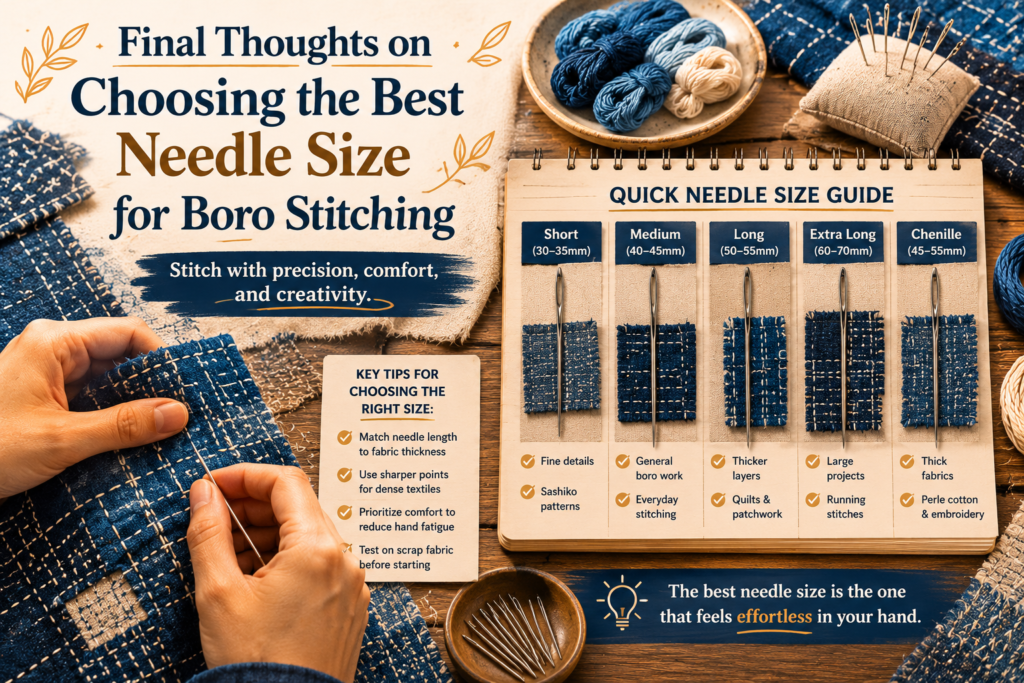
The best needle size for boro stitching usually falls between 48 mm and 65 mm depending on the fabric thickness, repair style, and stitching experience level. Traditional Japanese boro techniques strongly favor long sashiko needles because they improve running-stitch rhythm, reduce hand fatigue, and maintain more consistent stitch spacing across layered repairs.
Beginners often achieve the best results with medium-length needles around 48–51 mm because they balance traditional stitching efficiency with easier hand control. More experienced stitchers working on heavily layered denim repairs may prefer longer 57–65 mm needles that support faster continuous stitching movement.
Needle thickness matters just as much as needle length. Thin needles may bend under layered fabric pressure, while excessively thick needles can damage delicate vintage textiles. Medium-thickness sashiko needles generally provide the safest balance for most repair situations.
Thread compatibility should also influence needle selection. Larger needle eyes reduce friction when using thick sashiko thread and help prevent thread fraying during large projects. Investing in smooth high-quality needles often improves stitching comfort noticeably over time.
Traditional boro stitching developed as a practical repair method focused on durability, efficiency, and fabric preservation. Choosing the correct needle size supports all three goals while helping modern stitchers preserve the authentic visual rhythm associated with historical Japanese textile repair culture.
Best Overall Needle Recommendations
- Beginners → 48–51 mm sashiko needle
- General boro repairs → 51–57 mm needle
- Heavy layered denim → 57–65 mm needle
- Decorative visible mending → medium-length fine needle
The correct needle transforms both the comfort and quality of boro stitching projects.
FAQ Section
What is the best needle length for sashiko stitching?
Most sashiko and boro artists prefer needles between 48 mm and 65 mm because they support continuous running stitches across layered fabric.
Can I use embroidery needles for boro stitching?
Yes, but embroidery needles are usually shorter and less efficient for traditional running-stitch techniques.
Why are long needles used in boro stitching?
Long needles allow multiple stitches to be loaded at once, improving speed, rhythm, and stitch consistency.
What needle works best for thick denim repairs?
Medium-thick long sashiko needles work best for denim because they resist bending while penetrating layered fabric.
Are expensive sashiko needles worth it?
Higher-quality needles often reduce thread fraying, bending, and hand fatigue during large stitching projects.
What needle size is easiest for beginners?
Beginners usually adapt fastest to 48–51 mm needles because they balance control and traditional stitching efficiency.
Can sharp needles damage vintage fabric?
Yes. Extremely sharp needles may weaken fragile vintage fibers if excessive force is used.
Do thicker needles create bigger holes?
Yes. Very thick needles can enlarge stitch holes and affect delicate fabric durability.