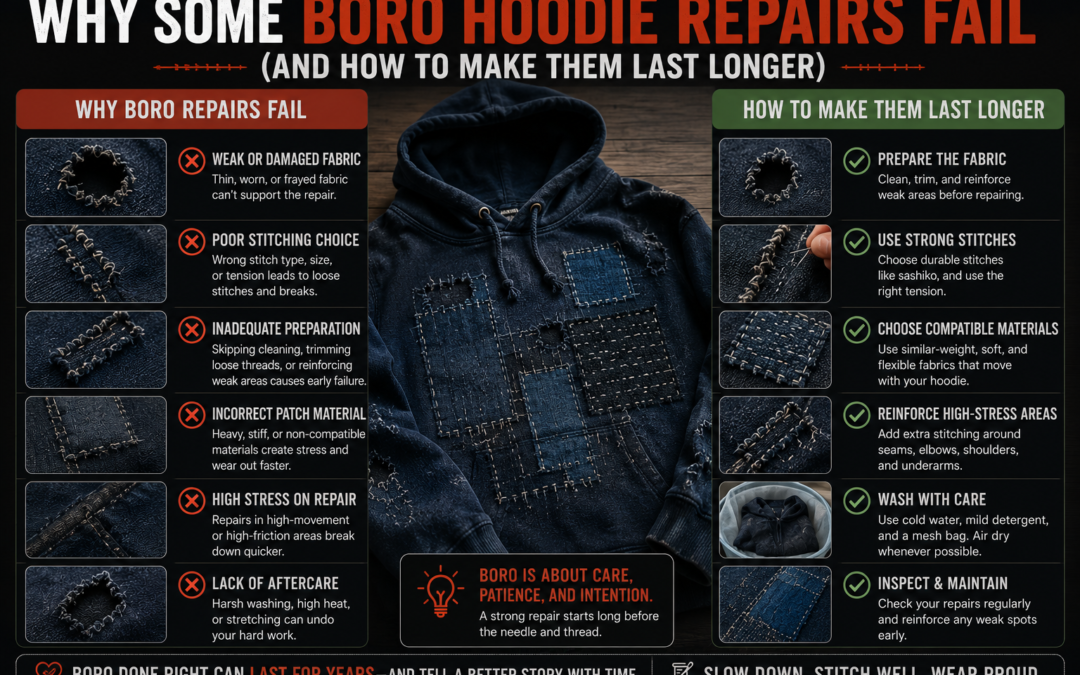
Traditional Boro Repair techniques can make hoodies look beautifully worn while extending their lifespan dramatically. However, not every repair survives long-term wear. Some patches loosen after only a few months, while others tear beside the repaired area or become stiff and uncomfortable. In most cases, repair failure happens because the original fabric is too weak, the stitching is too dense, or the patch material does not move naturally with the hoodie fabric. Modern hoodies are also very different from the durable woven workwear used in historical Japanese boro clothing. Stretchy knits, synthetic fleece, and lightweight fashion hoodies behave differently under stress.
Understanding why repairs fail is important because visible mending is not only decorative. A successful repair should strengthen the garment without creating new stress points. Traditional boro methods worked because they distributed tension gradually across the fabric rather than concentrating it in one small area. Modern repair mistakes often do the opposite.
This guide explains:
- Why some boro hoodie repairs fail
- Which fabrics are hardest to repair
- How stitch density affects durability
- Why elbows and pockets tear faster
- How washing damages repairs
- The best patch placement methods
- Ways to make visible mending last longer
Why Do Some Boro Hoodie Repairs Fail So Quickly?
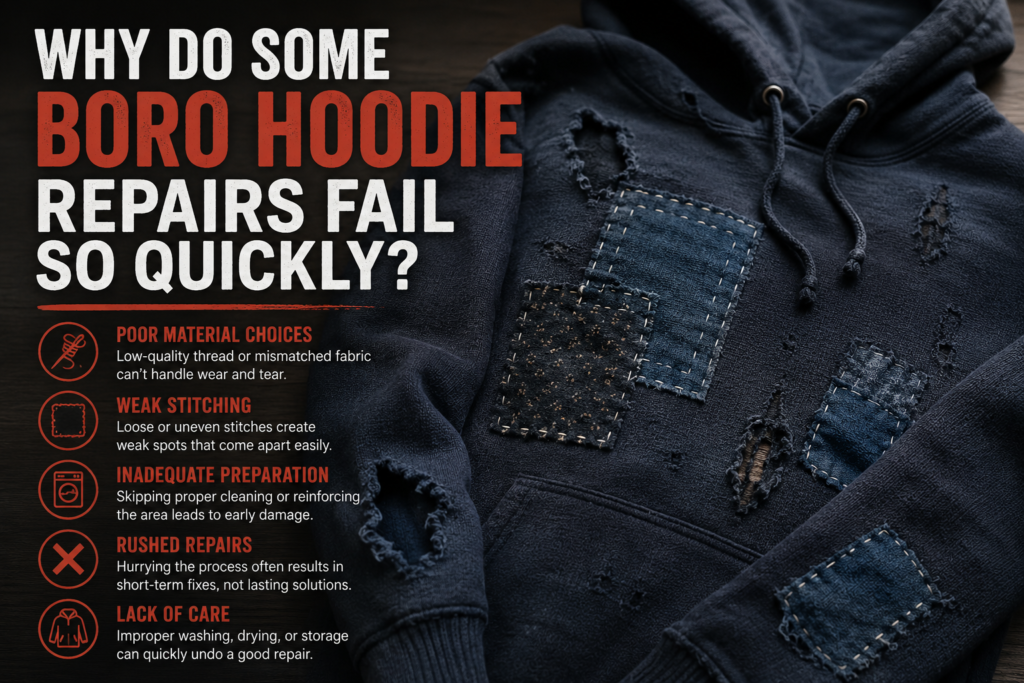
Many boro hoodie repairs fail because the fabric underneath the repair is already structurally weak before stitching begins. A patch can reinforce material, but it cannot completely restore fibers that have already broken down internally from wear, friction, and repeated washing. Hoodies experience constant movement stress in areas like elbows, cuffs, shoulders, and pocket openings. Over time, the knit structure becomes thinner and softer long before holes appear visibly on the surface.
One common mistake is repairing only the visible hole itself. Traditional boro repairs usually extend well beyond damaged areas so stress spreads across a larger section of fabric. When a repair is too small, the surrounding weakened fabric absorbs most of the movement force and tears beside the patch instead of through it. This creates the familiar “repair halo” where fresh damage forms around the edges.
Another issue is excessive stitch density. Many beginners assume tighter stitching equals stronger reinforcement, but hoodies are flexible knit garments. Dense stitching creates rigid zones that stop stretching naturally. Stress then concentrates at stitch edges during movement.
Poor patch material selection also contributes to failure. Heavy denim patches on lightweight fleece hoodies create imbalance between flexible and rigid fabrics. The repair survives while the hoodie fabric around it weakens rapidly.
Common Reasons Repairs Fail
- Fabric was already too thin
- Repair area was too small
- Stitch density became excessive
- Wrong patch material was used
- Stress zones were ignored
- Hoodie fabric stretched unevenly
- Washing and dryer heat weakened stitches
- Patch corners caught during wear
How Hoodie Fabric Weakens Before a Boro Repair Fails
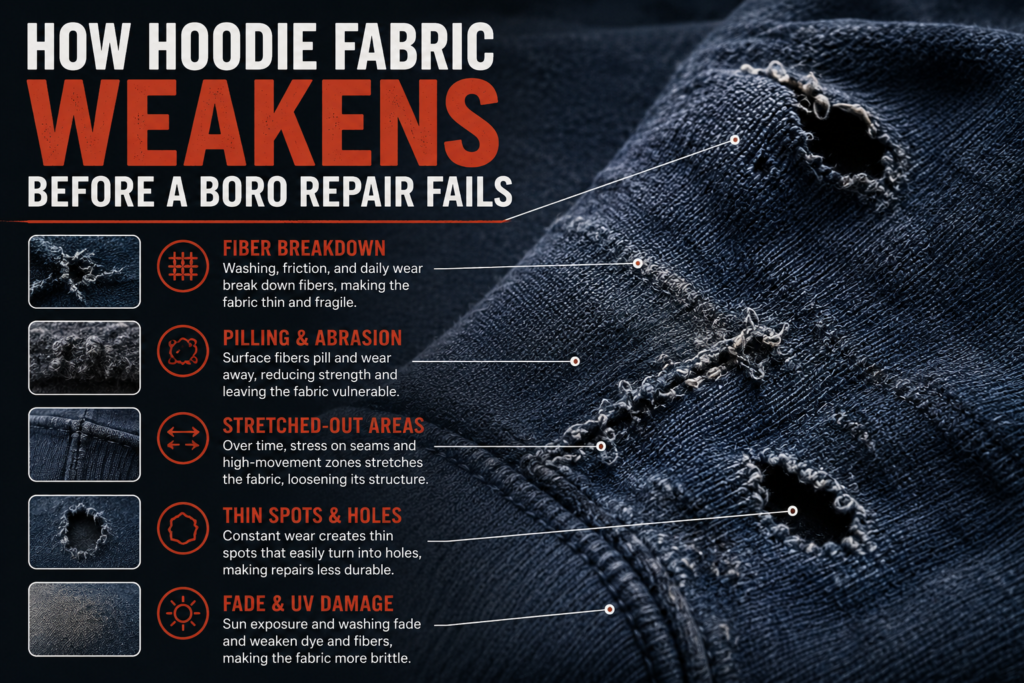
Most hoodie fabric does not fail suddenly. The weakening process usually begins months before visible holes appear. Repeated friction slowly compresses cotton fibers, especially around elbows, cuffs, and pocket openings. Over time, the knit structure loses elasticity and the fabric becomes thinner internally even if the outer surface still looks intact.
One early warning sign is “stress whitening,” where stretched hoodie areas appear lighter because fibers are separating under tension. Another common sign is surface fuzzing that feels unusually soft or flat compared to the surrounding fabric. This often means the internal fleece structure has started collapsing from abrasion.
As the hoodie continues aging, repeated washing weakens the knit loops further. The fabric begins losing recovery strength, meaning stretched areas no longer bounce back properly. Eventually, stitches from repairs start pulling against unstable fibers instead of healthy material.
This is why late-stage repairs often fail beside the patch rather than directly through it. The patch may remain strong while the surrounding hoodie fabric continues deteriorating.
Traditional boro repairs worked best because reinforcement usually began before catastrophic tearing occurred.
Signs Fabric Is Weakening Before Holes Form
- Thin shiny areas
- Stress whitening
- Flattened fleece texture
- Uneven softness
- Excessive stretching
- Surface fuzz buildup
- Distorted knit structure
Which Hoodie Fabrics Are Hardest to Repair With Boro?
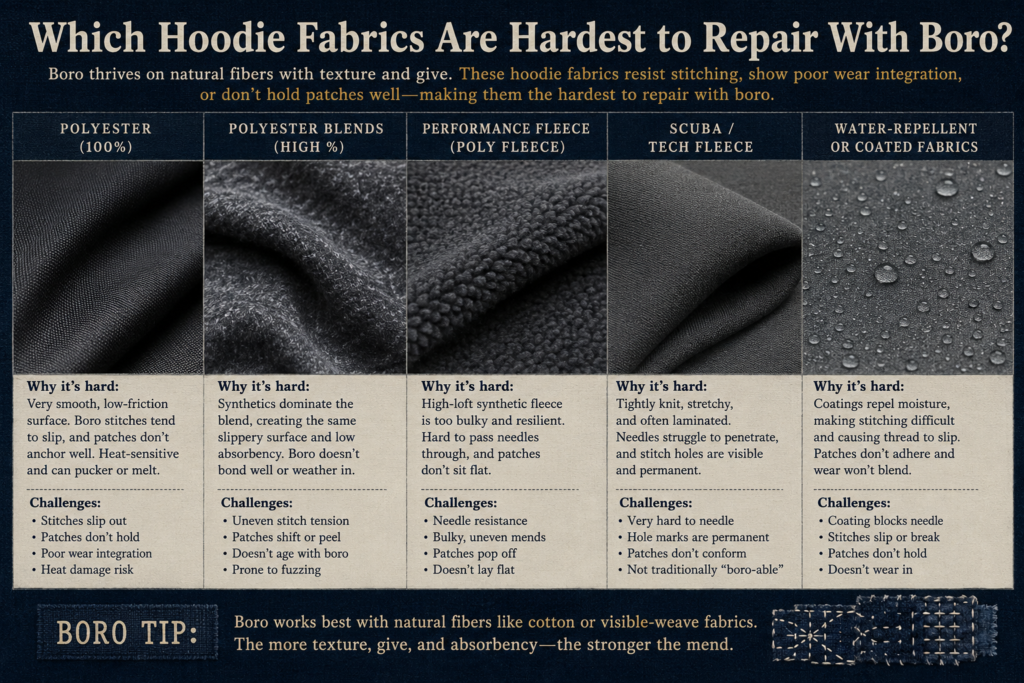
Not every hoodie fabric responds well to traditional visible mending techniques. Historical boro repairs were developed for tightly woven cotton workwear fabrics that had very little stretch. Modern hoodies are usually made from knit constructions like fleece or jersey, which behave differently under tension. These fabrics stretch, compress, and recover constantly during movement. That flexibility makes them comfortable, but also harder to repair permanently.
Lightweight fast-fashion hoodies are especially difficult because the fabric often contains blended synthetic fibers and loose knit structures. Thin polyester fleece can become weak internally while still looking visually intact on the surface. Once repairs are stitched onto fragile fleece, the fibers surrounding the patch may continue breaking down.
Highly elastic hoodies also create problems for sashiko stitching. If the fabric stretches significantly but the stitching does not, stress accumulates around needle holes. Eventually, the repair becomes rigid while the surrounding fabric remains flexible.
Heavyweight cotton hoodies are generally much more repair-friendly. Dense loopback fleece and French terry fabrics hold stitches better because their fibers distribute tension more evenly. Traditional-style layered patching also works better on thicker hoodies because the fabric can support additional stitch reinforcement without becoming overly stiff.
Natural cotton hoodies also age more attractively with visible mending. Indigo fading, patch wear, and thread softening tend to blend naturally over time.
Hard-to-Repair Hoodie Fabrics
- Thin polyester fleece
- Lightweight jersey hoodies
- Stretch-heavy synthetic blends
- Fast-fashion hoodies
- Ultra-soft brushed fleece
Better Fabrics for Boro Repairs
- Heavyweight cotton fleece
- French terry hoodies
- Loopback cotton knits
- Workwear hoodies
- Dense cotton-blend sweatshirts
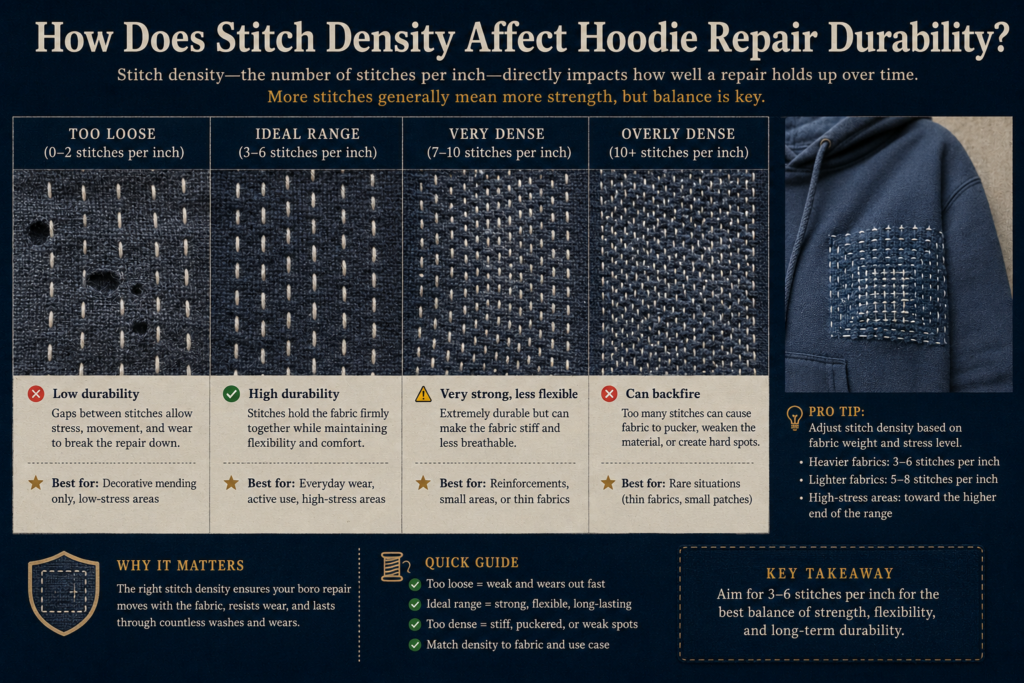
How Does Stitch Density Affect Hoodie Repair Durability?
Stitch density is one of the biggest factors determining whether a boro repair lasts or fails. Traditional sashiko stitching was designed to reinforce fabric while still allowing movement. Hoodies require flexibility because knit fabrics stretch naturally during wear. When stitching becomes too dense, the repaired section loses that flexibility and turns into a rigid panel.
This rigidity creates mechanical stress around the patch edges. Every time the hoodie bends, stretches, or twists, force transfers to the softer surrounding fabric instead of distributing evenly across the repair. Eventually, tearing begins beside the patch rather than through it.
Too many stitches can also weaken knit fabric directly. Each needle hole slightly interrupts fiber continuity. In woven cotton this effect is less severe, but in stretchy hoodie knits excessive stitching can act similarly to perforations in paper. Closely packed needle holes reduce the fabric’s ability to absorb movement stress.
Balanced stitching works better than overly decorative dense stitching. Traditional boro repairs often used wider running stitches with layered reinforcement beneath the surface instead of compact embroidery-style patterns.
Thread thickness also matters. Heavy thread on thin hoodie fabric can create stiffness and tension imbalance. Moderate stitch spacing combined with supportive internal patching usually produces stronger long-term results.
Signs Stitch Density Is Too High
- Fabric puckering
- Repair stiffness
- Cracking beside stitches
- Reduced stretch
- Distorted hoodie shape
- Tension lines around patches
Better Stitching Practices
- Use moderate stitch spacing
- Allow some fabric flexibility
- Extend stitches beyond damage
- Layer patches instead of over-stitching
- Use softer sashiko thread on lightweight fabrics
- How Long Different Boro Hoodie Repairs Usually Last
- Not all hoodie repairs age at the same speed. Repair lifespan depends on fabric thickness, washing frequency, stitch density, and stress exposure. Lightweight fleece hoodies usually wear out faster because the knit structure cannot support reinforcement for long periods under constant movement.
- Preventive repairs generally last longer than reactive repairs because the original fabric still retains much of its structural strength. Heavyweight cotton hoodies also tend to hold layered sashiko stitching more effectively than thin synthetic blends.
- Dense decorative stitching may initially look durable, but overly rigid repairs often fail earlier because they reduce fabric flexibility. Balanced layered reinforcement usually survives much longer during daily wear.
- The table below shows approximate lifespan expectations for different repair approaches under normal weekly hoodie use.
| Repair Type | Typical Lifespan |
| Thin fleece single patch | 2–6 months |
| Lightweight jersey repair | 3–8 months |
| Heavyweight cotton layered repair | 1–3 years |
| Preventive elbow reinforcement | 1–2 years |
| Dense overstitching on fleece | Early stiffness failure |
| Rounded layered patch repair | Longer-term durability |
| Pocket corner reinforcement | Moderate lifespan |
| Underarm repair | Shorter lifespan due to moisture and friction |
- Repair longevity also depends heavily on washing habits. Gentle washing and air drying can significantly extend visible mending lifespan
Why Do Hoodie Elbows and Pockets Fail Faster Than Other Areas?
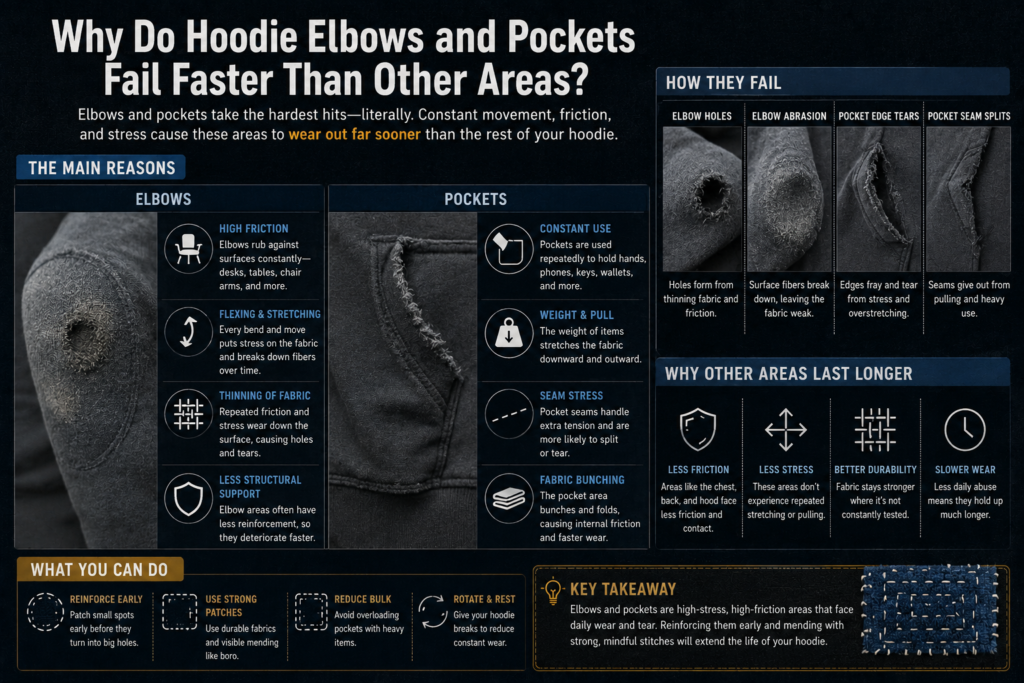
Certain hoodie sections fail much faster because they experience concentrated mechanical stress every day. Elbows repeatedly bend and compress whenever the arms move. Pocket corners stretch outward constantly when hands enter pockets or objects are carried inside. Cuffs rub against desks, tables, and other surfaces during daily wear. These repeated movements slowly weaken fibers even before visible holes appear.
Traditional Japanese workwear garments often showed multiple overlapping patches around elbows because these zones naturally wore out faster than flat body panels. Modern hoodies behave similarly, but stretchy knit fabrics make stress concentration even more severe.
Pocket corners are especially difficult because force gathers into small points. When a repair covers only the torn section without extending outward, the surrounding fabric continues absorbing strain. This often causes fresh tearing immediately beside the patch.
Underarm areas also experience unique stress because they combine friction, moisture, and stretching simultaneously. Sweat weakens fibers gradually, while arm movement repeatedly flexes the fabric.
Rounded patch shapes usually survive longer in high-stress areas because they distribute tension smoothly. Square patches with sharp corners create concentrated pull points that catch during movement and washing.
Preventive reinforcement is far more effective than reactive repair in these areas. Reinforcing thinning elbows before holes form allows the original fabric structure to remain partially intact.
Highest-Stress Hoodie Areas
- Elbows
- Pocket corners
- Cuffs
- Underarms
- Hem edges
- Shoulder seams
Why Rounded Patches Work Better
- Reduced edge tension
- Less corner catching
- Smoother movement distribution
- Better flexibility
Why Rounded Boro Patches Usually Last Longer Than Square Ones
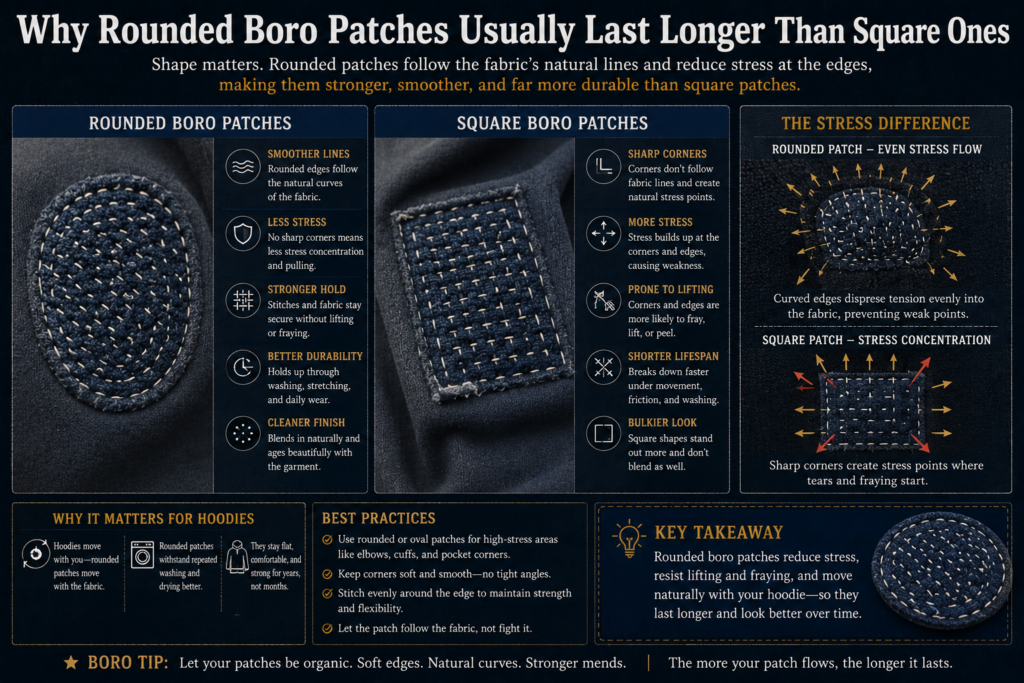
Patch shape affects repair durability more than many beginners realize. Rounded boro patches usually survive longer because they distribute tension smoothly across the fabric instead of concentrating force into sharp corners.
Square patches create four directional stress points where movement pressure gathers repeatedly during bending and washing. Over time, those corners become vulnerable to lifting, catching, and tearing. Rounded edges reduce this concentration and allow hoodie fabric to flex more naturally.
This matters especially on stretchy knit garments like hoodies because the fabric constantly shifts during movement. Sharp patch geometry interrupts that movement flow and creates rigid transition zones between repaired and unrepaired fabric.
Rounded patches also snag less during washing. Sharp corners are more likely to curl upward, increasing friction against other garments inside the machine.
Traditional Japanese boro garments frequently used organically shaped layered patches for exactly this reason. The goal was long-term stress distribution rather than perfectly geometric repair aesthetics.
Why Rounded Patches Perform Better
- Reduced corner stress
- Smoother tension flow
- Less snagging during washing
- Better movement flexibility
- Lower edge lifting risk
Why Square Patches Fail Faster
- Concentrated corner tension
- Increased snagging
- Rigid movement transitions
- Higher edge friction
How Washing and Drying Damage Boro Hoodie Repairs
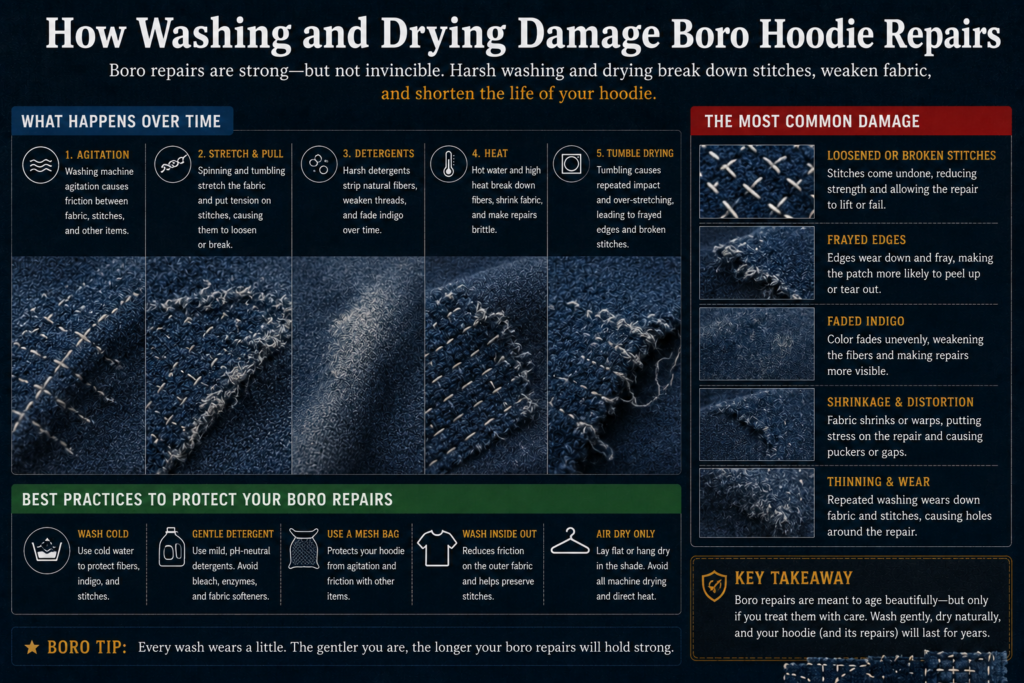
Even strong repairs can fail prematurely if hoodies are washed aggressively. Water dramatically increases garment weight during washing cycles. Heavy wet fabric pulls repeatedly against stitches and patch edges while spinning inside the machine. Over time, this mechanical stress loosens thread tension and weakens surrounding fibers.
Heat is another major problem. Cotton hoodie fabrics and patch materials may shrink at different rates during high-temperature drying. When patch shrinkage differs from the hoodie itself, tension forms around repair edges. This causes puckering, distortion, and eventual tearing.
Dryer heat can also weaken natural cotton sashiko thread gradually. While cotton thread ages beautifully, excessive heat accelerates fiber breakdown and fuzzing. Some mild fuzzing is normal in traditional boro repairs, but harsh drying speeds up deterioration unnecessarily.
Frequent washing also wears down the original hoodie fabric. Even if the repair remains strong, surrounding material may continue weakening from detergent abrasion and friction.
Gentle washing significantly extends repair lifespan. Turning hoodies inside out protects stitches from direct rubbing against other garments. Air drying helps maintain both patch flexibility and thread integrity.
Traditional boro garments were often washed less aggressively and repaired repeatedly over time instead of relying on one permanent reinforcement.
Washing Mistakes That Damage Repairs
- High heat drying
- Overwashing
- Heavy spin cycles
- Harsh detergents
- Washing with rough garments
- Twisting wet fabric
Better Care Practices
- Wash cold
- Use gentle cycles
- Turn inside out
- Air dry whenever possible
- Wash only when necessary
- Avoid overloading machines
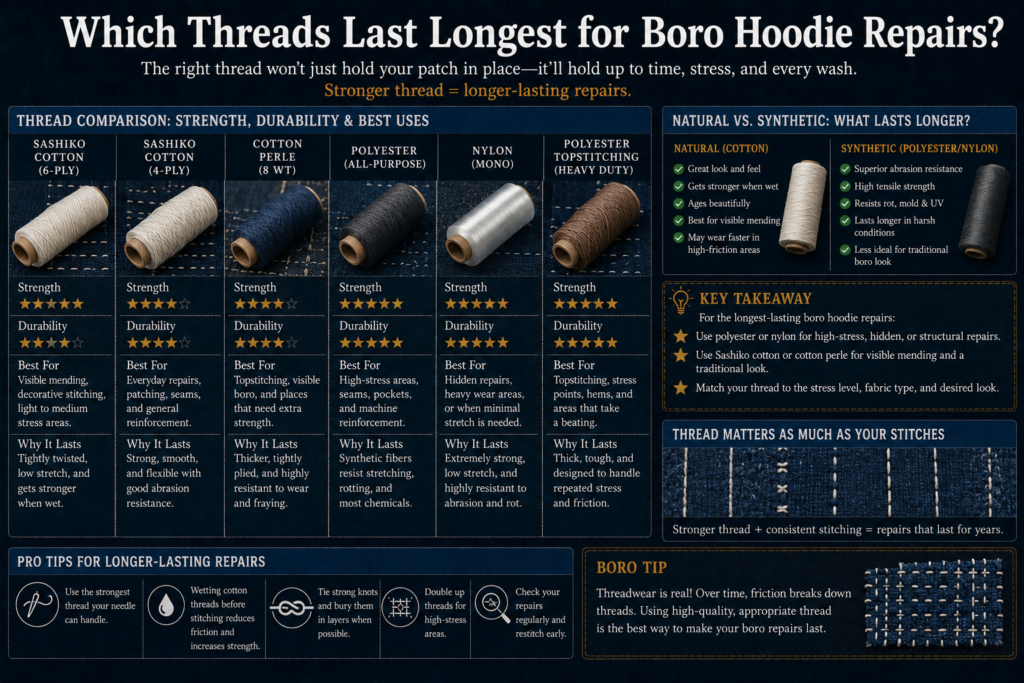
Which Threads Last Longest for Boro Hoodie Repairs?
Thread selection affects both durability and aging appearance. Traditional sashiko repairs often used cotton thread because it softened naturally over time and blended beautifully with worn fabric. Modern repairers sometimes prefer polyester for strength, but synthetic thread behaves differently during aging and washing.
Cotton sashiko thread remains popular because it flexes well with hoodie fabrics and develops attractive fuzzing as the repair ages. However, it may wear faster under heavy abrasion than polyester.
Polyester thread is stronger and more resistant to moisture, but it can sometimes feel too rigid on lightweight knit hoodies. The contrast between stiff synthetic thread and soft fleece fabric may create tension imbalance over time.
Linen thread offers a textured middle ground with moderate durability and a more traditional handmade appearance.
The best choice depends on the hoodie fabric, repair location, and desired aging style.
| Thread Type | Strength | Flexibility | Aging Appearance |
| Cotton sashiko | Medium | High | Soft natural fading |
| Polyester | High | Lower | Cleaner modern look |
| Linen | Medium | Moderate | Rustic texture |
| Embroidery thread | Lower | Moderate | Decorative focus |
Good Thread Characteristics
- Moderate flexibility
- Balanced tension
- Soft aging behavior
- Consistent stitch thickness
- Wash durability
Are Internal or External Hoodie Patches Stronger?
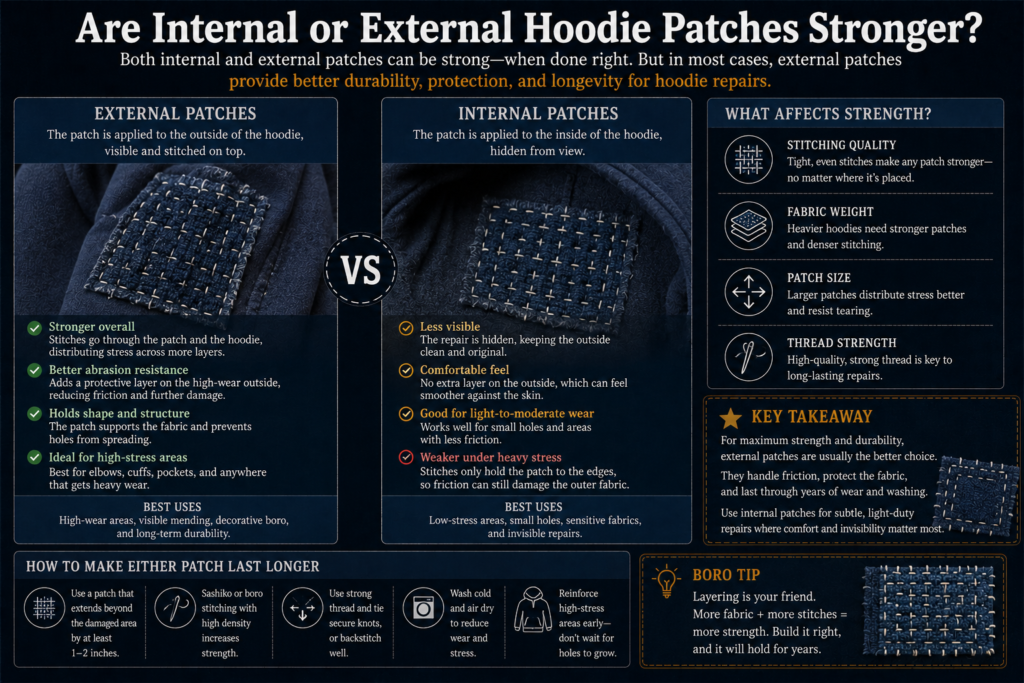
The strongest boro hoodie repairs usually combine both internal and external reinforcement rather than relying on only one patch layer. Internal patches stabilize weakened fabric from underneath, while external patches protect the surface from future abrasion. Together, they distribute tension more evenly across damaged areas.
External-only patches often fail because the original hoodie fabric underneath continues weakening. Even if the patch remains intact, the surrounding material may tear beside the stitches. Internal support helps prevent this by reinforcing the hoodie’s structural base before stress reaches the surface.
Internal patches are also more comfortable because they preserve smoother outer flexibility. However, they alone may not resist external abrasion well enough in high-wear zones like elbows or cuffs. That is why layered repairs usually last longer.
Patch shape matters as well. Rounded and oval patches move more naturally with hoodie fabric. Square corners create hard tension points that catch during wear and washing.
Fabric compatibility is equally important. Heavy canvas patches on lightweight jersey hoodies may create imbalance between stiff and soft materials. Ideally, patch flexibility should resemble the original hoodie fabric closely enough to move together naturally.
Traditional boro garments often used repeated layering because repairs were considered ongoing maintenance rather than one-time fixes.
Advantages of Internal Patches
- Better structural support
- Smoother flexibility
- Reduced edge catching
- Lower visible bulk
Advantages of External Patches
- Abrasion resistance
- Decorative visible mending
- Reinforced surface protection
- Easier future maintenance
Strongest Repair Structure
- Internal stabilizing layer
- External reinforcement patch
- Moderate sashiko stitching
- Rounded patch geometry
- Stress distribution beyond damaged area
What Bad Boro Hoodie Repairs Usually Look Like
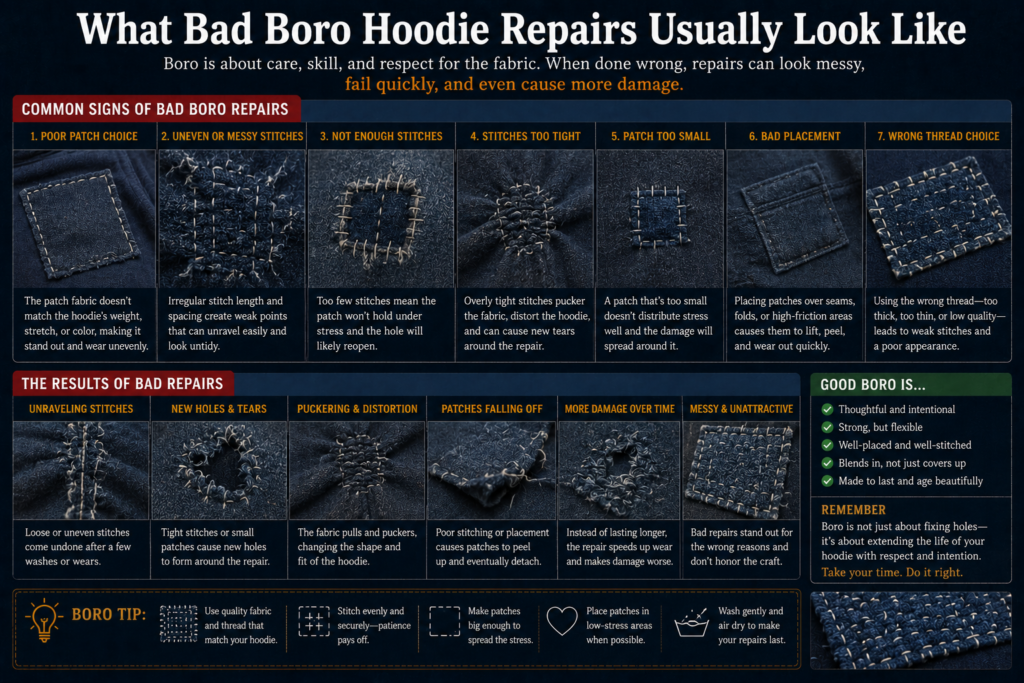
Failed hoodie repairs often show recognizable warning patterns before completely breaking down. One of the most common problems is excessive stiffness caused by dense stitching or overly rigid patch materials. When repaired sections stop flexing naturally with the hoodie fabric, stress transfers outward into weaker surrounding areas.
Another common issue is puckering. This happens when stitch tension pulls fabric unevenly, creating ripples around the repair. Puckering may look minor at first, but it usually signals imbalance between the patch and the hoodie’s natural stretch behavior.
Square patch corners also fail frequently because sharp edges concentrate movement stress into small points. Rounded patches generally survive longer because force distributes more evenly during bending and washing.
Poor repairs may also show distorted seam lines, uneven thread spacing, or raised ridges that catch against surfaces during wear.
Recognizing these warning signs early helps prevent larger structural failures later.
Common Signs of a Weak Repair
- Overly stiff fabric
- Sharp patch corners
- Dense overstitching
- Heavy puckering
- Raised patch ridges
- Uneven stitch spacing
- Distorted hoodie seams
- New tearing beside repair
Signs of a Healthy Repair
- Flexible movement
- Balanced stitch spacing
- Smooth tension distribution
- Gradual wear blending
- Softened patch edges
When a Hoodie Is Too Damaged for Boro Repair
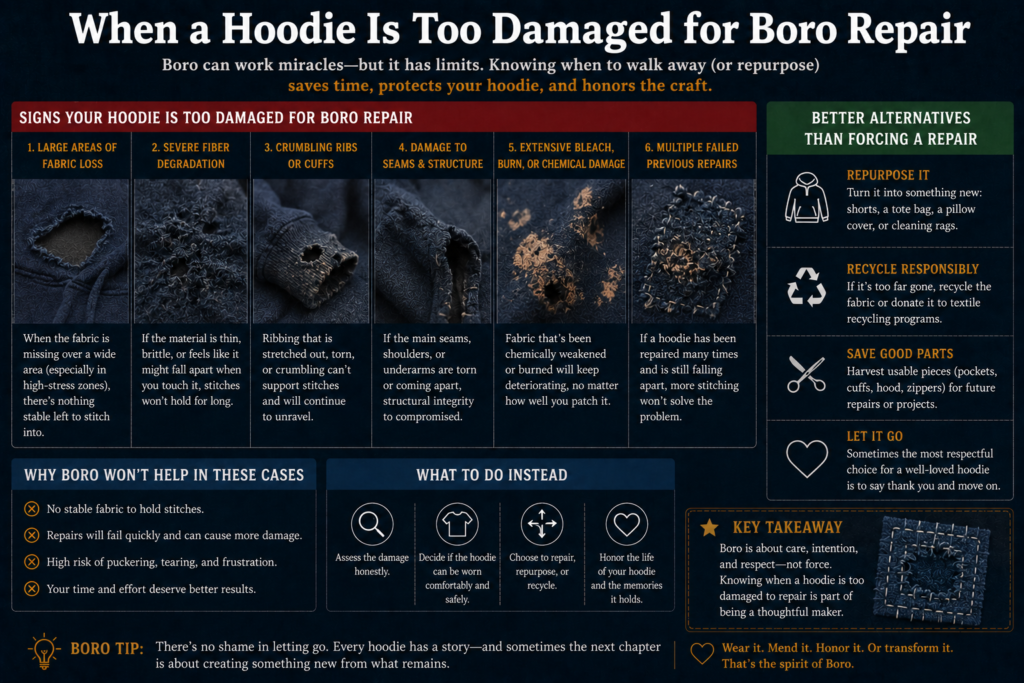
Not every hoodie can be saved successfully with visible mending. Some garments reach a point where the surrounding fabric has weakened too extensively to support additional stitching or reinforcement. In these situations, repairs may continue failing no matter how carefully patches are applied.
One major warning sign is widespread fabric transparency. If large sections of the hoodie become thin enough to let light pass through easily, the knit structure may already be collapsing internally. Excessive stretching, seam distortion, and dry brittle texture are also signs of advanced fabric fatigue.
Synthetic-heavy hoodies sometimes degrade differently than natural cotton garments. Polyester fleece can lose internal structural integrity while still appearing visually intact. Once fibers stop holding stitch tension properly, patches may begin tearing away repeatedly.
Seam collapse is another serious issue. If shoulder seams, underarms, or side seams have already weakened significantly, isolated patch repairs may not restore overall garment stability.
In some cases, sections of fabric can still be reused creatively for smaller boro projects even if the hoodie itself is no longer wearable.
Signs a Hoodie May Be Beyond Repair
- Widespread thinning
- Fabric transparency
- Brittle texture
- Multiple seam failures
- Extreme stretching distortion
- Repeated patch failure
- Excessive synthetic breakdown
Better Candidates for Continued Repair
- Localized damage
- Strong surrounding fabric
- Heavyweight cotton
- Stable seam structure
- Moderate wear zones
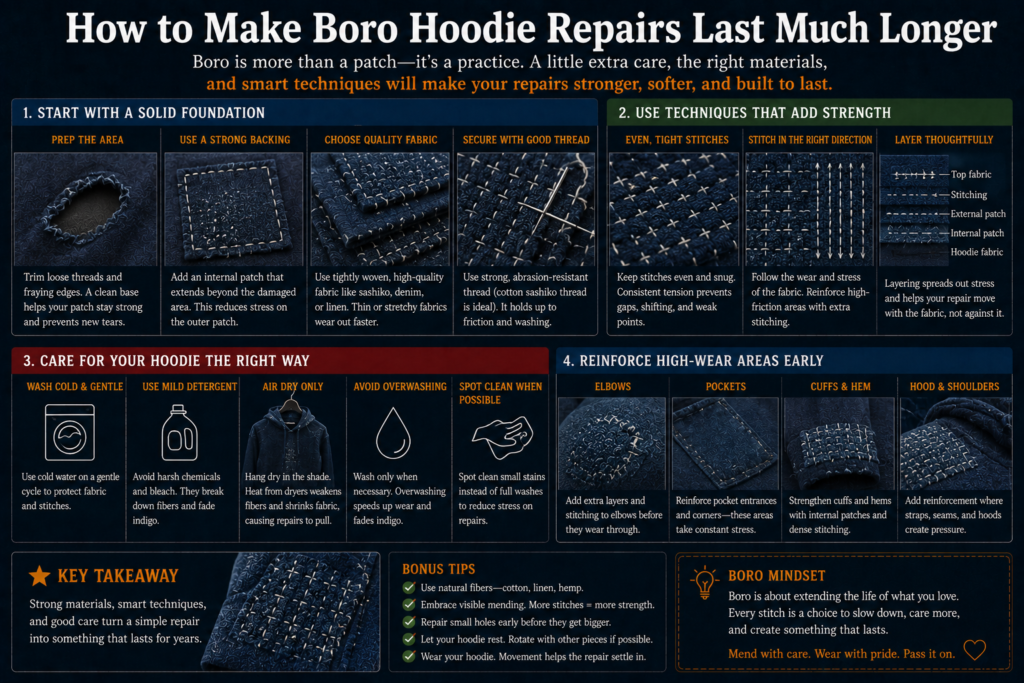
How to Make Boro Hoodie Repairs Last Much Longer
Long-lasting boro repairs depend more on prevention and balance than aggressive reinforcement. The goal is not to create the strongest possible patch in isolation. Instead, the repair should work together with the hoodie fabric so movement stress spreads naturally across the garment.
The best repairs begin before catastrophic holes appear. Thin elbows, faded pocket edges, and weakened cuffs can often be stabilized early with light reinforcement stitching and soft internal patching. Once large tears form, the surrounding fibers are usually already compromised.
Patch material selection matters enormously. Midweight woven cotton usually performs better than rigid denim on hoodies because it flexes more naturally with knit fabrics. Stitch density should remain moderate, especially on lightweight fleece.
Routine inspection also helps. Small thread loosening or patch edge lifting can often be corrected early before larger failures develop. Traditional boro garments survived for years because they received repeated maintenance instead of one permanent repair attempt.
Visible mending works best when approached as continuous garment care rather than a final solution.
Best Practices for Durable Repairs
- Reinforce thinning areas early
- Use rounded patches
- Match patch flexibility to hoodie fabric
- Avoid overly dense stitching
- Layer internal and external support
- Wash gently
- Air dry when possible
- Extend repairs beyond visible damage
- Use quality cotton sashiko thread
- Inspect repairs regularly
Signs a Repair Is Aging Naturally
- Soft thread fuzzing
- Gentle fading
- Flexible patch edges
- Even wear distribution
- Gradual texture blending
How Boro Hoodie Repairs Usually Change Over Time
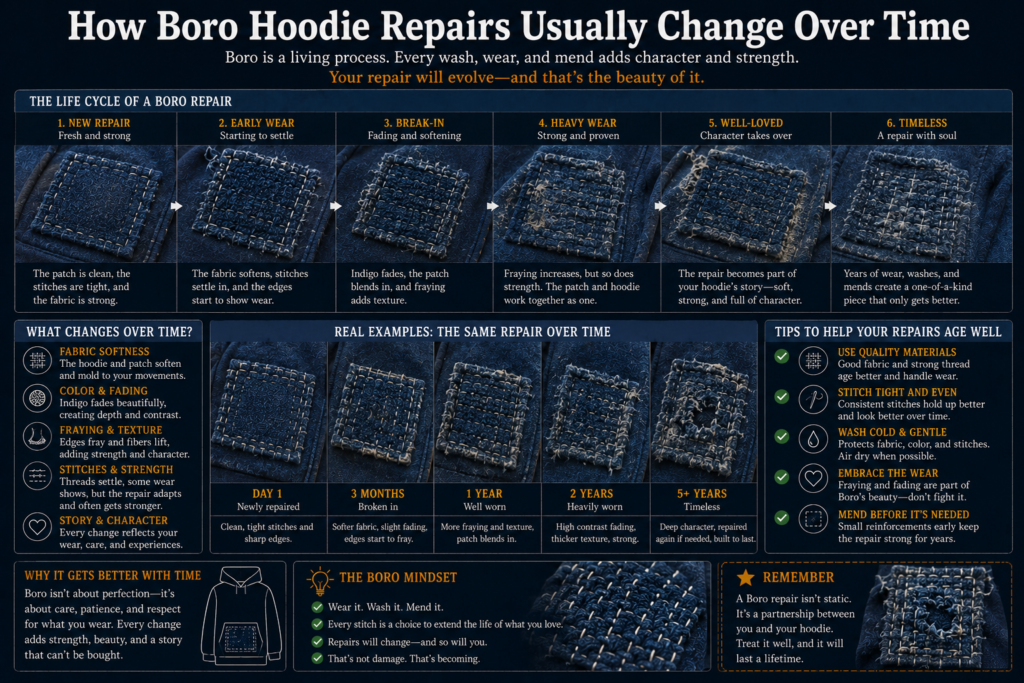
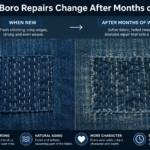
Boro repairs rarely stay visually identical after months of wear. As the hoodie ages, the patch, thread, and surrounding fabric gradually soften together. This natural aging process is one reason visible mending develops character over time rather than looking factory-made.
During the first few weeks, stitches usually settle into the fabric and become slightly flatter. After several months, cotton sashiko thread may begin developing mild fuzzing from abrasion and washing. Indigo-dyed patches often fade unevenly, especially around raised stitch areas.
Well-balanced repairs usually become softer and more integrated with the hoodie over time. Poorly balanced repairs often become increasingly stiff or begin separating around the edges.
The aging process varies depending on washing habits, wear frequency, hoodie fabric type, and thread material.
| Time Period | Typical Changes |
| First month | Stitch settling |
| 3 months | Mild thread fuzzing |
| 6 months | Patch softening |
| 1 year | Visible fading and blending |
| Long-term wear | Natural texture integration |
Signs a Repair Is Aging Well
- Even fading
- Softening fabric
- Flexible movement
- Stable stitch tension
- Gradual blending
Signs a Repair Is Failing
- Edge separation
- New tearing
- Excessive stiffness
- Distorted fabric
FAQ Section
Why do boro hoodie repairs tear beside the patch?
Because surrounding fabric is often weaker than the repair itself, causing stress to shift outward.
Are hoodies harder to repair than denim?
Yes. Hoodies stretch more than woven denim, creating tension problems around stitches.
Can sashiko stitching damage knit fabrics?
Excessively dense stitching can weaken stretchy hoodie material over time.
Which hoodie areas wear out fastest?
Elbows, cuffs, pocket corners, and underarms usually fail first.
Is preventive visible mending worth doing?
Yes. Reinforcing weak fabric early dramatically improves repair lifespan.
Should hoodie patches go inside or outside?
Using both together usually creates the strongest repair.
Why do hoodie repairs become stiff?
Heavy patch materials and excessive stitching reduce flexibility.
Does washing shorten repair lifespan?
Aggressive washing and high dryer heat can weaken both thread and fabric.