Boro stitching and sashiko are deeply connected in Japanese textile history, but they are not exactly the same thing. Many beginners assume they must first master traditional sashiko stitching before attempting boro repairs, yet that belief is not entirely accurate. Historically, boro focused more on extending fabric life through layered repairs, while sashiko served as one practical stitching method used to hold those layers together. Modern visible mending culture has expanded these possibilities even further. This guide is a complete analysis of whether: “Can You Do Boro Stitching Without Sashiko?” or not, with its replacements as per the situation arises.
Today, many artists, denim repair specialists, and textile hobbyists create beautiful boro-inspired repairs using simple running stitches, embroidery thread, machine stitching, and freeform visible mending instead of strict traditional sashiko patterns. This flexibility makes boro much more approachable for beginners who want to start repairing clothing immediately without worrying about perfect geometric stitching.
Key Takeaways
- Boro and sashiko are related but not identical
- Sashiko is a stitching method, while boro is a repair philosophy
- Beginners can absolutely start boro without mastering sashiko
- Modern visible mending overlaps heavily with boro techniques
- Durability depends more on repair structure than decorative perfection
- Machine stitching can also work in modern boro-inspired repairs
What Is the Difference Between Boro and Sashiko?
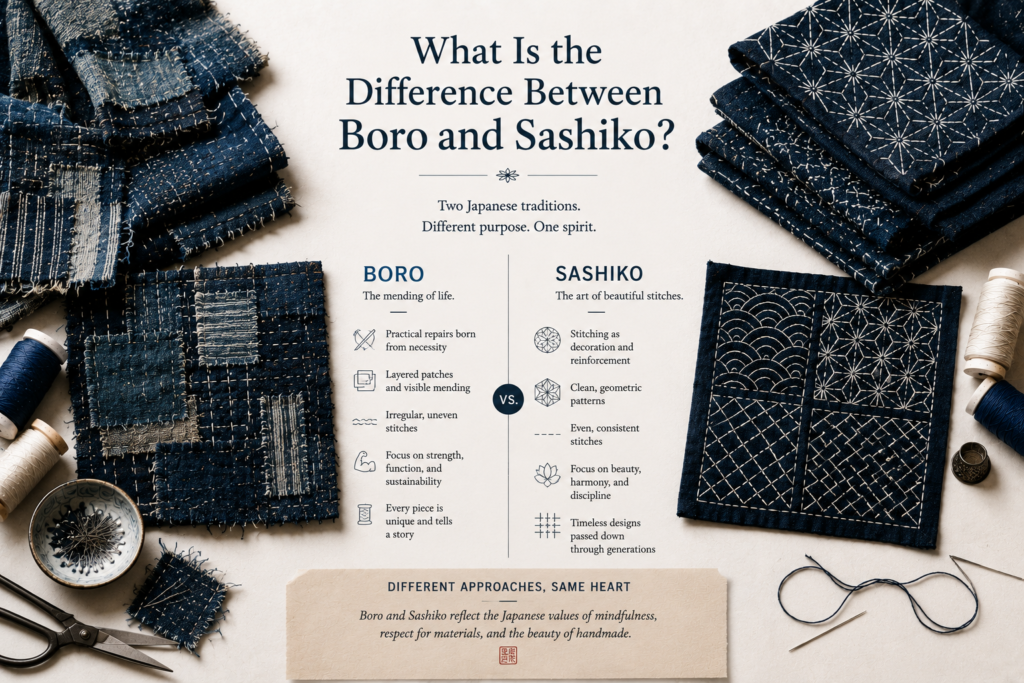
Boro and sashiko are often treated as interchangeable terms online, but they actually describe two different parts of Japanese textile repair culture. Boro refers to the overall practice of repeatedly patching, layering, and preserving worn fabrics over time. Sashiko, on the other hand, refers specifically to the stitching technique traditionally used to reinforce those repairs. Understanding this difference helps beginners approach boro more confidently without feeling forced to immediately master decorative stitching patterns.
Historically, rural Japanese families repaired garments repeatedly because fabric was valuable and difficult to replace. Clothing evolved through generations of patching and reinforcement until heavily layered textiles developed the distinctive boro appearance seen today. Sashiko stitches were commonly used because they were strong, flexible, and efficient, but the spirit of boro always centered on preservation and practicality first.
Have a read of our comprehensive breakdown on Boro vs Sashiko for further information on the contrasting features between the two.
Important Distinction
- Boro = layered textile repair philosophy
- Sashiko = running stitch technique
- Boro emphasizes preservation and reuse
- Sashiko emphasizes stitch structure and reinforcement
- Not all boro repairs require decorative sashiko patterns
Real-World Insight
Many authentic historical boro garments contained uneven stitching, improvised repairs, and inconsistent patchwork because survival mattered more than visual perfection. Modern social media often romanticizes highly symmetrical sashiko stitching, but true historical boro was usually much rougher and more practical.
Why Are Boro and Sashiko Frequently Confused?
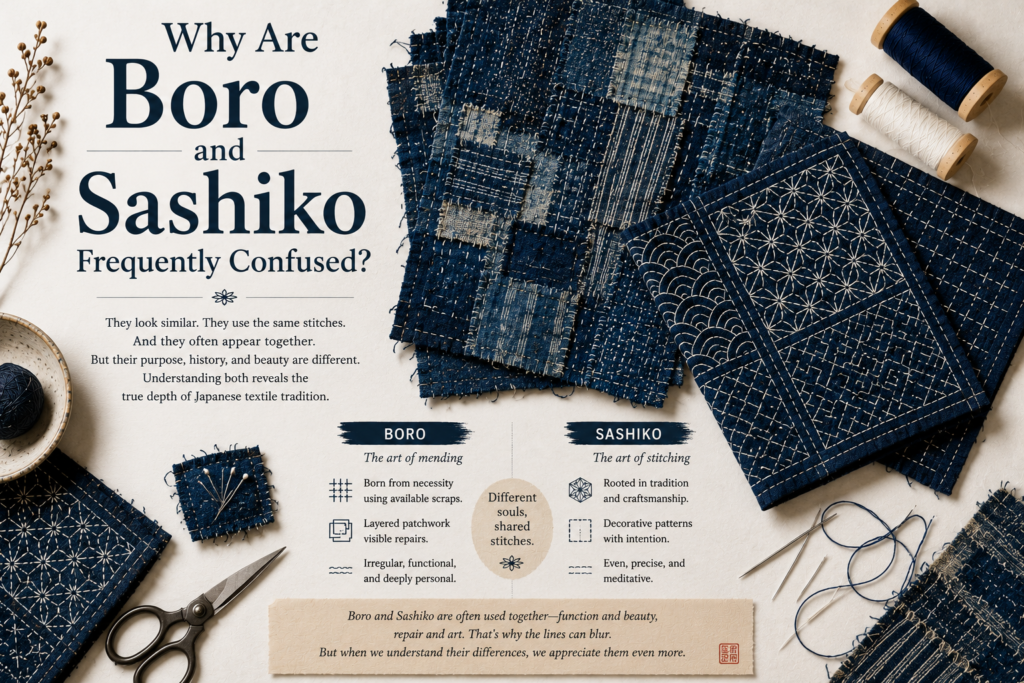
The confusion between boro and sashiko exists because the two practices evolved together throughout Japanese textile history. Most historical boro garments used sashiko stitching for reinforcement, which caused people to visually associate the two traditions as a single technique. Over time, fashion brands, social media creators, and visible mending communities began labeling almost every Japanese-style repair as “boro sashiko,” even when the repair itself did not follow traditional methods.
Another reason for confusion is the visual overlap. Both techniques often use indigo fabrics, visible white stitching, layered patches, and hand-sewn reinforcement. To beginners, these similarities make them appear identical. However, sashiko can exist without boro, and boro can absolutely exist without formal sashiko stitching patterns.
Modern textile culture has also changed how people interpret these traditions. Decorative visible mending projects sometimes prioritize artistic expression over practical reinforcement, while historical boro focused primarily on extending garment life. This shift causes many online tutorials to blur the distinction between traditional utility and modern textile art.
Reasons the Terms Overlap
- Both originated in Japanese textile culture
- Both commonly use indigo fabrics
- Both involve visible stitching
- Both emphasize repair instead of replacement
- Modern fashion merges the two aesthetics together
Important Clarification
garment with decorative sashiko stitching is not automatically boro. Likewise, a layered repair with simple running stitches can still strongly reflect authentic boro philosophy even without geometric sashiko patterns.
How Climate and Textile Scarcity Shaped Historical Boro
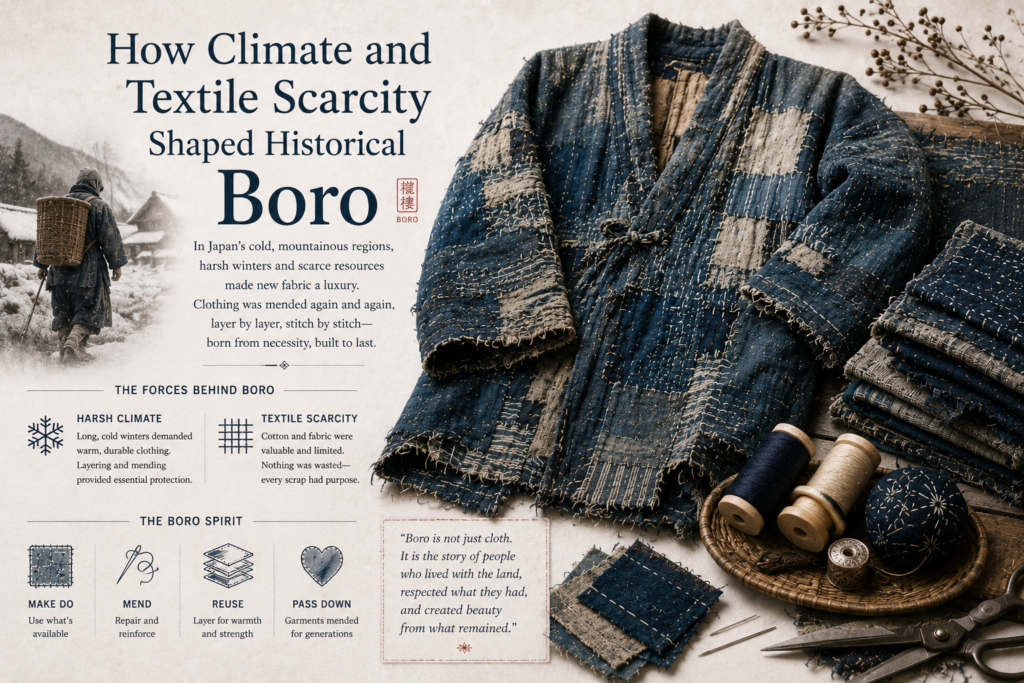
Historical boro developed largely because rural Japanese communities experienced harsh winters, textile scarcity, and limited access to new fabric. In northern regions especially, families repeatedly layered and repaired garments to improve warmth and extend clothing life through generations. Cotton fabric was expensive, so worn textiles were carefully preserved instead of discarded.
Many garments evolved slowly over decades as newer patches covered older repairs repeatedly. This process created the deeply layered visual texture now associated with antique boro textiles. Indigo-dyed cotton became common partly because indigo naturally resisted insects and bacterial growth, making repaired garments more practical for long-term use.
Historical Factors That Influenced Boro
- Cold northern climates
- Limited textile availability
- Expensive cotton fabric
- Multi-generational clothing reuse
- Need for thermal insulation
- Agricultural workwear demands
Decision Clarity
Traditional boro was shaped as much by survival conditions and textile scarcity as by artistic or cultural preference.
Can Traditional Boro Exist Without Sashiko Stitching?
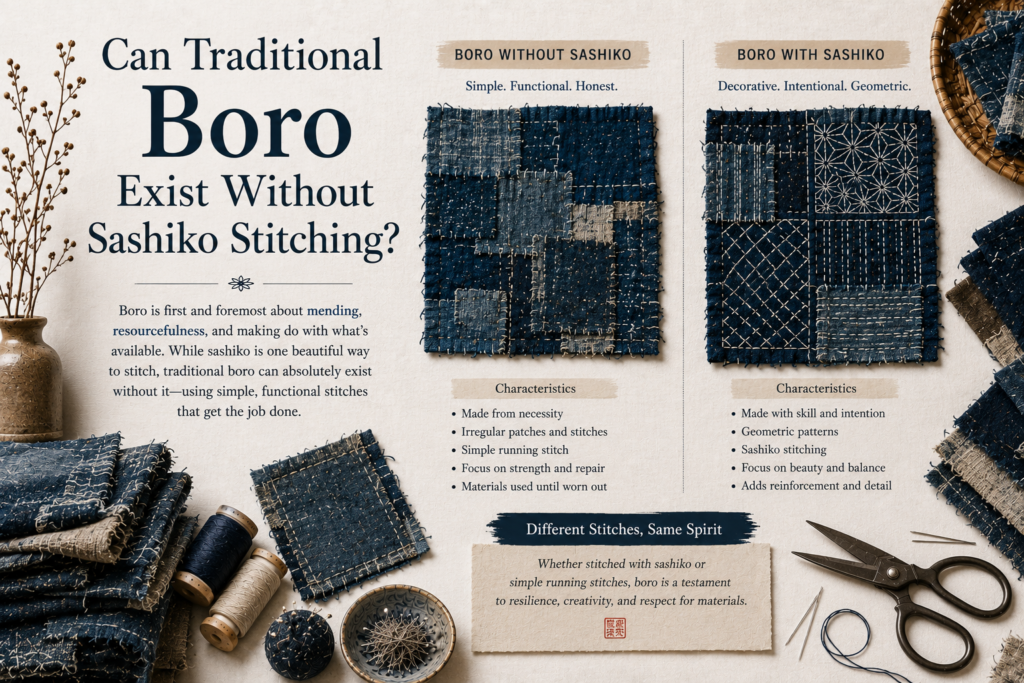
Traditional boro absolutely can exist without perfectly executed sashiko stitching because the heart of boro has always been resourcefulness rather than technical perfection. Historical Japanese families repaired textiles using whatever methods were practical and available at the time. Although sashiko became one of the most recognizable reinforcement methods, survival and durability mattered more than artistic consistency.
Many historical garments included rough hand stitching, uneven patch placement, layered scrap fabrics, and improvised repairs created over decades of continuous use. This historical reality is important because modern beginners often place unnecessary pressure on themselves to achieve perfect sashiko symmetry before attempting any form of boro repair.
The original spirit of boro focused on extending textile life for as long as possible. Fabrics were reused repeatedly, patched over older patches, and reinforced whenever holes or weak areas developed. The beauty associated with boro today emerged naturally through years of use and repair rather than deliberate decoration.
Historical Realities Often Ignored
- Many repairs were uneven and improvised
- Stitch consistency varied widely
- Families repaired clothing over generations
- Durability mattered more than aesthetics
- Boro evolved through necessity, not fashion
Real-World Perspective
Some museum-quality historical boro textiles contain surprisingly irregular stitching patterns that would be considered “incorrect” by modern sashiko standards. Yet these imperfections are exactly what make the pieces feel authentic and deeply human.
Why Was Sashiko Traditionally Used in Boro Repairs?
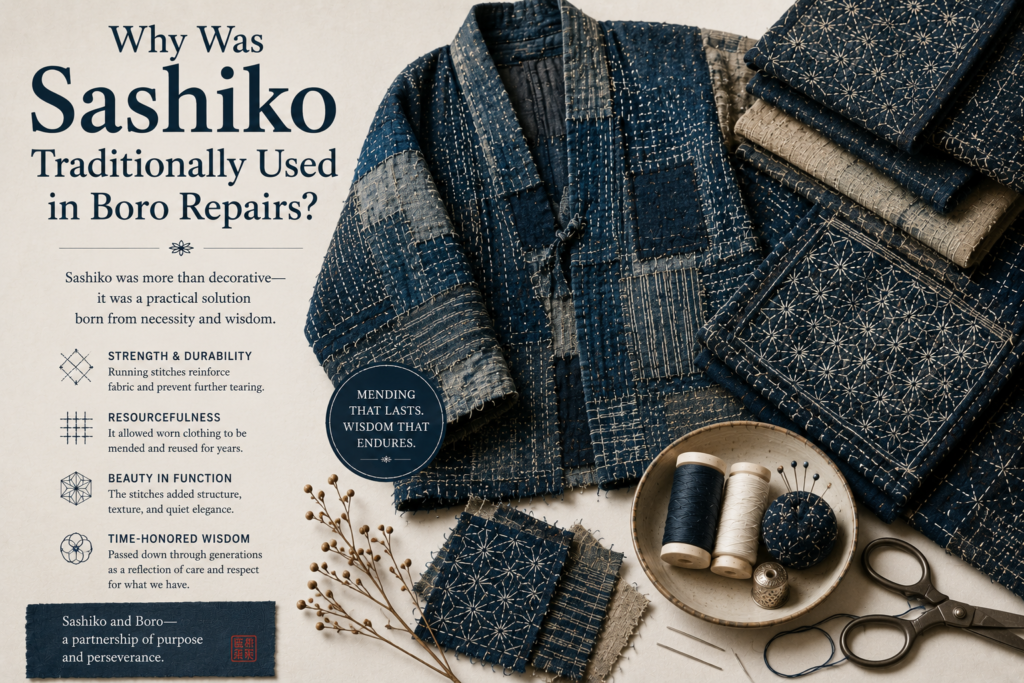
Sashiko became heavily associated with traditional boro repairs because the stitching method solved multiple practical problems at the same time. Rural Japanese families needed clothing repairs that remained flexible, durable, and easy to maintain through years of repeated wear. Simple running stitches distributed tension evenly across weakened fabric instead of concentrating stress into a single point. This helped heavily worn garments survive much longer under constant movement and physical labor.
Another important reason sashiko became common in boro was efficiency. Repeated rows of running stitches could secure layered patches quickly while also strengthening thin areas of fabric without making the garment excessively stiff. Over time, these repeated reinforcement lines created the distinctive visual texture people now associate with traditional Japanese repair work. The beauty of sashiko originally emerged from functionality rather than decoration.
Why Sashiko Worked So Well Historically
- Evenly distributes fabric tension
- Prevents tearing around repair edges
- Keeps layered patches flexible
- Reinforces weak cotton fabrics
- Allows movement without excessive stiffness
- Makes repeated repairs easier over time
Decision Clarity
Sashiko was never used purely for decoration in historical boro. It became popular because it balanced flexibility, reinforcement, speed, and durability better than many other hand-sewing methods available at the time.
What Stitches Can Replace Sashiko in Boro Repairs?
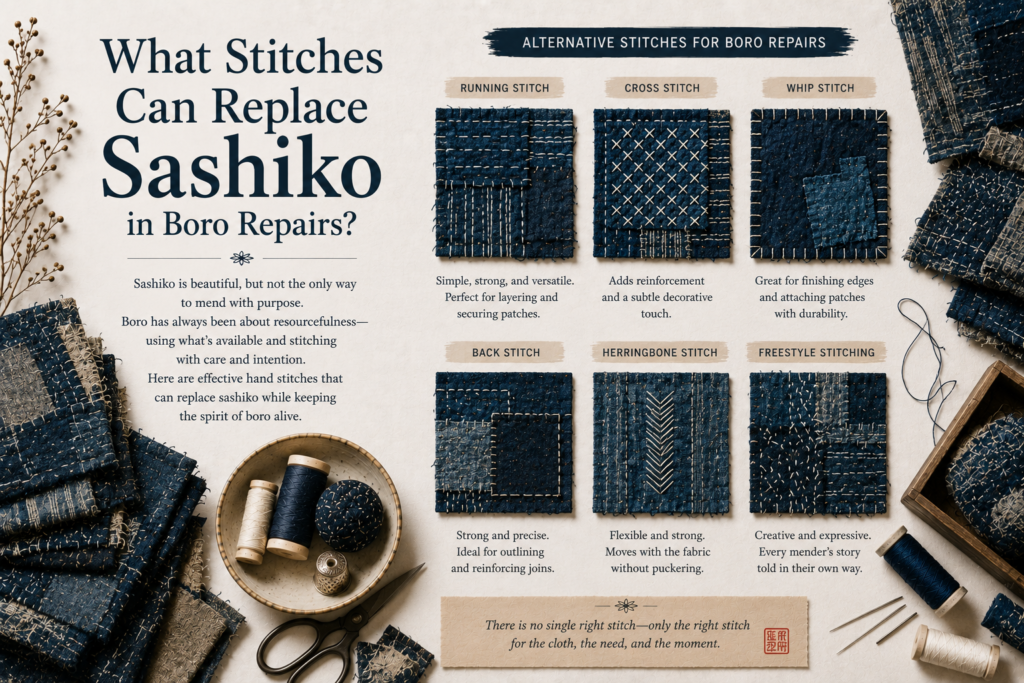
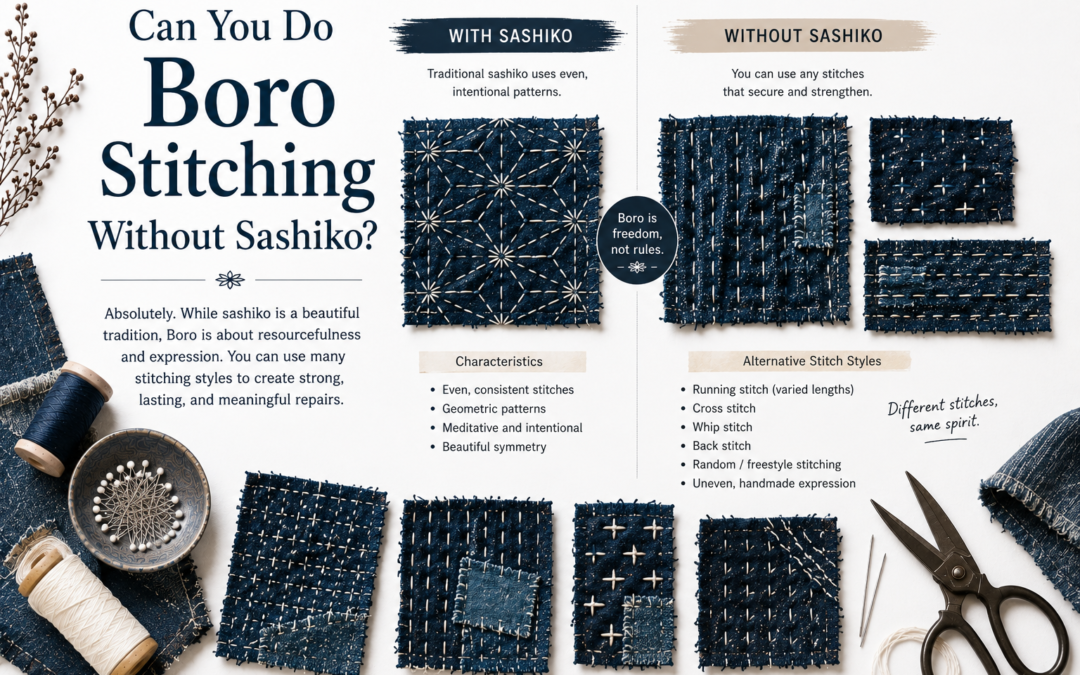
One of the biggest misconceptions surrounding boro is that traditional sashiko stitching is the only acceptable way to secure fabric patches. In reality, many stitch types can work successfully in boro-inspired repairs depending on the desired appearance, flexibility, and durability. Beginners especially benefit from experimenting with simpler stitches before moving into advanced sashiko techniques.
The easiest alternative is the simple running stitch because it closely resembles traditional sashiko while remaining extremely beginner-friendly. Embroidery stitches, whip stitches, machine zigzag stitching, and freeform visible mending also work effectively in modern boro projects. Different stitching methods create entirely different repair personalities, allowing artists and hobbyists to customize repairs according to their own aesthetic preferences.
Choosing the correct stitch often depends on the fabric itself. Heavy denim may require stronger reinforcement stitching, while lighter cotton garments may benefit from softer, more flexible repair methods.
Popular Alternatives to Sashiko
- Simple running stitch
- Embroidery stitching
- Whip stitch edging
- Cross-stitch reinforcement
- Freeform visible mending
- Straight machine stitching
- Zigzag machine reinforcement
| Stitch Type | Durability | Appearance | Beginner Friendly |
| Running stitch | High | Traditional | Excellent |
| Whip stitch | Medium | Rustic | Very Easy |
| Embroidery stitch | Medium | Decorative | Good |
| Machine zigzag | High | Modern | Excellent |
Decision Clarity
The most successful repair is not necessarily the most decorative one. Strong reinforcement, balanced tension, and proper patch placement matter far more than perfect stitch geometry.
How Slow Stitching and Repair Culture Connect to Modern Boro
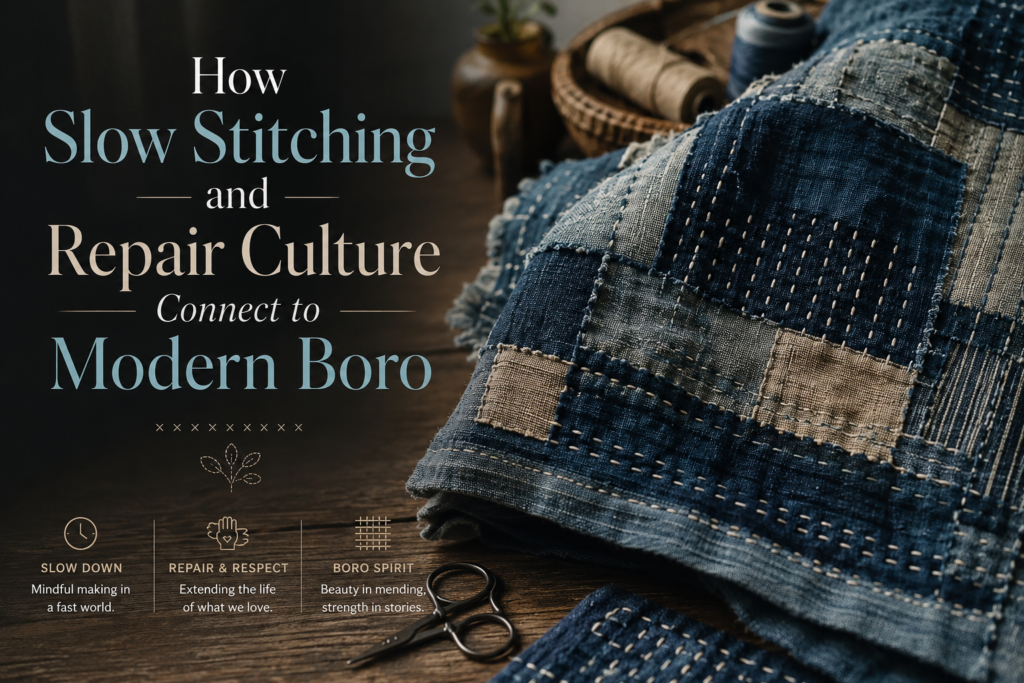
Modern boro has become closely connected to the broader slow stitching and repair culture movement. Many people are now repairing garments not only to save money, but also to reduce textile waste, avoid fast fashion consumption, and build a stronger emotional connection with clothing they already own. This shift has helped visible mending evolve from a survival-based necessity into a mindful creative practice.
Slow stitching emphasizes patience, handcraft, sustainability, and intentional repair rather than mass production or perfection. Boro naturally fits within this philosophy because historical Japanese textile repair also centered around preserving valuable materials for as long as possible. Modern makers often describe visible mending as calming, personal, and emotionally rewarding because repaired garments begin reflecting individual history and use over time.
Shared Values Between Boro and Slow Stitching
- Sustainability and reuse
- Mindful handcraft
- Repair instead of replacement
- Reduced textile waste
- Emotional attachment to garments
- Appreciation for imperfection
Decision Clarity
Modern boro is no longer only about repairing damaged fabric. For many people, it also represents sustainability, personal creativity, and a slower relationship with clothing.

Is Modern Visible Mending Considered Boro?
Modern visible mending overlaps heavily with boro philosophy, but the two are not always identical. Visible mending refers broadly to repairs intentionally designed to remain visible instead of hidden. Boro, however, traditionally emphasizes layered reinforcement, repeated textile preservation, and the gradual evolution of repaired fabric over time.
Many modern visible mending artists create projects strongly inspired by boro aesthetics using indigo fabric, exposed stitching, and layered patches. These projects often share the same sustainability values as historical boro culture. However, some modern visible mending prioritizes decoration and artistic expression more heavily than structural durability.
This distinction matters because historical boro emerged from necessity rather than artistic intention. Japanese families repaired clothing because fabric was expensive and difficult to replace. The beauty associated with boro developed naturally through age, wear, and repeated repair cycles.
If you want to have a look at the vast historical impact of japanese boro stitching, we recommend you go to our historical overview for a wonderful lesson on the history of japanese boro and its roots starting from the Edo Period in Japan.
Shared Characteristics
- Visible repair techniques
- Slow fashion philosophy
- Fabric preservation
- Sustainability values
- Handcrafted appearance
- Reuse of worn textiles
Important Difference
Modern visible mending may focus more on visual creativity, while traditional boro prioritized warmth, durability, and extending garment life.
Decorative Boro vs Functional Boro Repair
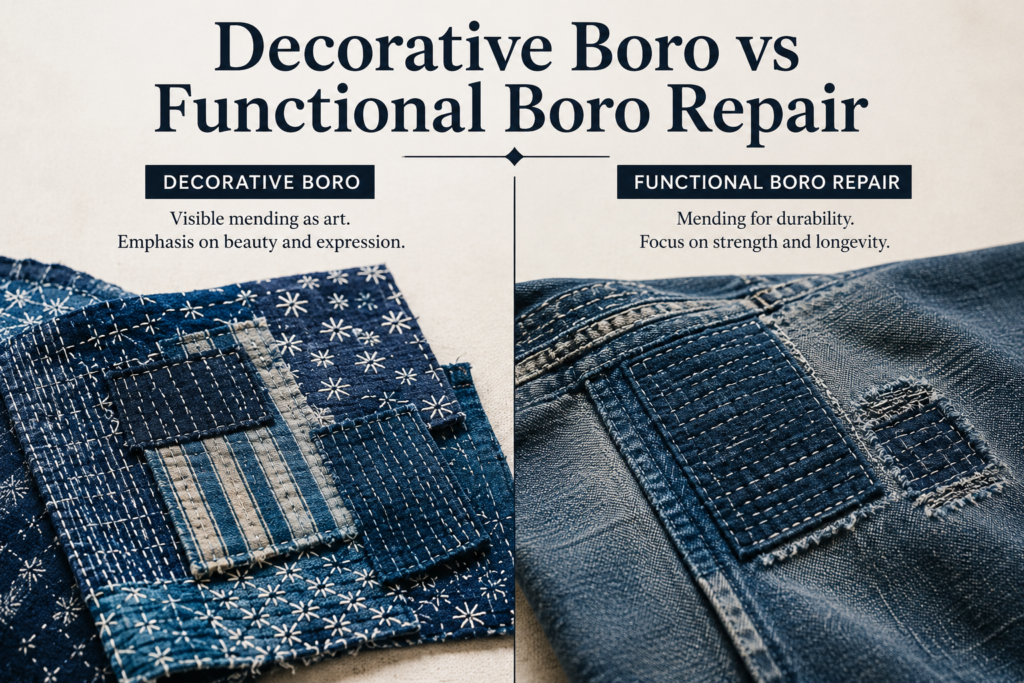
Modern boro-inspired stitching now exists across two very different approaches: decorative boro and functional boro. Decorative boro often prioritizes visual aesthetics, artistic stitching, and fashion-oriented patch placement. Functional boro, however, focuses primarily on strengthening damaged garments so they survive long-term wear. Both approaches can be valuable, but understanding the difference helps beginners choose repair methods more intentionally.
Historically, traditional Japanese boro belonged almost entirely to the functional category because clothing repairs were necessary for survival and textile preservation. Modern slow-fashion communities sometimes combine both styles together by creating repairs that are visually expressive while still structurally durable. The balance between beauty and practicality depends entirely on the purpose of the garment being repaired.
| Decorative Boro | Functional Boro |
| Prioritizes artistic appearance | Prioritizes durability |
| Often symmetrical | Often irregular |
| Fashion-oriented | Workwear-oriented |
| Decorative stitching focus | Reinforcement focus |
| May use delicate thread | Uses stronger thread |
| Visual storytelling | Long-term wearability |
Which Style Is Better for Beginners?
- Decorative boro encourages creativity
- Functional boro teaches durability faster
- Functional repairs improve repair confidence
- Decorative stitching can develop later
- Practical reinforcement builds stronger habits
Decision Clarity
Beginners usually learn faster when they focus on functional durability first and decorative perfection second.
Does Boro Without Sashiko Still Look Authentic?

Boro repairs can still look deeply authentic without formal sashiko stitching because authenticity comes more from repair philosophy, layered textile history, and natural wear patterns than from perfect geometric stitch spacing. Many modern beginners mistakenly believe authentic boro requires evenly spaced white sashiko stitches across every patch, but historical boro garments were often much more irregular and organic.
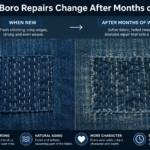
The strongest visual elements associated with boro usually come from fabric aging, patch layering, visible reinforcement, and the relationship between old and new textile surfaces. Worn indigo tones, faded cotton fibers, softened edges, and repeated repair marks create the emotional depth people associate with authentic boro aesthetics.
Overly decorative repairs can sometimes feel less authentic because they prioritize visual perfection rather than practical reinforcement. Historical boro garments frequently evolved slowly through years of real wear and repeated patching.
What Creates Authentic Boro Appearance
- Layered fabric textures
- Natural fading and wear
- Repeated reinforcement areas
- Softened textile edges
- Visible repair history
- Organic stitching movement
Real-World Insight
A simple uneven running stitch on naturally aged denim often feels more historically authentic than perfectly symmetrical decorative sashiko patterns created purely for display purposes.
Why Imperfect Repairs Still Matter in Modern Boro
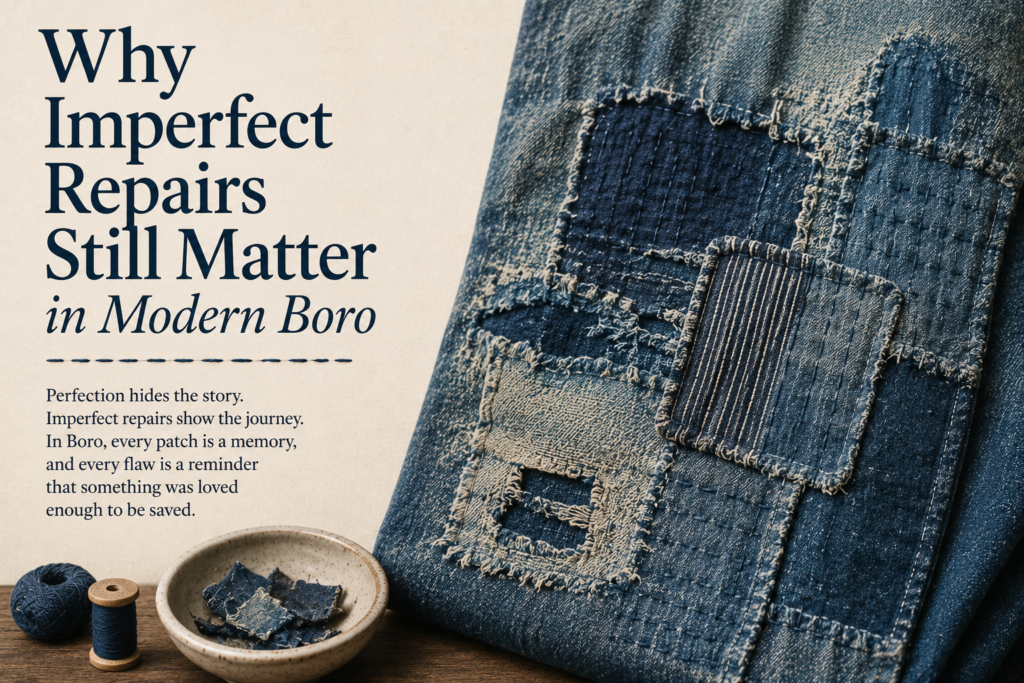
Many beginners hesitate to start visible mending because they worry their stitching will look uneven or unprofessional. However, one of the most meaningful aspects of boro is that imperfect repairs often carry more personality and emotional value than perfectly symmetrical decorative stitching. Historical boro garments were rarely flawless because they evolved through necessity, repeated use, and practical repair over many years.
Modern repair culture increasingly embraces imperfection because repaired garments begin reflecting personal history instead of mass-produced uniformity. Uneven stitches, faded patches, and visible reinforcement marks can make clothing feel more individual and emotionally connected to the person wearing it. This mindset removes much of the pressure beginners feel when learning textile repair for the first time.
Why Imperfection Can Be Valuable
- Makes repairs feel personal
- Reflects authentic handmade work
- Encourages creative experimentation
- Reduces fear of failure
- Builds repair confidence faster
- Connects emotionally with clothing
Decision Clarity
Boro repair is not about achieving factory-level perfection. It is about extending fabric life while allowing garments to develop visible history and character over time.

Can Beginners Start Boro Without Learning Sashiko?
Beginners can absolutely begin boro repairs without first mastering sashiko stitching, and in many cases this creates a far less intimidating learning process. One reason many people abandon textile repair early is because they assume traditional Japanese stitching techniques require advanced precision from the beginning. In reality, simple practical repairs are often the best entry point into boro.
Starting with basic running stitches allows beginners to focus on patch placement, fabric layering, repair tension, and textile behavior before worrying about decorative consistency. Over time, these practical repair skills naturally improve stitch control and confidence.
Modern boro communities are also much more flexible than many beginners expect. Most experienced visible mending artists encourage experimentation and personal interpretation rather than rigid rule-following. This creative freedom makes boro especially welcoming for people interested in sustainable fashion and clothing repair.
Beginner-Friendly Approach
- Start with small fabric holes
- Use simple running stitches
- Practice patch layering
- Focus on durability first
- Improve stitch consistency gradually
Helpful Beginner Materials
- Old denim jeans
- Cotton thread
- Embroidery needle
- Scrap fabric patches
- Soft woven textiles
Decision Clarity
Learning sashiko later can absolutely improve repair quality, but it should never become a barrier preventing beginners from starting textile repair immediately.
Best Beginner Path for Learning Boro Without Sashiko
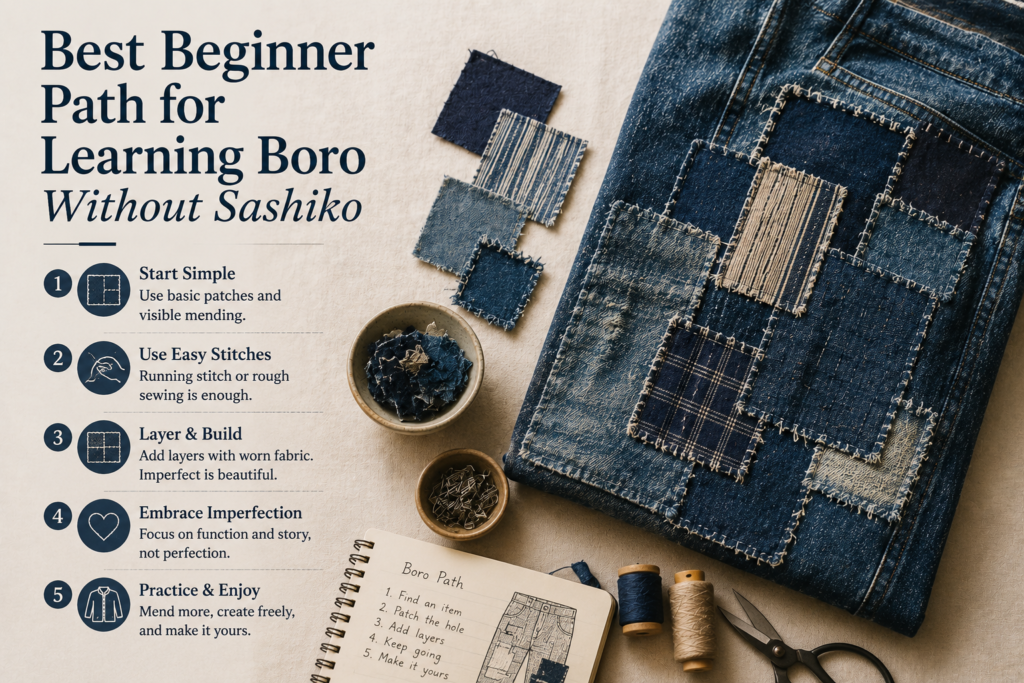
Many beginners become overwhelmed because they try to learn advanced sashiko patterns before understanding basic textile repair principles. A much easier approach is learning boro progressively through simple practical repairs first. This builds confidence naturally while helping beginners understand how fabric behaves under stitching tension, layering, and repeated movement.
The best beginner path focuses first on durability and comfort rather than decorative precision. Once basic reinforcement skills feel comfortable, decorative sashiko techniques become much easier to understand later. This progression prevents frustration while also creating stronger long-term repair habits.
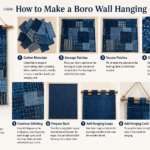
Want to have an awesome first time experience with boro stitching, refer to out beginner friendly guide on how to do boro stitching (step-by-step).
E Recommended Beginner Progression
Step 1 — Learn Simple Running Stitches
Practice straight hand stitches on scrap denim or cotton fabric.
Step 2 — Understand Patch Placement
Learn how to position patches behind weak areas for support.
Step 3 — Practice Fabric Layering
Experiment with layered reinforcement on worn fabric sections.
Step 4 — Improve Stitch Tension
Focus on balanced stitching that allows natural movement.
Step 5 — Explore Decorative Stitching Later
Add sashiko-inspired patterns once structural repair feels natural.
Beginner-Friendly Materials
- Old denim jeans
- Cotton thread
- Embroidery needles
- Soft woven fabric scraps
- Lightweight canvas patches
Decision Clarity
The fastest way to improve at boro is starting with simple durable repairs immediately instead of waiting until every stitch looks perfect.
Is Machine Stitching Acceptable for Modern Boro Repairs?
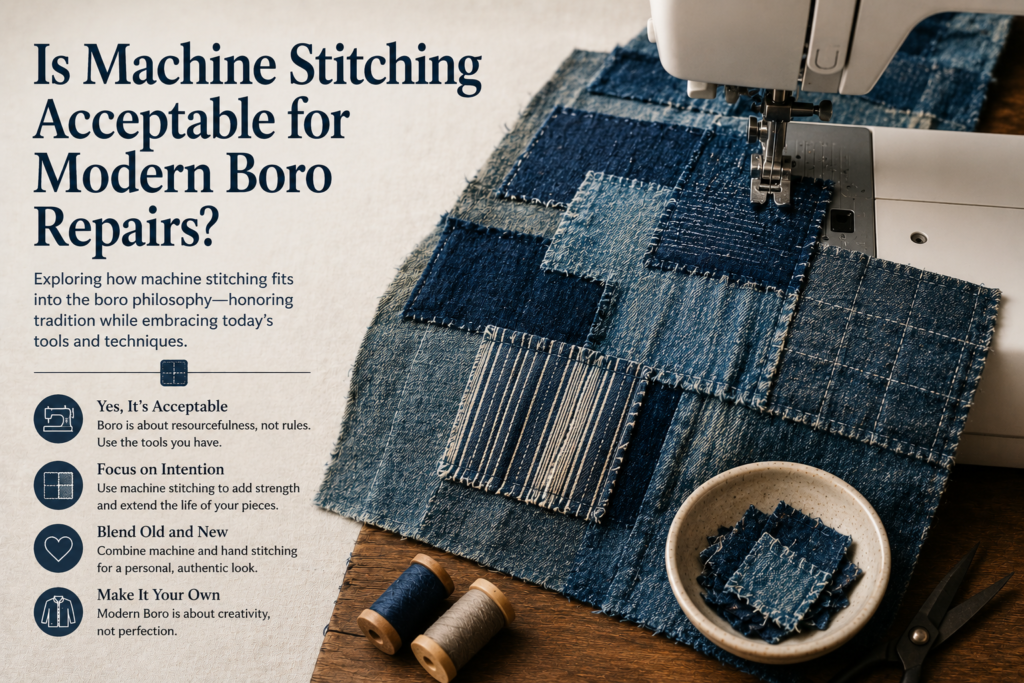
Machine stitching is widely accepted in many modern boro-inspired repairs, especially when durability and practicality are the primary goals. Although traditional boro relied on hand sewing because sewing machines did not exist, contemporary textile repair continues evolving alongside modern tools and materials.
Many denim repair specialists now combine machine stitching with hand-finishing techniques to create strong repairs while preserving the visual texture associated with boro aesthetics. Machine stitching is especially useful for reinforcing high-stress areas such as knees, elbows, pocket corners, and workwear seams.
However, machine stitching changes the visual feel of a repair. Hand stitching often creates softer movement and more organic texture, while machine stitching can appear cleaner, tighter, and more structured. Some artists intentionally mix both methods together to balance authenticity and durability.
Advantages of Machine Stitching
- Faster repair process
- Strong reinforcement
- Easier for thick denim
- Better for high-stress areas
- Consistent stitch tension
Potential Drawbacks
- Less handmade character
- Reduced organic texture
- Can feel overly rigid
- Decorative flexibility decreases
Real-World Example
Many modern Japanese denim brands use machine reinforcement internally while adding visible hand stitching externally to preserve traditional visual aesthetics.
Why Fabric Flexibility Matters in Durable Boro Repairs
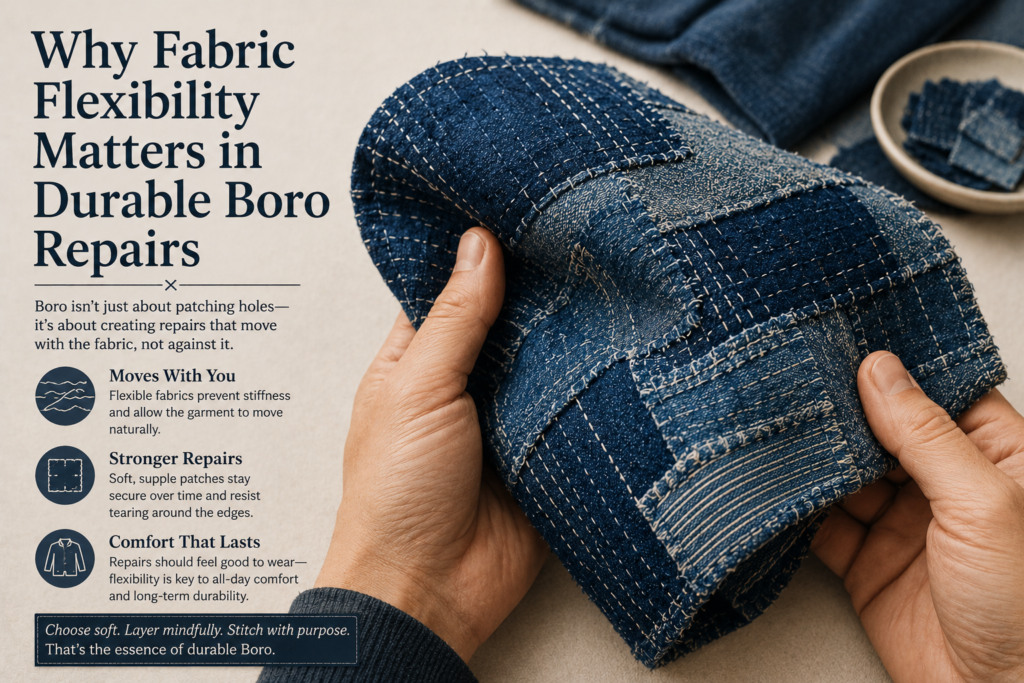
One of the biggest reasons some visible mending repairs fail is excessive rigidity. Clothing constantly bends, stretches, folds, and shifts during daily movement. If repair stitching becomes too tight or overly dense, stress concentrates around the patch edges instead of spreading naturally through the fabric. This eventually creates tearing, puckering, or thread breakage around the repaired area.
Traditional sashiko succeeded partly because running stitches allowed repaired fabric to move naturally while still reinforcing weak sections. Modern non-sashiko boro repairs can achieve the same durability if stitch tension remains balanced and flexible. Softer stitching patterns usually survive longer on denim, workwear, and heavily used garments because they adapt more naturally to repeated movement.
Signs a Repair Is Too Rigid
- Fabric puckers heavily around stitches
- Patch corners curl upward
- Denim feels stiff after repair
- Threads snap under movement
- Wrinkles form around repair edges
- Fabric tears beside the stitching line
Decision Clarity
The strongest boro repairs are not always the tightest repairs. Flexible reinforcement usually lasts longer because it works with fabric movement instead of fighting against it.
How Durable Is Boro Without Traditional Sashiko?
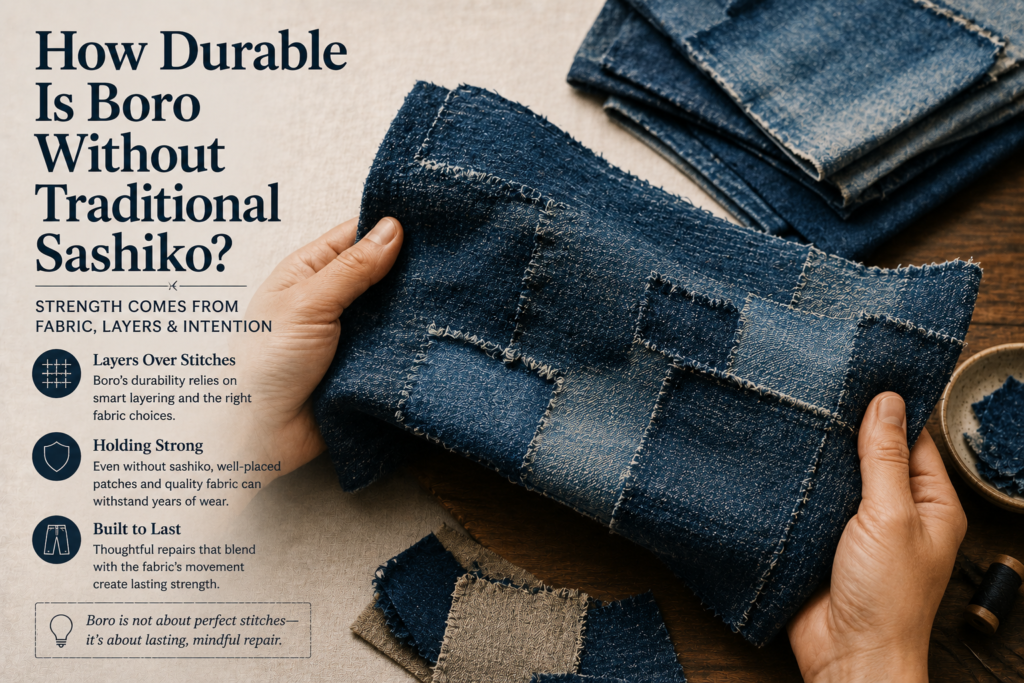
Boro repairs can remain extremely durable even without formal sashiko stitching because long-term strength depends more on repair structure than decorative stitch style alone. Proper patch placement, balanced tension, layered reinforcement, and fabric compatibility all play a much larger role in durability than whether the stitching technically qualifies as sashiko.
Poorly executed sashiko can actually fail faster than simple well-placed running stitches if the repair structure itself is weak. Flexible stitching that allows natural fabric movement usually lasts longer than overly tight decorative stitching that stresses the textile.
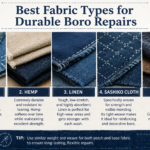
Fabric choice also dramatically affects repair longevity. Strong woven fabrics such as denim, cotton canvas, and linen generally support repeated repairs far better than thin stretch materials.
Major Durability Factors
- Strong patch material
- Balanced stitch tension
- Reinforced stress points
- Flexible fabric movement
- Proper layer alignment
- Durable thread selection
Common Durability Mistakes
- Overly tight stitching
- Thin weak thread
- Tiny decorative stitches
- Poor patch positioning
- Unsupported fabric edges
Decision Clarity
A structurally sound repair with simple running stitches often outlasts decorative repairs that prioritize appearance over reinforcement quality.
Why Some Non-Sashiko Boro Repairs Fail Quickly
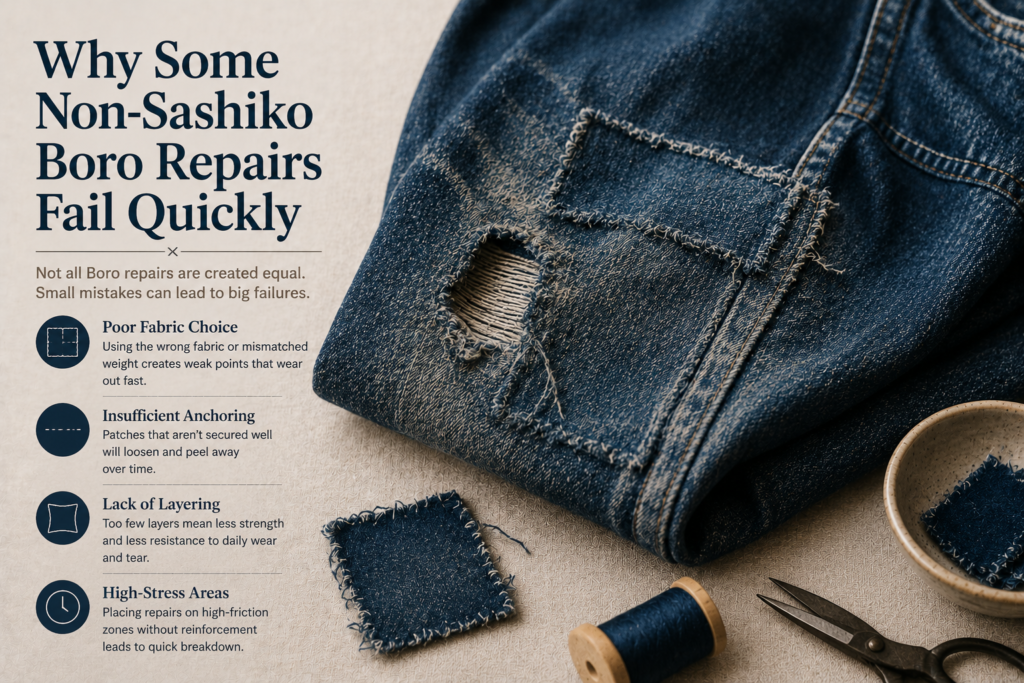
Many non-sashiko boro repairs fail not because the stitching style is wrong, but because the structural reinforcement itself is poorly planned. Beginners sometimes focus heavily on decorative appearance while overlooking how fabric moves, stretches, and weakens during regular wear. As a result, patches may detach, threads may snap, or holes may reopen around stress points surprisingly quickly.
Repair durability depends heavily on thread strength, patch placement, stitch spacing, and fabric compatibility. Stretch fabrics are especially difficult because movement constantly stresses repaired areas. Weak repair edges also become major failure points if patches are not secured properly around the entire damaged section.
Common Causes of Repair Failure
- Overly tight stitching
- Weak decorative thread
- Tiny stitch spacing
- Unsupported patch edges
- Poor fabric layering
- Using stretch fabric incorrectly
- Ignoring stress-point reinforcement
Signs a Repair May Fail Soon
- Threads pulling unevenly
- Patch edges lifting
- Excessive fabric wrinkling
- Tight puckering around stitches
- Visible strain around holes
- Stiff repair movement
Decision Clarity
Strong boro repairs come from balanced reinforcement and flexible structure, not from decorative complexity alone.
Final Thoughts on Doing Boro Without Sashiko
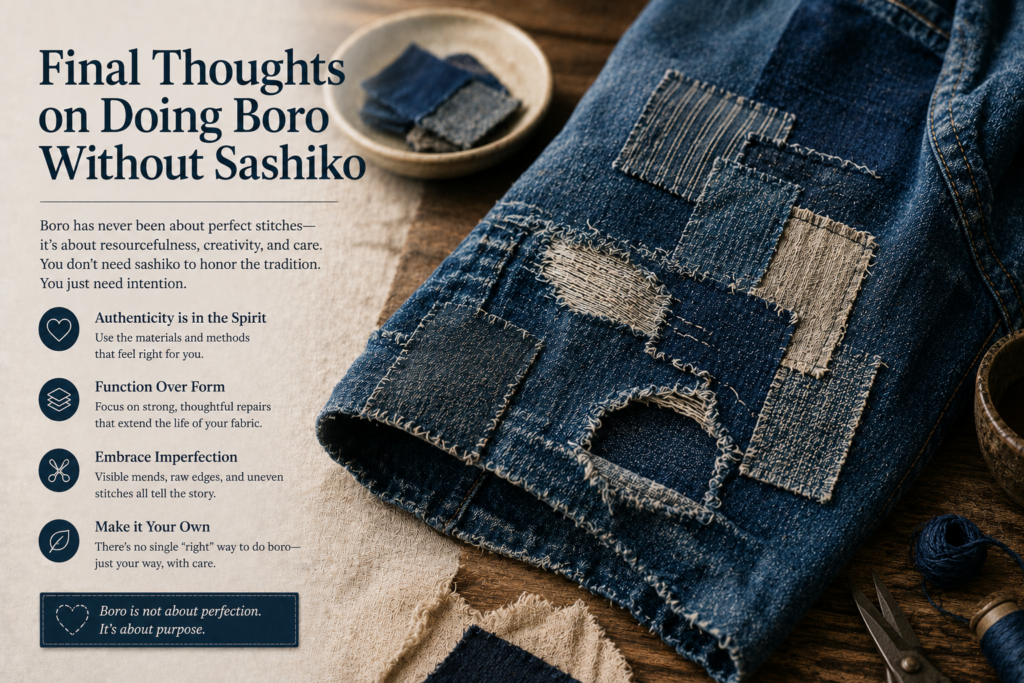
Boro stitching without sashiko is completely valid because the core philosophy of boro has always centered on preservation, reuse, repair, and extending textile life rather than strict technical perfection. While sashiko became one of the most recognizable Japanese stitching methods associated with boro, it was never the only acceptable way to reinforce worn fabrics.
Modern visible mending culture has expanded these possibilities even further by encouraging experimentation, sustainability, and creative interpretation. Beginners can confidently start with simple running stitches, machine reinforcement, embroidery thread, or freeform visible mending techniques while still honoring the broader spirit of boro repair.
The most authentic boro pieces usually reflect patience, repeated use, repair history, and human craftsmanship rather than flawless decorative stitching. Historical boro garments were often irregular, layered, heavily worn, and constantly evolving over time. That imperfect humanity remains one of the most beautiful aspects of boro culture today.
Final Key Takeaways
- Boro is a repair philosophy first
- Sashiko is one reinforcement technique
- Beginners do not need perfect stitching
- Durability matters more than decoration
- Visible mending overlaps strongly with boro
- Machine stitching can work successfully
- Authenticity comes from repair history and texture
Decision Clarity
If you want to begin boro repair, start now using simple stitches and practical reinforcement methods. Traditional sashiko can always be learned later as your confidence and textile experience continue growing.
FAQ Section
Is sashiko mandatory for boro stitching?
No, sashiko is not mandatory. Boro can use many stitching methods as long as the repair reinforces layered fabric.
Can beginners do boro without learning Japanese stitching?
Yes, beginners can start with simple running stitches and learn advanced techniques later.
Is visible mending the same as boro?
Not exactly. Visible mending overlaps with boro aesthetics, but boro traditionally emphasizes layered textile reinforcement.
Can machine stitching be used for boro?
Yes, modern boro-inspired repairs often combine machine and hand stitching.
What is the easiest stitch for beginner boro repairs?
A simple running stitch is usually the easiest and most versatile beginner option.
Does boro need indigo fabric?
No, but indigo textiles are historically associated with traditional Japanese boro.
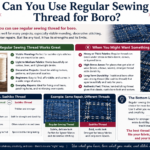
Can embroidery thread replace sashiko thread?
Yes, embroidery thread works well for decorative and artistic repairs.
Are irregular stitches acceptable in boro?
Yes, many authentic historical boro pieces contained irregular and improvised stitching.